
Strategic Rail Expansion: Eurostar's London-Amsterdam Push and the Future of European Cross-Border Travel
 Aime Summary
In the post-pandemic era, the European Union has emerged as a global leader in reimagining sustainable mobility. With €83 billion allocated to smart and sustainable transport via the Recovery and Resilience Facility (RRF) and the Connecting Europe Facility (CEF), rail infrastructure has become a cornerstone of the continent's green transition. Amid this transformative backdrop, Eurostar's recent expansion of its London-Amsterdam services stands out as a strategic investment opportunity, blending operational innovation with long-term policy tailwinds.
A New Era for the London-Amsterdam Route
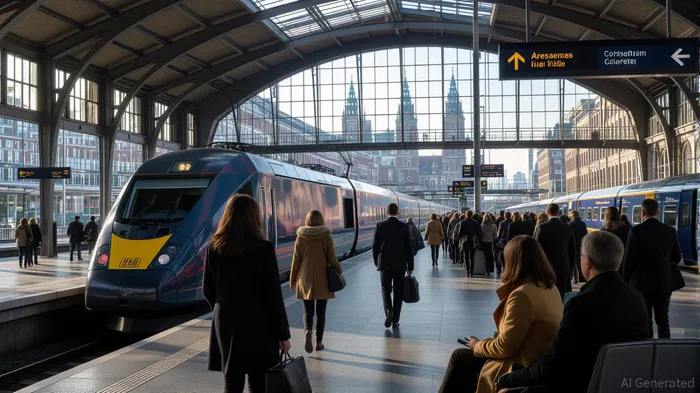
Eurostar's decision to introduce a fifth daily return service between London and Amsterdam by December 2025 is not merely a response to demand—it is a calculated move to capitalize on a structural shift in European travel. The opening of a new cross-channel terminal at Amsterdam Centraal in February 2025 has tripled the route's capacity, enabling 650 passengers per train compared to 275 in 2024. This expansion is underpinned by a 18% year-on-year growth in passenger numbers, driven by both leisure and business travelers.
For investors, this growth trajectory aligns with the EU's broader vision of a “European high-speed backbone.” Eurostar's CEO, Gwendoline Cazenave, has emphasized that the route's expansion is part of a broader ambition to shift high-speed rail from a niche option to a dominant mode of travel. With 4.3 million passengers transported to and from the Netherlands in 2024 alone, and a long-term target of 30 million annually, the London-Amsterdam corridor is a microcosm of the EU's decarbonization goals.
Policy Tailwinds: Rail as the Backbone of Sustainable Mobility
The EU's post-pandemic investments in rail infrastructure provide a critical tailwind for Eurostar's ambitions. Rail accounts for 59% of the €48.9 billion allocated under the RRF for transport, with a focus on cross-border interoperability, ERTMS implementation, and green corridors. Projects like Rail Baltica and upgrades to Greece's rail network are part of a €515 billion plan to complete the TEN-T core network by 2030. These initiatives directly benefit Eurostar's operations, as improved track speeds and interoperability reduce travel times and enhance reliability.
Moreover, the EU's emphasis on shifting short-haul air travel to rail—exemplified by the Channel Tunnel corridor's potential to become a “high-speed backbone”—creates a unique value proposition for Eurostar. The company's recent acquisition of 50 new high-speed trains and its plans to expand to Geneva and Frankfurt by 2030 position it as a beneficiary of these policy-driven trends.
The Investment Case: Long-Term Growth and Resilience
Eurostar's expansion into the London-Amsterdam market is not an isolated play. It is part of a broader strategy to leverage the EU's sustainable mobility agenda. Key metrics underscore its appeal:
- Demand Resilience: Business travel accounts for 15% of passengers (130,000 annually), indicating strong corporate adoption.
- Scalability: The new Amsterdam terminal's capacity allows for rapid scaling as demand grows.
- Policy Alignment: Eurostar's infrastructure investments align with EU funding priorities, reducing capital risk.
For investors, the company's focus on sustainability and its role in the EU's green transition make it an attractive long-term play. The EU's 2025 CEF grants, which allocate 77% of funding to rail, further reinforce the sector's resilience.
Risks and Mitigants
While the long-term outlook is positive, investors must consider short-term challenges. Geopolitical tensions, such as the war in Ukraine, could disrupt cross-border logistics. However, Eurostar's strategic partnerships with Getlink and London St. Pancras Highspeed mitigate these risks by diversifying infrastructure dependencies. Additionally, the EU's focus on dual-use infrastructure (benefiting both civilian and military mobility) ensures continued support for rail projects.
Conclusion: A Strategic Bet on Europe's Future
Eurostar's London-Amsterdam expansion is more than a service upgrade—it is a harbinger of Europe's shift toward sustainable, interconnected mobility. As the EU channels record investments into rail infrastructure and ERTMS, companies like Eurostar are uniquely positioned to benefit. For investors seeking exposure to the green transition and cross-border connectivity, Eurostar's operations represent a compelling long-term opportunity.
In a world increasingly defined by environmental and geopolitical uncertainty, rail is not just the future of travel—it is the foundation of a resilient, sustainable economy. Eurostar's expansion is a clear signal that the tracks are being laid for a new era.

Delivering real-time insights and analysis on emerging financial trends and market movements.
Latest Articles
Stay ahead of the market.
Get curated U.S. market news, insights and key dates delivered to your inbox.


AInvest
PRO
AInvest
PRO



Comments
No comments yet