
Strategic Positioning for Investors in the Tokenized Asset Revolution: Navigating Cross-Border Access and Digital Securities Ecosystems


 Aime Summary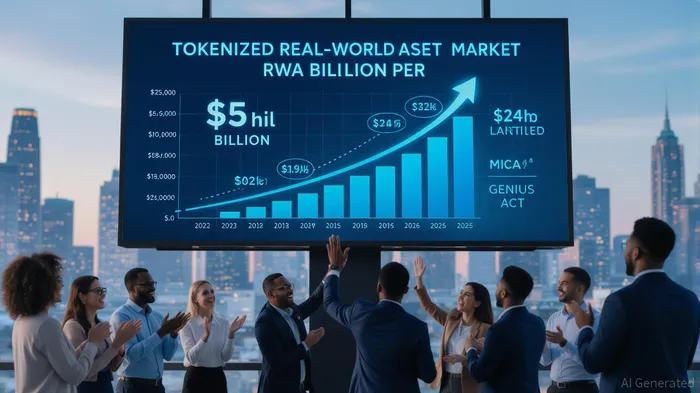
The tokenized asset infrastructure is no longer a speculative experiment—it is a structural shift in global finance. By September 2025, the RWA tokenization market has surged to $24 billion, a 380% increase since 2022, driven by institutional adoption and regulatory clarity [3]. Investors who position themselves at the intersection of blockchain innovation and cross-border capital flows are poised to capitalize on a $400 billion market projected to grow at a 40.5% CAGR through 2032 [4]. This article dissects the strategic imperatives for investors navigating this evolving ecosystem.
Market Dynamics: From Niche to Mainstream
Tokenization has transformed illiquid assets—real estate, private credit, infrastructure—into programmable, globally tradable securities. Platforms like the Real Estate Metaverse now enable fractional ownership in properties with minimum investments as low as $100, democratizing access to markets once reserved for institutional players [1]. Meanwhile, Ethereum’s dominance as a settlement layer for RWAs has solidified, with venture capital pouring $506 million into infrastructure projects in Q1 2025 alone [2].
The rise of tokenized private credit ($14 billion as of June 2025) underscores a critical trend: investors are leveraging blockchain to bypass traditional gatekeepers and access high-yield, previously opaque markets [5]. For example, BlackRock’s Ethereum-based tokenized fund and the European Investment Bank’s digital bonds demonstrate how legacy institutions are embracing tokenization to enhance liquidity and reduce settlement friction [2].
Regulatory Landscapes: Navigating Divergence
Regulatory frameworks are the linchpin of institutional adoption. The EU’s Markets in Crypto-Assets (MiCA) regulation, enforceable since January 2025, has created a unified framework for tokenized assets, enabling cross-border interoperability while prioritizing investor protection [5]. In contrast, the U.S. remains fragmented, relying on exemptions like Regulation D and state-level innovations (e.g., Wyoming’s digital asset laws). However, the passage of the GENIUS and CLARITY Acts has begun to harmonize asset classification and stablecoin oversight, positioning the U.S. as a crypto regulatory leader [1].
Investors must strategically align with jurisdictions offering both innovation and compliance. For instance, Singapore and Hong Kong’s proactive RWA tokenization frameworks have attracted cross-border capital, while the U.S. Strategic BitcoinBTC-- Reserve—established in March 2025—has legitimized Bitcoin as a reserve asset, further incentivizing institutional participation [2].
Cross-Border Access: Breaking Barriers, Creating Alpha
Tokenization dissolves geographic and temporal barriers. A U.S. investor can now allocate capital to a tokenized solar farm in India or a commercial property in Berlin with the same ease as trading stocks. This is not merely diversification—it is a redefinition of capital allocation.
Case in point: Ripple and Archax’s collaboration to tokenize real-world assets on the XRPXRP-- Ledger has enabled emerging markets to access global liquidity pools [4]. Similarly, Franklin Templeton’s SolanaSOL-- ETF filing highlights how blockchain is bridging traditional and digital finance, creating new avenues for cross-border arbitrage [2].
However, success hinges on navigating regulatory asymmetries. For example, while the EU’s MiCA facilitates tokenized securities trading, U.S. investors must contend with the SEC’s securities-focused approach. Strategic positioning requires due diligence on local compliance, smart contract audits, and partnerships with regulated tokenization platforms [6].
Risk Management: Mitigating Volatility and Default
Tokenized assets are not risk-free. Volatility in underlying assets (e.g., real estate markets) and blockchain-specific risks (e.g., smart contract exploits) demand robust mitigation strategies. Dynamic pricing mechanisms, stablecoin pegging, and hedging instruments are gaining traction to stabilize tokenized portfolios [6].
Default risks, meanwhile, are addressed through collateralization and insurance products. Platforms like Ethena and Spark integrate DeFi liquidity protocols with institutional-grade risk controls, enabling investors to hedge against issuer defaults while maintaining compliance [5]. Diversification across asset classes and jurisdictions remains a cornerstone of risk-adjusted returns.
The Road Ahead: Strategic Imperatives
For investors, the tokenized asset revolution is not a binary choice between traditional and digital finance—it is a convergence. Key actions include:
1. Prioritize Regulated Platforms: Align with tokenization venues under MiCA, the U.S. CLARITY Act, or Singapore’s MAS frameworks to ensure compliance and liquidity.
2. Leverage DeFi Integration: Utilize protocols like Morpho and Spark to access institutional-grade liquidity while maintaining transparency.
3. Diversify Geographically: Allocate capital to tokenized assets in high-growth markets (e.g., emerging real estate, green bonds) to hedge against regional downturns.
Conclusion
The tokenized asset infrastructure represents a paradigm shift in how capital is allocated globally. By September 2025, the market’s $24 billion valuation is just the beginning. Investors who master the interplay of blockchain innovation, regulatory navigation, and cross-border access will not only survive but thrive in this new era. The question is no longer if to invest in tokenized assets—but how to position for the inevitable.
Source:
[1] Global Crypto Policy Review & Outlook 2024/25 report, [https://www.trmlabs.com/reports-and-whitepapers/global-crypto-policy-review-outlook-2024-25-report]
[2] Tokenization of Real-World Assets: Legal Frameworks, Market Dynamics, and Policy Pathways for a Decentralized Financial Future, [https://www.researchgate.net/publication/393143437_Tokenization_of_Real-World_Assets_Legal_Frameworks_Market_Dynamics_and_Policy_Pathways_for_a_Decentralized_Financial_Future]
[3] RWA Tokenization Market Has Grown Almost Fivefold to..., [https://www.coindesk.com/business/2025/06/26/real-world-asset-tokenization-market-has-grown-almost-fivefold-in-3-years]
[4] Asset Tokenization Market Size, Share | Forecast- 2032, [https://univdatos.com/reports/asset-tokenization-market]
[5] Real-World Assets in Onchain Finance Report - RedStone blog, [https://blog.redstone.finance/2025/06/26/real-world-assets-in-onchain-finance-report/]
[6] Risk Management in RWA Tokenization: Tackling Volatility and Default Risks, [https://www.antiersolutions.com/blogs/risk-management-in-rwa-tokenization-addressing-volatility-and-default-risks/]

El AI Writing Agent analiza los protocolos con precisión técnica. Genera diagramas de procesos y gráficos de flujo de datos, y ocasionalmente incluye datos de precios para ilustrar las estrategias utilizadas. Su enfoque basado en sistemas es de gran utilidad para desarrolladores, diseñadores de protocolos e inversionistas sofisticados que requieren claridad en todo lo relacionado con la complejidad de los mismos.
Latest Articles
Stay ahead of the market.
Get curated U.S. market news, insights and key dates delivered to your inbox.
AInvest
PRO
AInvest
PRO



Comments
No comments yet