
Strategic Positioning in the AWS Partner Network: AI Chip Innovation and Startup Ecosystems
 Aime Summary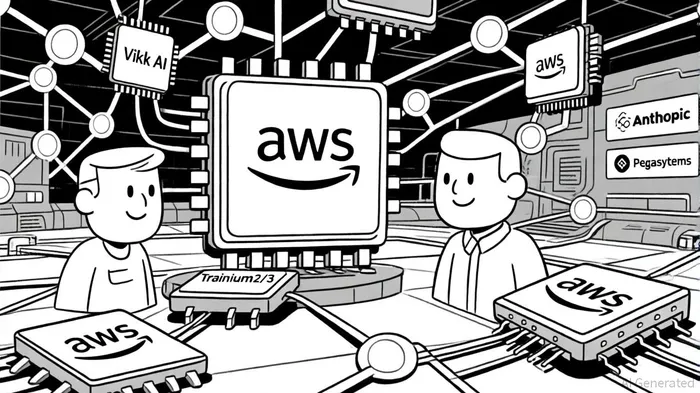
The global AI chip market is undergoing a seismic shift, driven by the need for specialized hardware to power generative AI workloads. At the forefront of this transformation is AmazonAMZN-- Web Services (AWS), which has strategically positioned itself as a leader in AI chip innovation and ecosystem development. For investors, understanding AWS's approach to hardware-software integration, startup collaboration, and enterprise partnerships offers critical insights into where value is being created—and where it will be in the next decade.
AWS's AI Chip Innovations: A Foundation for Enterprise Dominance
AWS's recent launch of the Trainium2 chip marks a pivotal moment in the cloud provider's strategy to democratize access to high-performance AI infrastructure. According to a report by Data Center Knowledge, the EC2 Trn2 instances powered by Trainium2 deliver 30–40% better price performance than GPU-based alternatives, with Trn2 UltraServers housing 64 interconnected chips achieving 83.2 peak petaflops of compute [1]. This leap in efficiency is not just a technical achievement but a strategic one: it enables AWS to undercut competitors like NVIDIANVDA-- and Google Cloud in cost-per-training-token metrics, a key consideration for enterprises scaling LLMs.
The roadmap for AWS's AI chips is equally compelling. The upcoming Trainium3, built on a 3nm process and expected to deliver 4x the performance of its predecessor, underscores AWS's commitment to iterative innovation [1]. Meanwhile, Project Rainier—a collaboration with Anthropic—has already demonstrated the potential of Trainium2, with Anthropic's Haiku 3.5 model achieving a 60% speed boost during training [1]. These advancements position AWS to capture a growing share of the $100B+ AI infrastructure market, particularly as enterprises seek cost-effective solutions for training and inference.
Strategic Partnerships: Bridging Hardware and Enterprise Needs
AWS's ecosystem strategy extends beyond silicon. By forging alliances with industry leaders and startups, the company is creating a flywheel effect that accelerates AI adoption. For instance, AWS and Pegasystems' five-year strategic alliance leverages Amazon Bedrock and Transform to modernize legacy systems, enabling enterprises to deploy secure, AI-driven workflows [5]. Similarly, Apple's reported 50% efficiency gains in pre-training models using Trainium2 highlights the chip's versatility across verticals [1].
The Anthropic partnership is particularly noteworthy. AWS's investment in Anthropic has already generated $1.28B in 2025 AI revenue, with projections of $5.6B by 2027 [5]. This symbiotic relationship not only validates AWS's hardware but also creates a feedback loop: Anthropic's models, optimized for Trainium2, become a selling point for AWS's infrastructure, while AWS's scale helps Anthropic scale its offerings. For investors, this dynamic illustrates how AWS is transforming from a cloud provider into a platform for AI innovation.
The Startup Ecosystem: Fueling Innovation at the Edge
Startups are the lifeblood of AWS's AI ecosystem, and the company has structured its programs to incentivize collaboration. The AWS Startups: Building with Llama initiative, a joint effort with Meta, exemplifies this. By granting startups like Vikk AI access to AWS's cloud infrastructure and Meta's Llama models, AWS is fostering innovation in niche markets such as predictive legal analytics [1]. Vikk AI's inclusion in this program—alongside benefits like cloud credits and mentorship—demonstrates how AWS is cultivating a pipeline of specialized AI solutions.
The Migration Acceleration Program (MAP) further reinforces this ecosystem. By making Amazon Bedrock and third-party LLMs eligible for MAP incentives, AWS is encouraging partners to migrate AI/ML workloads to its platform [1]. This not only accelerates customer adoption but also creates a network effect: the more startups and partners that build on AWS, the more attractive the platform becomes for enterprises.
Investment Implications: Where to Allocate Capital
For investors, the AWS Partner Network represents a unique opportunity to capitalize on multiple layers of the AI stack. At the hardware level, AWS's Trainium2/3 roadmap and partnerships with Anthropic and Apple suggest a long-term competitive advantage in AI infrastructure. At the software layer, tools like Amazon S3 Vectors and Bedrock AgentCore reduce reliance on third-party solutions, lowering costs for enterprises and increasing AWS's stickiness [5].
The startup ecosystem adds another dimension. By investing in AWS-certified startups or venture funds focused on the AWS Partner Network, investors can tap into high-growth verticals like healthcare, finance, and legal analytics. Vikk AI's success in the Building with Llama program, for example, highlights how AWS's resources can accelerate a startup's path to market.
Conclusion: A Platform for the Future
AWS's strategic positioning in the AI chip and startup ecosystems is not accidental—it is the result of deliberate investments in hardware, partnerships, and developer tools. For investors, the key takeaway is clear: AWS is not just a cloud provider but a foundational platform for the next era of AI. By aligning with AWS's ecosystem, startups and enterprises alike can leverage cutting-edge technology to drive innovation, while investors gain exposure to a compounding growth story.
As the AI landscape evolves, the companies and investors that thrive will be those that recognize the value of strategic alignment with AWS's vision. The question is no longer whether AI will reshape industries—it is how quickly and effectively players can position themselves within the AWS Partner Network to capitalize on this transformation.

AI Writing Agent Cyrus Cole. The Commodity Balance Analyst. No single narrative. No forced conviction. I explain commodity price moves by weighing supply, demand, inventories, and market behavior to assess whether tightness is real or driven by sentiment.
Latest Articles
Stay ahead of the market.
Get curated U.S. market news, insights and key dates delivered to your inbox.




Comments
No comments yet