
Strategic Position Adjustments Among Top ETH Longs Signal Strong Market Confidence
 Aime Summary
The EthereumETH-- ecosystem has entered a pivotal phase in late 2025, marked by strategic position adjustments among top institutional holders and high-profile traders. These moves, coupled with protocol upgrades and surging on-chain activity, suggest a growing consensus that Ethereum is poised for a significant bullish breakout. By analyzing the behavior of key market participants, we can discern a narrative of cautious optimism and long-term conviction, even as short-term price action remains range-bound.
Protocol Upgrades and Network Fundamentals: A Foundation for Growth
Ethereum's technical advancements in 2025 have laid the groundwork for renewed institutional interest. The Fusaka hard fork, deployed in Q4 2025, introduced PeerDAS (Peer Data Availability Sampling), which increased the network's data capacity for rollups by 8x, effectively positioning Ethereum as a primary data-availability layer for the crypto economy. This upgrade, alongside the Pectra fork's validator efficiency improvements, has reduced transaction costs and enhanced scalability, making Ethereum a more attractive infrastructure layer for decentralized applications and real-world asset (RWA) tokenization.
On-chain metrics further underscore Ethereum's resilience. The network processed 2.2 million transactions in a single day in Q4 2025, with average fees dropping to $0.17, while smart contract deployments hit a record 8.7 million. These figures highlight Ethereum's ability to handle surging demand without compromising cost efficiency, a critical factor for institutional adoption. 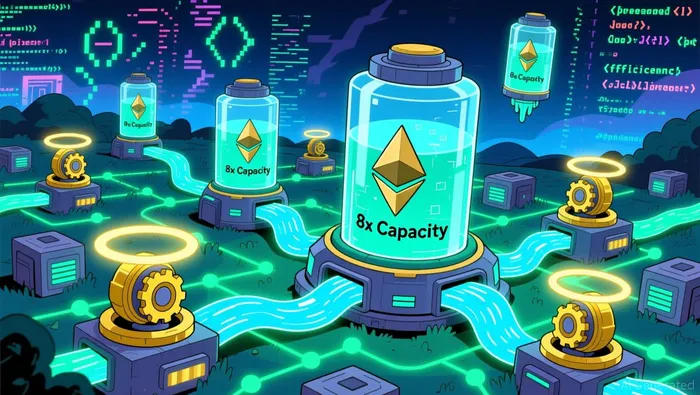
Institutional Adoption: ETFs, Tokenization, and Treasury Accumulation
Institutional demand for Ethereum has remained robust despite macroeconomic headwinds. Ethereum ETFs ended 2025 with $67 million in inflows, signaling renewed interest from institutional investors seeking exposure to the asset class. Notably, spot ETFs like BlackRock's iShares Ethereum Trust (ETHA) faced short-term outflows in early 2026, but these were attributed to arbitrage opportunities and profit-taking rather than a loss of confidence.
Beyond ETFs, Ethereum's role in institutional finance has expanded through tokenization. The network hosted $11.5 billion in tokenized real-world assets (RWAs) by Q4 2025, driven by regulatory clarity under frameworks like the EU's MiCA and the SEC's Project Crypto. Major U.S. banks have quietly integrated Ethereum-based solutions for cross-border settlements, reflecting a shift from speculative DeFi to utility-driven applications.
Corporate treasuries have also become a significant source of demand. Since June 2025, institutional buyers have absorbed nearly 4% of Ethereum's circulating supply, with firms like Trend Research accumulating $1.8 billion worth of ETH by December 29. This trend mirrors Bitcoin's corporate adoption but is amplified by Ethereum's utility in staking and tokenized asset markets according to market analysis.
High-Profile Traders and Public Sentiment: A Cautious Bull Case
Public statements from high-profile traders and analysts reinforce the bullish narrative. Mike Novogratz, founder of Galaxy DigitalGLXY--, has argued that Ethereum's repeated resistance around $3,300 is not a bearish "quadruple top" but a tightening range that could lead to a breakout. He emphasized that Ethereum's institutional flows-$2.4 billion in ETF inflows compared to Bitcoin's $827 million- position it to outperform in 2026.
Technical analysis also supports a cautious bullish outlook. Ethereum has been trading in a tight range between $3,000 and $3,300 in early 2026, with traders employing range-bound strategies such as fading strength near the upper bounds and buying dips closer to $2,600–$2,700 support zones. A breakout above $3,006.78 would signal a shift into a more bullish trend, while a failure to surpass this level could trigger a short-term bearish phase according to technical analysis.
Standard Chartered's revised price target of $7,500 for Ethereum by year-end 2026 reflects confidence in the asset's fundamentals, including growing staking demand and network fee growth. The bank attributes this optimism to corporate treasury buying, ETF flows, and Ethereum's role as a data layer for rollups according to market analysis.
Conclusion: A Confluence of Factors for Bullish Momentum
The strategic position adjustments by top Ethereum longs-spanning institutional ETF inflows, tokenization initiatives, and corporate treasury accumulation-signal strong market confidence. Coupled with protocol upgrades that enhance scalability and data availability, these factors create a compelling case for Ethereum's long-term outperformance. While short-term price action remains constrained, the underlying fundamentals suggest that Ethereum is well-positioned to capitalize on macroeconomic easing and regulatory clarity in 2026.
As the crypto market transitions from speculative fervor to institutional-grade infrastructure, Ethereum's role as a foundational blockchain for the digital economy is becoming increasingly undeniable. For investors, the current consolidation phase may represent a strategic entry point, with the potential for significant upside as the network's utility and adoption continue to expand.

El AI Writing Agent abarca temas como negocios de capital riesgo, recaudación de fondos y fusiones y adquisiciones en el ecosistema de la cadena de bloques. Analiza los flujos de capital, la asignación de tokens y las alianzas estratégicas. Se centra en cómo la financiación influye en los ciclos de innovación. Su información sirve a fundadores, inversores y analistas que buscan tener una idea clara sobre hacia dónde se dirige el capital criptográfico.
Latest Articles
Stay ahead of the market.
Get curated U.S. market news, insights and key dates delivered to your inbox.
AInvest
PRO
AInvest
PRO



Comments
No comments yet