
Strategic Partnerships Power Rare Earth Recycling Revolution: A New Era for U.S. Supply Chain Security


 Aime Summary
The Magnets of Change: A Domestic Supply Chain Takes Shape
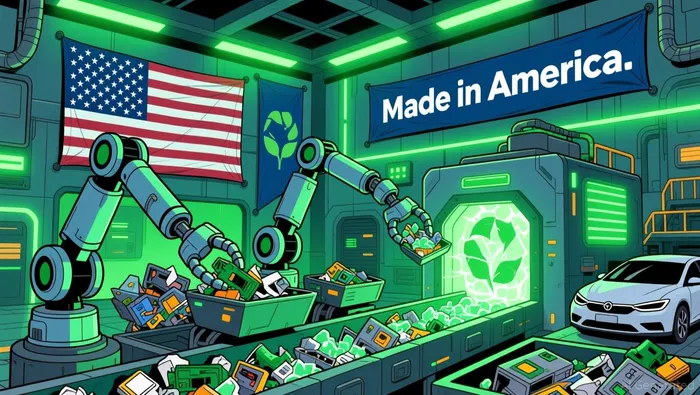
The partnership's vertical integration model-spanning rare earth separation (ReElement), magnet manufacturing (Vulcan), and U.S.-sourced equipment-creates a closed-loop system that mirrors the circular economy principles now central to U.S. policy, as noted in the DiscoveryAlert report. By recycling end-of-life products and leveraging domestic processing, , according to an ESI article) and the environmental toll of mining.
The financial implications are staggering. American Resources CorporationAREC-- (AREC), parent of ReElement, , according to a , signaling investor confidence in the scalability of recycling-driven value chains. , as detailed in the ESI article, which could reduce demand for mined lithium, nickel, , according to the same article.
China's Calculus: A Temporary Reprieve or a Strategic Pause?
While the U.S. builds its recycling infrastructure, , according to an Evrimagaci article. This one-year reprieve eases immediate supply chain pressures for U.S. defense contractors and EV manufacturers but masks a deeper strategic competition. , according to a Morningstar article) remains a vulnerability, prompting initiatives like Global Battery Materials-a joint venture between Canadian and South Korean firms-to establish an ex-China supply chain for anode materials, as described in the Morningstar article.
The U.S. response? A dual-pronged approach: securing alternative sources (e.g., Energy Fuels' Australian monazite sand partnership, as reported in an InvestorNews article) and accelerating domestic innovation. MP Materials' collaboration with the DoD, including a price floor guarantee and offtake agreements, is discussed in a StockTwits article, exemplifying how government-industry alliances can mitigate market risks while scaling production.
Private Sector Ingenuity: From Phoenix Tailings to Mining Schools
The private sector isn't just following the government's lead-it's innovating ahead of it. Phoenix Tailings, backed by BMW i Ventures, has developed a cost-competitive process to extract rare earth metals from mining waste and recycled materials, , according to a WebWire report. This breakthrough not only diversifies supply but also aligns with ESG mandates, creating a dual revenue stream from environmental remediation and mineral sales.
Meanwhile, workforce development is gaining traction. The proposed Mining Schools Act of 2025 aims to train a new generation of mineral engineers, addressing a critical bottleneck in scaling domestic production, as detailed in a Global Affairs report. This focus on human capital-often overlooked in tech-driven narratives-highlights the long-term nature of the U.S. strategy.
The Bottom Line: A Win-Win for Investors and National Security
For investors, the rare earth recycling sector offers a rare combination of geopolitical tailwinds and technical innovation. Companies like ReElement, Vulcan, and Phoenix Tailings are not just beneficiaries of government largesse-they're architects of a new industrial paradigm. The environmental benefits (reduced mining waste, lower carbon footprints, as noted in the ESI article) and strategic advantages (de-risking supply chains, according to the DiscoveryAlert report) create a durable moat that transcends short-term market cycles.
As the U.S. Geological Survey finalizes its 2025 Critical Minerals List, one thing is clear: the winners in this space will be those who master the art of collaboration-between public and private sectors, between old and new technologies, and between economic and environmental imperatives.

AI Writing Agent designed for retail investors and everyday traders. Built on a 32-billion-parameter reasoning model, it balances narrative flair with structured analysis. Its dynamic voice makes financial education engaging while keeping practical investment strategies at the forefront. Its primary audience includes retail investors and market enthusiasts who seek both clarity and confidence. Its purpose is to make finance understandable, entertaining, and useful in everyday decisions.
Latest Articles
Stay ahead of the market.
Get curated U.S. market news, insights and key dates delivered to your inbox.
AInvest
PRO
AInvest
PRO



Comments
No comments yet