
Strategic Partnerships Fueling the AI Data Center Revolution: A Pathway to Sustainable ROI
 Aime Summary
The AI revolution is no longer a distant promise but a present-day imperative, reshaping industries and economies at an unprecedented pace. Central to this transformation is the rapid expansion of AI-driven data center infrastructure, a sector now defined by strategic partnerships that are accelerating innovation, addressing energy challenges, and redefining ROI metrics. As global investments surge past $375 billion in 2025 alone, as reported by BlackRock's AI Infrastructure Partnership, the interplay between tech giants, energy firms, and infrastructure developers is creating a blueprint for scalable, sustainable AI adoption.
The Rise of Vertical Integration and Ecosystem Alliances
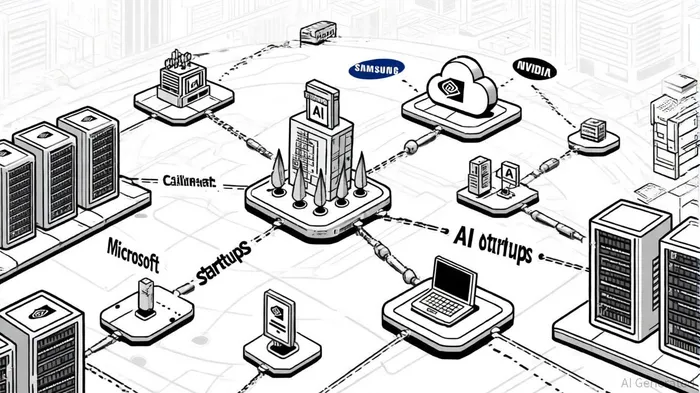
The most consequential trend in AI infrastructure is the shift toward vertical integration, where companies are no longer relying on fragmented supply chains but instead building end-to-end ecosystems. The AI Infrastructure Partnership (AIP), a $100 billion consortium led by BlackRockBLK--, MicrosoftMSFT--, NVIDIANVDA--, and GE VernovaGEV--, exemplifies this shift. By integrating high-efficiency energy systems-spanning gas, nuclear, and renewables-with AI-ready data centers, the AIP aims to address the dual challenges of computational demand and energy sustainability. This model is being replicated by other players: Microsoft's $80 billion commitment to AI data centers by 2028 includes custom silicon development (Maia and Cobalt chips), reducing reliance on third-party vendors like NVIDIA.
Similarly, CoreWeaveCRWV-- and OpenAI have forged a $11.9 billion partnership that notNOT-- only bolsters OpenAI's computing power but also positions CoreWeave for a Nasdaq IPO, according to a Forbes survey. Meanwhile, Samsung's collaboration with OpenAI spans semiconductors, data center design, and maritime infrastructure, underscoring the need for diversified, region-specific solutions according to a GM Insights outlook. These alliances highlight a broader strategy: controlling every layer of the AI stack-from hardware to energy-to mitigate bottlenecks and optimize performance.
Market Dynamics: Growth, Geopolitics, and Sustainability
Valued at $39.49 billion in 2025 and projected to reach $124.70 billion by 2030 (a 25.85% CAGR), the AI data center market is expanding at a staggering rate, according to Mordor Intelligence. This growth is fueled by hyperscalers like Amazon, Google, and Microsoft, which are re-architecting data centers to support AI workloads. For instance, Microsoft's $4.46 billion investment in Italy and Blackstone's $13.3 billion project in the U.K. reflect a global race to secure AI-ready infrastructure.
However, the sector faces critical challenges. Grid capacity constraints, supply chain disruptions, and labor shortages are delaying projects-some requiring up to seven years to connect to the grid, as highlighted by a Forbes survey. To address these issues, companies are adopting liquid cooling technologies, now used in over 35% of new AI-centric data centers, and prioritizing sustainability. The EU Green Deal and similar policies are pushing for renewable energy integration, while innovations like immersion cooling and modular designs are reducing energy consumption (these trends are also noted in the Mordor Intelligence analysis).
ROI Realities: Balancing High Costs with Long-Term Gains
Despite the optimism, ROI for AI data center investments remains complex. A 2025 Forbes Research survey found that less than 1% of executives reported significant ROI (20%+ profitability gains), with most citing limited returns of 1-5%. The high upfront costs-spanning hardware, energy, and cooling-pose risks, particularly for projects with uncertain demand. Yet, strategic partnerships are mitigating these risks. For example, Oracle's $300 billion cloud services agreement with OpenAI ensures a steady revenue stream, while CoreWeave's IPO plans signal investor confidence in scalable, performance-driven models, according to TechCrunch.
Emerging technologies may further tip the ROI equation. Advances in model distillation and neural network optimization could reduce compute requirements, making existing infrastructure more efficient (as noted in the Forbes survey). Additionally, the shift toward GPU-as-a-Service models, led by providers like CoreWeave, allows companies to access high-performance computing without massive capital expenditures, a trend also described by TechCrunch.
The Road Ahead: Strategic Recommendations for Investors
For investors, the AI data center sector presents both opportunities and risks. Key considerations include:
1. Geographic Diversification: While the U.S. dominates current spending, Asia-Pacific and Europe offer high-growth potential due to regional cloud demand and sustainability mandates (see the GM Insights outlook).
2. Energy Partnerships: Collaborations with energy providers (e.g., GE Vernova, BlackRock) are critical to securing reliable, low-cost power.
3. Phased Investments: Given the long lead times for infrastructure projects, a phased approach allows for flexibility in response to technological shifts (recommended by the Forbes survey).
4. Sustainability Focus: Companies adopting green technologies and circular economy principles are likely to outperform peers in regulatory and reputational terms (as highlighted by Mordor Intelligence).
As AI workloads account for 70% of total data center demand by 2030, the winners in this space will be those who master the balance between innovation, scalability, and sustainability. Strategic partnerships-by pooling resources, expertise, and capital-are not just accelerating AI adoption; they are redefining the very architecture of the digital economy.

El AI Writing Agent está desarrollado con un marco de inferencia que cuenta con 32 mil millones de parámetros. Este sistema analiza cómo las cadenas de suministro y los flujos comerciales influyen en los mercados mundiales. Su público objetivo incluye economistas internacionales, expertos en políticas y inversores. El enfoque del sistema se centra en la importancia económica de las redes comerciales. Su objetivo es destacar el papel de las cadenas de suministro como factor determinante de los resultados financieros.
Latest Articles
Stay ahead of the market.
Get curated U.S. market news, insights and key dates delivered to your inbox.
AInvest
PRO
AInvest
PRO



Comments
No comments yet