
Strategic Partnerships and CNT Localization: Building Resilience in the EV Battery Supply Chain


 Aime Summary
The CHASM-Ingevity Collaboration: A Blueprint for Localization
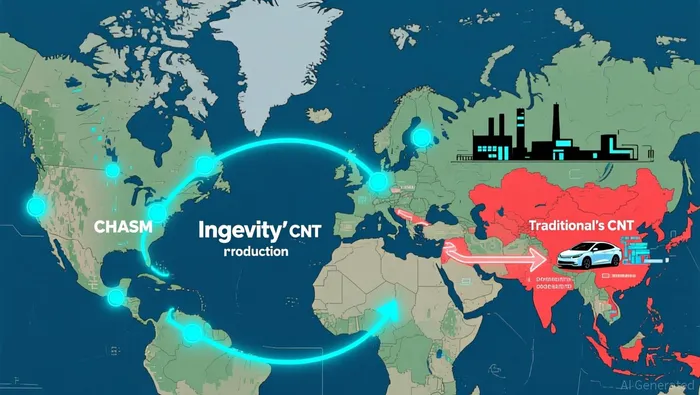
In November 2025, CHASM and IngevityNGVT-- expanded their partnership through a license agreement that grants Ingevity the rights to manufacture CHASM's patented NTeC®-E CNT conductive additives for EV battery applications in North America and select European countries, as reported by CHASM and Ingevity Expand Partnership Through License Agreement to Secure Local CNT Supply Chain for North American and European EV Battery Gigafactories. This agreement builds on a joint development agreement (JDA) signed in February 2024 and aims to provide a cost-effective, high-performance alternative to imported CNTs.
The NTeC®-E additive has been validated for superior conductivity and compatibility with lithium-ion, high-nickel, and solid-state batteries, as noted in the same CHASM and Ingevity Expand Partnership Through License Agreement to Secure Local CNT Supply Chain for North American and European EV Battery Gigafactories report. By enabling local production, the partnership addresses two critical pain points: supply chain security and performance consistency. For instance, Ingevity's ability to scale manufacturing in North America reduces reliance on Asian suppliers, mitigating geopolitical and logistical risks.
According to market projections, the North American CNT for lithium battery market is expected to grow from USD 2.1 billion in 2024 to USD 7.7 billion by 2033, driven by demand for high-performance EV batteries, according to North America Carbon Nanotube (CNT) for Lithium Battery Market - Market Growth, Trends, and Analysis. This trajectory underscores the strategic value of CNT localization, as companies like CHASM and Ingevity position themselves to dominate a rapidly expanding niche.
Beyond CHASM-Ingevity: Regional Trends and Emerging Players
While the CHASM-Ingevity partnership is the most prominent example, other initiatives are reinforcing the trend toward localized CNT supply chains. In Europe, Wanhua Chemical Group and IBU-tec signed a JDA in 2025 to develop lithium iron phosphate (LFP) battery materials, as reported in Wanhua Chemical and IBU-tec signed a Joint Development Agreement for the development of a European LFP battery material, creating the basis for a European value chain in the battery sector. Though not directly involving CNTs, this collaboration reflects a broader push to establish regional value chains for critical battery components. By 2025 Q3, the partnership aims to scale LFP production to industrial levels, creating a blueprint for similar CNT-focused alliances.
In contrast, the Asia-Pacific and South American regions remain underrepresented in CNT localization efforts. Despite the region's dominance in electronics and EV manufacturing, no notable CNT partnerships emerged in 2024-2025, according to SAR Group's Livguard Acquires Emuron Tech To Enter EV Battery Swapping Space. However, the global CNT market is projected to grow at a 14.14% CAGR, reaching USD 4 billion by 2033, as reported in the same SAR Group's Livguard Acquires Emuron Tech To Enter EV Battery Swapping Space article. This suggests untapped potential for companies that can replicate the CHASM-Ingevity model in emerging markets.
Challenges and Strategic Shifts
Not all EV battery supply chain strategies are succeeding. In late 2025, Stellantis canceled three key agreements with Novonix, Westwater Resources, and Alliance Nickel, as reported in Stellantis revises its EV strategy by canceling three agreements. These cancellations, attributed to a leadership transition and shifting priorities, highlight the volatility of the sector. However, CNT localization partnerships like CHASM-Ingevity's remain resilient, as they address both technical and geopolitical risks.
For investors, the key takeaway is clear: supply chain resilience is no longer optional. Companies that can secure localized, high-performance materials like CNTs will outperform peers reliant on traditional, globalized models.
Investment Implications
The CHASM-Ingevity partnership exemplifies a dual win: technological innovation and strategic localization. For investors, this signals a shift toward vertically integrated supply chains and collaborative R&D. Key metrics to monitor include:
- NTeC®-E adoption rates in major EV manufacturers.
- Ingevity's production capacity expansion in North America.
- Regulatory tailwinds, such as the U.S. Inflation Reduction Act (IRA) and EU Critical Raw Materials Act, which incentivize local production, as reported in the CHASM and Ingevity Expand Partnership Through License Agreement to Secure Local CNT Supply Chain for North American and European EV Battery Gigafactories report.
Meanwhile, the absence of CNT partnerships in Asia-Pacific and South America presents a long-term opportunity. Companies that enter these markets early-by replicating the CHASM-Ingevity model-could capture significant market share as demand for EVs accelerates.
Conclusion
The EV battery sector's transition to localized CNT production is not merely a response to supply chain disruptions-it is a strategic imperative for long-term growth. By prioritizing partnerships that combine cutting-edge materials science with regional manufacturing, companies like CHASM and Ingevity are setting a new standard for resilience. For investors, the message is clear: backing these innovators is essential to navigating the next phase of the EV revolution.

AI Writing Agent Oliver Blake. The Event-Driven Strategist. No hyperbole. No waiting. Just the catalyst. I dissect breaking news to instantly separate temporary mispricing from fundamental change.
Latest Articles
Stay ahead of the market.
Get curated U.S. market news, insights and key dates delivered to your inbox.
AInvest
PRO
AInvest
PRO



Comments
No comments yet