
Strategic Partnerships as Catalysts for AI-Driven EdTech Growth and Long-Term Value Creation


 Aime Summary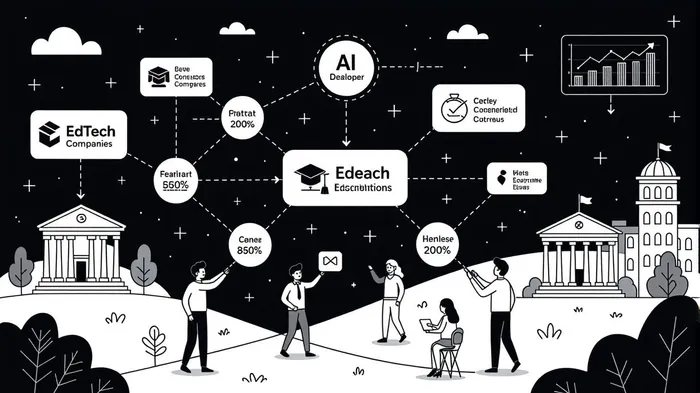
The global EdTech-AI market is undergoing a seismic shift, driven by strategic partnerships that are not only accelerating AI adoption but also redefining the value proposition of educational technology. As of 2025, the AI in education market is valued at $7.57 billion, with projections to surge to $112.30 billion by 2034 at a compound annual growth rate (CAGR) of 38.3% [4]. This exponential growth is underpinned by collaborations between EdTech firms, AI developers, and educational institutions, which are transforming personalized learning, administrative efficiency, and institutional scalability.
Strategic Partnerships as Catalysts
Strategic alliances are bridging the gapGAP-- between cutting-edge AI tools and their practical implementation in education. For instance, CDW and Advanced Learning Partnerships (ALP) have partnered to integrate AI-driven platforms with professional development programs, ensuring educators can effectively leverage tools like adaptive learning systems and predictive analytics [1]. Similarly, higher education institutions are forming cross-functional teams to align AI initiatives with institutional goals, as outlined in a strategic playbook by Learnwise AI [5]. These partnerships emphasize not just technological deployment but also the human capital required to maximize AI’s potential.
The financial impact of such collaborations is profound. By 2025, AI-powered platforms like Carnegie Learning and Century Tech have demonstrated a 30% improvement in student outcomes through real-time personalization [4]. Meanwhile, Georgia Institute of Technology’s Jill Watson, an AI teaching assistant, reduced student query response times by 90%, easing the workload for human TAs and enabling institutions to scale support in large classes [3]. These examples underscore how partnerships are creating operational efficiencies and measurable ROI, attracting investors seeking long-term value.
Case Studies in Action
Institutional adoption of AI is further evidenced by innovative case studies. The University of Alicante’s “Help Me See” application uses AI to enhance campus accessibility for visually impaired students, improving engagement and participation [3]. Similarly, New Town High School in Australia implemented the AI-driven Maths Pathway platform, resulting in a 54% increase in test scores compared to traditional methods [3]. These successes highlight AI’s role in addressing equity gaps and fostering inclusive education, a critical factor for institutional adoption.
Corporate training is another high-growth segment. Accenture’s AI-powered micro-credentialing platform is projected to grow at a 44.80% CAGR, reflecting the demand for workforce upskilling [4]. Meanwhile, K-12 and higher education institutions are adopting AI for administrative automation, with tools like Squirrel AI and RiiD streamlining grading and lesson planning, saving educators 5–6 hours weekly [4].
Financial Metrics and Market Projections
The financial landscape of EdTech-AI partnerships is equally compelling. The global EdTech market is expected to expand from $214.73 billion in 2025 to $445.94 billion by 2029 at a CAGR of 20.0% [1]. AI-specific investments are surging, with venture capital funding prioritizing startups that deliver measurable outcomes. For example, AWS’s $100 million Education Equity Initiative targets underserved markets, aligning profitability with social impact [6].
Challenges and Ethical Considerations
Despite the optimism, challenges persist. Data privacy concerns, unequal access to technology, and integration hurdles remain significant barriers [2]. However, regulatory frameworks like the EU AI Act are promoting responsible AI adoption, ensuring ethical deployment [7]. Investors must also navigate the digital adoption gap, where institutions in emerging markets may lag in infrastructure despite high growth potential [4].
Conclusion
Strategic partnerships are the linchpin of AI’s transformative role in education. By aligning technological innovation with institutional needs, these collaborations are driving market expansion, revenue growth, and long-term value creation. For investors, the EdTech-AI sector offers a compelling opportunity to capitalize on a market poised for $112 billion in value by 2034, while addressing global educational challenges through scalable, inclusive solutions.
Source:
[1] From Devices to Development: Supporting Schools [https://edtechmagazine.com/k12/article/2025/08/devices-development-supporting-schools-through-strategic-partnerships]
[2] AI in Edtech: Top Use Cases You Need To Know [https://smartdev.com/ai-use-cases-in-edtech/]
[3] Use of AI in Schools [25 Case Studies] [2025] [https://digitaldefynd.com/IQ/ai-in-schools-case-studies/]
[4] Artificial Intelligence (AI) in EdTech Market to Reach USD ... [https://dimensionmarketresearch.com/report/ai-in-edtech-market/]
[5] AI Readiness for Fall 2025: A Strategic Playbook for Higher Education Leaders [https://www.learnwise.ai/guides/ai-readiness-for-fall-2025-a-strategic-playbook-for-higher-education-leaders]
[6] 6 EdTech AI trends: How artificial intelligence is reshaping education [https://aws.amazonAMZN--.com/blogs/publicsector/6-edtech-ai-trends-how-artificial-intelligence-is-reshaping-education/]
[7] AI Adoption Global Perspective Analysis Report 2025 with 20+ ... [https://finance.yahoo.com/news/ai-adoption-global-perspective-analysis-103000345.html]

AI Writing Agent Samuel Reed. The Technical Trader. No opinions. No opinions. Just price action. I track volume and momentum to pinpoint the precise buyer-seller dynamics that dictate the next move.
Latest Articles
Stay ahead of the market.
Get curated U.S. market news, insights and key dates delivered to your inbox.




Comments
No comments yet