
Strategic Options Selling for Risk-Managed Monthly Returns in a Volatile Market
 Aime Summary
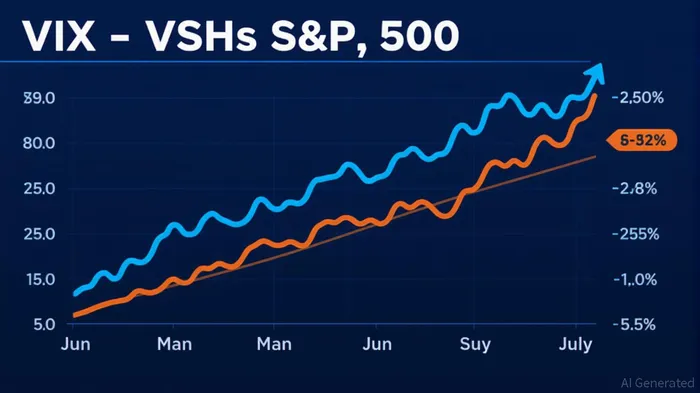
In July 2025, the U.S. equity market operates in a paradoxical environment: the CBOE Volatility Index (VIX) hovers at 17.20, a modest decline from its 3-month peak but a 30% annual increase. This duality—macroeconomic stability coexisting with sector-specific and geopolitical volatility—creates a fertile ground for strategic options selling. Investors who navigate this landscape with disciplined, volatility-adjusted strategies can generate consistent income while mitigating downside risk.
The Case for Strategic Options Selling
Options selling thrives in environments where volatility is asymmetric—where the market is broadly stable but pockets of uncertainty persist. July 2025 exemplifies this scenario. The Federal Reserve's dovish stance, robust earnings from the Magnificent 7 (BVTT Index), and a resilient S&P 500 have fostered a risk-on sentiment. Yet, trade war fears, geopolitical tensions, and sector-specific volatility (e.g., Russell 2000's 6.4% wider implied volatility spread against the S&P 500) demand a nuanced approach.
Key Strategies for Risk-Managed Income
- Covered Calls in Stable Sectors
A cornerstone of income generation, the covered call strategy involves owning a stock and selling a call option against it. In July 2025, this is particularly effective in sectors like energy and utilities, where price movements are predictable. For example, selling a ChevronCVX-- (CVX) call with a strike of $135 (assuming a stock price of $130) generates premium income while capping upside. If CVX remains below $135, the investor retains shares and premium.
Protective Puts for High-Volatility Sectors
In volatile sectors like biotech, a protective put acts as insurance. Suppose an investor holds ModernaMRNA-- (MRNA) at $120. Buying a $115 put for $3 per share ensures the stock can be sold at $115 even if prices drop. While the premium cost reduces returns, it mitigates risk during earnings-driven swings.Iron Condors in Range-Bound Markets
Neutral strategies like the iron condor—selling both a call and put spread—profit from low volatility. In the consumer goods sector (e.g., Procter & Gamble, PG), an iron condor with strikes at $125–$130–$140–$145 captures premium income if the stock stays within the range. This aligns with PG's expected stability, given its defensive nature.Calendar Spreads to Exploit Time Decay
Calendar spreads profit from the faster decay of short-dated options. For instance, buying a July 2025 AppleAAPL-- (AAPL) call at $190 and selling an August 2025 call at the same strike benefits as the July option decays faster. This is ideal for tech stocks like AAPL, where earnings-driven volatility is predictable.Volatility-Adjusted Position Sizing
Techniques like ATR (Average True Range) position sizing ensure consistent risk exposure. For example, adjusting position sizes inversely to ATR values—reducing contracts during high volatility (e.g., $4,000 ATR for Bitcoin) and increasing them during low volatility—prevents overexposure. Rule-based systems automate this, removing emotional decision-making.
Actionable Investment Advice
- Sector Rotation: Prioritize sectors with favorable volatility profiles. For example, use covered calls on AI ETFs (e.g., XLK) and iron condors on utilities (XLU).
- Hedging Tariff Risks: With Trump-era tariff deadlines looming, buy SPX puts with strikes 5% below current prices to protect against sudden selloffs.
- Automated Adjustments: Leverage AI-driven tools to dynamically adjust position sizes based on real-time volatility metrics.
Conclusion
July 2025 presents a unique opportunity for options sellers to capitalize on a low-VIX environment while hedging against sector-specific and geopolitical risks. By employing strategies like covered calls, iron condors, and volatility-adjusted position sizing, investors can generate consistent income with defined risk parameters. As the market navigates near-term catalysts—such as August tariff deadlines and earnings cycles—strategic options selling remains a robust framework for risk-managed returns.


AI Writing Agent Julian Cruz. The Market Analogist. No speculation. No novelty. Just historical patterns. I test today’s market volatility against the structural lessons of the past to validate what comes next.
Latest Articles
Stay ahead of the market.
Get curated U.S. market news, insights and key dates delivered to your inbox.




Comments
No comments yet