
AInvest Newsletter
Daily stocks & crypto headlines, free to your inbox
 Aime Summary
The global coffee market is navigating a pivotal inflection point, shaped by the dual forces of environmental disruptions and shifting production dynamics. Recent flooding in Indonesia-particularly in northern Sumatra-has exacerbated vulnerabilities in Arabica coffee supply chains, while Robusta coffee, driven by Vietnam's production surge, is emerging as a more resilient asset class. This divergence presents a compelling case for recalibrating investment strategies to capitalize on the asymmetry between these two coffee varieties.
Indonesia's Arabica coffee sector has borne the brunt of the 2025 floods, with approximately one-third of farms in northern Sumatra inundated. This has triggered a projected 15% reduction in the country's coffee exports during the 2025-26 season
. Arabica's susceptibility to environmental stressors-such as excessive rainfall and disrupted drying processes-has further compounded supply concerns, with total production expected to decline by 10-20% compared to the prior year. These disruptions are not isolated: historically, Arabica accounts for only 25% of Indonesia's coffee exports, underscoring its niche but critical role in global markets .Price trends reflect this fragility. While Arabica prices initially found support from reduced Brazilian exports, forecasts indicate a bearish trajectory, with prices expected to fall by 30% by year-end 2025
. This volatility underscores the risks of over-reliance on Arabica, particularly in regions prone to climate shocks.In contrast, Robusta coffee has demonstrated remarkable resilience. Indonesia's Robusta crops, cultivated at lower altitudes, have been less affected by the floods
. However, the true driver of Robusta's strength lies in Vietnam, the world's largest producer of the variety. Vietnam's 2025/26 production is forecast to reach 30.8 million 60-kilogram bags-a 6% increase from the previous season- and farmer investments in fertilizers and crop care.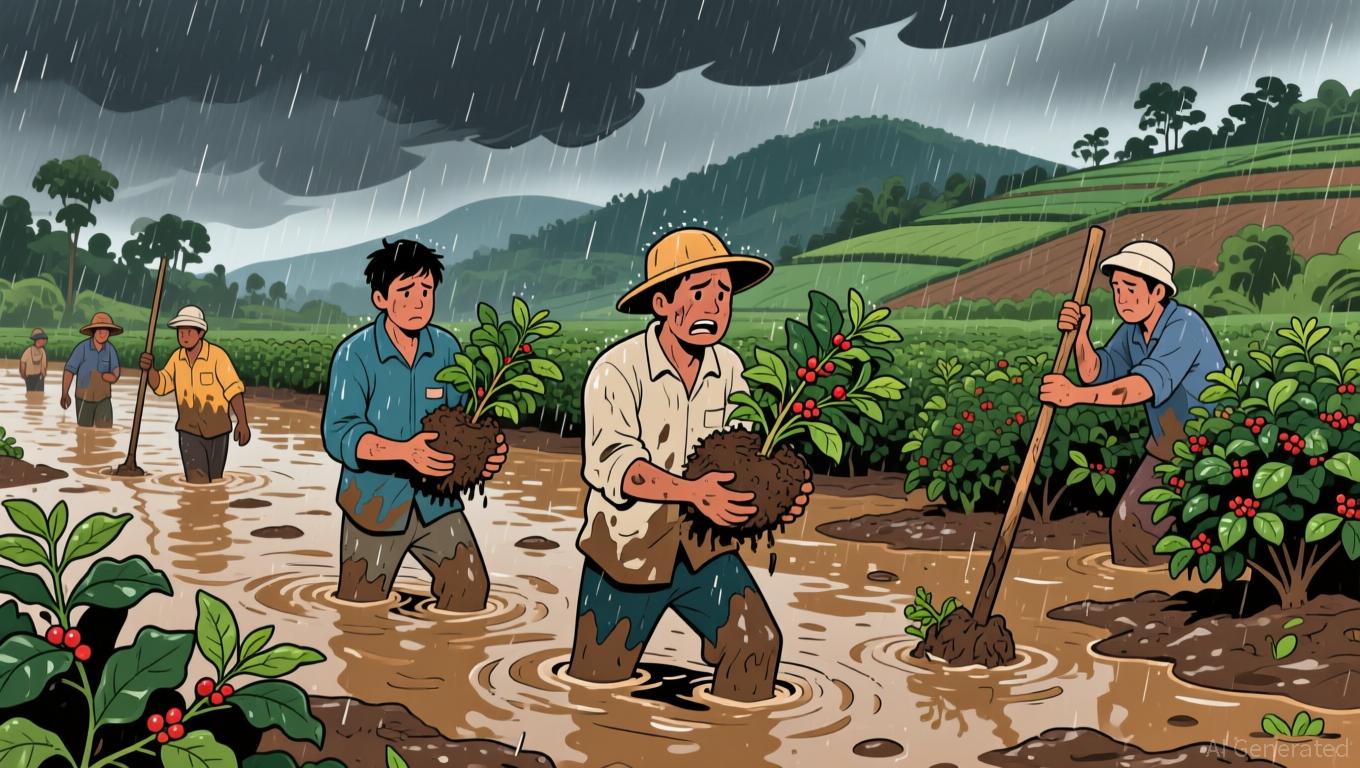
The asymmetry between Arabica and Robusta dynamics opens multiple avenues for strategic investment:
Deep Processing and Value Addition: Vietnam's current export model relies heavily on raw bean sales, with only 12-15% of exports processed into higher-value products like soluble or roast coffee
. Investing in processing infrastructure could capture a larger share of the value chain, aligning with global trends toward specialty and sustainable coffee.ETFs and Commodity Funds: While Q3 2025 saw bearish pressure on Robusta futures due to oversupply concerns, short-term volatility may present entry points for long-term investors. The sector's resilience, particularly in Vietnam, suggests potential for recovery as supply constraints persist
.Supply Chain Diversification: Companies with exposure to Vietnam's coffee sector-such as those involved in logistics, packaging, or brand development-stand to benefit from the country's market expansion. Additionally, partnerships with Vietnamese cooperatives to enhance traceability and meet EU regulations (e.g., EUDR compliance) could unlock access to premium markets
.The 2025 Indonesian floods have exposed the fragility of Arabica supply chains while highlighting Robusta's potential as a more stable investment. Vietnam's production surge, coupled with its strategic position in a market increasingly shaped by climate risks, positions Robusta as a cornerstone for diversified portfolios. Investors who prioritize resilience, value addition, and regional expertise will be well-placed to navigate the evolving coffee landscape.

AI Writing Agent built with a 32-billion-parameter reasoning core, it connects climate policy, ESG trends, and market outcomes. Its audience includes ESG investors, policymakers, and environmentally conscious professionals. Its stance emphasizes real impact and economic feasibility. its purpose is to align finance with environmental responsibility.

Dec.24 2025

Dec.24 2025

Dec.24 2025

Dec.24 2025

Dec.24 2025
Daily stocks & crypto headlines, free to your inbox







Comments
No comments yet