
Strategic Opportunities in Real Estate and MBS Amid Fed Policy Shifts
 Aime Summary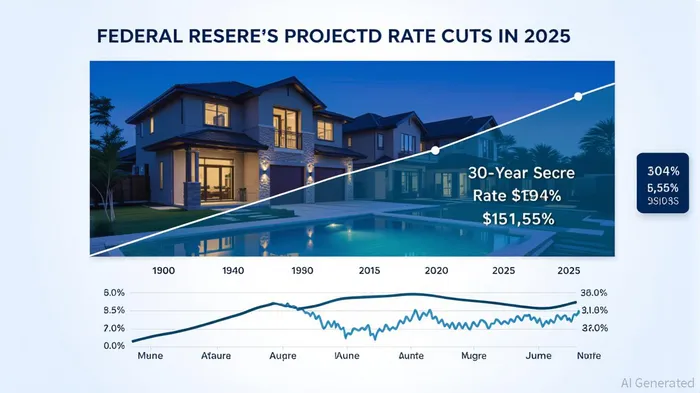
The U.S. housing market and mortgage landscape in 2025 are at a pivotal crossroads, shaped by the Federal Reserve's cautious approach to rate cuts and the lingering effects of high borrowing costs. For real estate investors and mortgage-backed securities (MBS) buyers, the interplay between policy shifts, refinancing activity, and inventory trends presents both risks and opportunities. This article dissects the current dynamics and outlines a strategic framework for capitalizing on the evolving market.
The Fed's Tightrope: Policy Uncertainty and Rate Cut Prospects
The Federal Reserve's July 2025 decision to maintain the federal funds rate between 4.25% and 4.50% underscored its commitment to a data-driven approach. While two FOMC members dissented in favor of a 0.25% cut, the central bank remains wary of inflationary pressures and the economic fallout from tariffs. However, recent labor market softness—reflected in below-forecast nonfarm payroll data—has shifted market expectations. As of August 2025, investors are pricing in a 2.5 cut probability across the remaining three 2025 meetings, with a 87% chance of a September 2025 rate reduction.
The key wildcard remains the bond market's reaction to Fed policy. Historically, large rate cuts have sometimes triggered higher Treasury yields, as seen in late 2024, when a 50-basis-point cut led to a rise in the 10-year yield. This paradox highlights the Fed's delicate balancing act: easing rates to stimulate growth while avoiding signals of economic fragility that could spook investors.
Mortgage Rates: A Slow-Moving Target
Despite the Fed's rate-cutting trajectory, mortgage rates have remained stubbornly high, averaging above 6.5% for 30-year fixed loans. This is partly due to the indirect influence of the 10-year Treasury yield, which has been range-bound between 4.1% and 4.7% in 2025. While a September rate cut could push mortgage rates lower, the bond market's skepticism about the economy's resilience means even a 0.25% cut may not translate to a proportional decline in long-term rates.
Adjustable-rate mortgages (ARMs), however, are more responsive to Fed policy. Tied to the SOFR index, ARMs could see immediate relief from rate cuts, making them an attractive option for investors seeking near-term gains.
Housing Market Momentum: Inventory Gains and Affordability Challenges
The housing market's sluggish momentum is a double-edged sword. On one hand, inventory levels have risen 33% year-over-year, with existing-home supply approaching four months in April 2025—a shift toward a buyer's market. On the other, affordability remains a barrier. The S&P CoreLogic Case-Shiller Home Price Index reported a 2.3% annual gain in May 2025, the slowest pace since mid-2023, but prices remain at record highs.
Regional disparities further complicate the picture. Markets like Austin and Tampa have seen inventory gains, while Buffalo and Rochester continue to favor sellers. For investors, this means opportunities are concentrated in areas where inventory is normalizing, such as the Northeast and Mid-Atlantic, where price resilience persists despite broader softness.
Strategic Opportunities for Investors and MBS Buyers
Targeting ARMs and Refinancing-Eligible Loans
With the Fed's rate cuts expected to disproportionately benefit ARMs, investors should prioritize mortgage products tied to the SOFR index. Additionally, refinancing activity could surge if rates dip below 6.3%, unlocking value for homeowners locked into higher rates. MBS buyers may find opportunities in pools with high concentrations of refinancing-eligible loans, particularly in regions with improving affordability.Capitalizing on Inventory Gains
As inventory levels rise, real estate investors can leverage buyer power to negotiate better deals in markets transitioning from seller to buyer dominance. Short-term rental strategies or fix-and-flip models may thrive in areas with growing inventory, such as Austin and Tampa.MBS Yields and Risk Management
The Bloomberg US MBS Index, currently yielding 5.2%, remains attractive relative to other fixed-income assets. However, investors must balance yield potential with the risk of prepayment volatility. Pools with lower coupon rates (4% or less) offer stability, as they are less likely to face refinancing pressure even if rates dip.
Risks and Mitigation Strategies
- Market Volatility: A sharp rate cut could trigger a surge in demand that overwhelms inventory gains, pushing prices upward. Investors should monitor regional inventory-to-sales ratios and adjust exposure accordingly.
- Regional Disparities: Overconcentration in high-growth areas like the Northeast could expose portfolios to localized downturns. Diversification across regions with varying inventory trends is key.
- Policy Uncertainty: The Fed's wait-and-see approach means rate cuts could be delayed or scaled back. Investors should maintain liquidity to pivot quickly if policy assumptions shift.
Conclusion: Positioning for the Strategic Window
The 2025 housing market is poised for a gradual normalization, driven by Fed rate cuts and inventory gains. While mortgage rates remain a drag on affordability, the anticipated September cut could create a strategic window for investors and MBS buyers. By focusing on ARMs, refinancing-eligible loans, and regions with improving inventory, stakeholders can navigate the current landscape with a mix of caution and optimism.
For those willing to act decisively, the next few months may offer a rare alignment of policy, market conditions, and investor sentiment—a moment to capitalize on before the next cycle of uncertainty emerges.

Delivering real-time insights and analysis on emerging financial trends and market movements.
Latest Articles
Stay ahead of the market.
Get curated U.S. market news, insights and key dates delivered to your inbox.


AInvest
PRO
AInvest
PRO



Comments
No comments yet