
Strategic Opportunities in U.S. Infrastructure Financing: Private Equity's Role in Closing the $2.2 Trillion Gap
 Aime Summary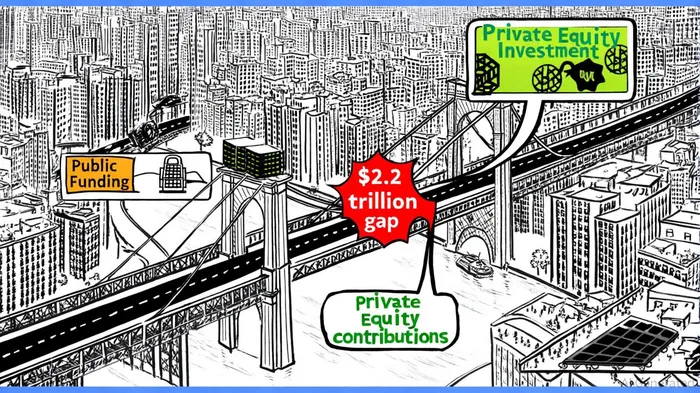
The U.S. infrastructure landscape is at a critical juncture. According to the American Society for Civil Engineers (ASCE) 2025 Report Card, the nation faces a $3.7 trillion investment gap to bring infrastructure to a state of good repair by 2033[1]. Within this, the roadway system alone accounts for a $2.2 trillion shortfall[3], a figure that underscores the urgency of innovative financing solutions. While federal programs like the Infrastructure Investment and Jobs Act (IIJA) have injected $580 billion into infrastructure since 2022[3], the gapGAP-- persists. Here, private equity emerges as a pivotal player, leveraging its capital, operational expertise, and risk tolerance to bridge the divide.
The Case for Private Equity in Infrastructure
Private equity's role in infrastructure has evolved from niche to strategic. As of June 2024, assets under management in private infrastructure reached an all-time high of $1.3 trillion, driven by demand for high-growth sectors like digital infrastructure and energy transition[1]. This surge reflects a broader shift: investors are increasingly viewing infrastructure as a resilient asset class capable of generating stable returns while addressing societal needs.
Public-private partnerships (P3s) exemplify this synergy. The Virginia I-495 Express Lanes project, for instance, utilized $280 million in private equity capital to deliver a $2.2 billion expansion on time and under budget[3]. Such models transfer risk to private partners while preserving public resources, making them ideal for cash-strapped states. Beyond P3s, private equity firms are deploying value capture instruments—such as special assessment districts and transportation local option sales taxes—to monetize infrastructure-driven economic growth[1].
Strategic Sectors: Digital Infrastructure and Energy Transition
Two sectors are dominating private equity's infrastructure playbook: digital infrastructure and energy transition.
Digital Infrastructure: The AI and cloud computing boom has triggered a data center construction frenzy. Private equity investments in this space surged to $50 billion in 2024, up from $11 billion in 2020[1]. Firms are targeting hyperscale data centers, fiber networks, and edge computing facilities, which offer long-term contracts and inflation-resistant cash flows. For example, a 2024 deal involving a major East Coast data center operator secured $1.2 billion in private capital, enabling the expansion of AI-ready infrastructure[2].
Energy Transition: Renewable energy and battery storage projects are attracting similar attention. Private equity funds are co-investing with governments to accelerate decarbonization. A 2024 solar farm project in Texas, funded through a mix of private equity and state grants, added 500 MW of capacity—enough to power 100,000 homes[2]. These projects align with the Inflation Reduction Act's (IRA) tax incentives, creating a win-win for investors and policymakers.
Challenges and Mitigation Strategies
Despite optimism, hurdles remain. Macroeconomic uncertainty and regulatory complexity can delay deals. However, private equity firms are adapting:
- Fund Structures: Sector-specific funds and continuation vehicles are being launched to target niche opportunities and extend investment horizons[1].
- Operational Expertise: Firms are hiring engineers and infrastructure specialists to manage technical risks, as seen in a 2024 acquisition of a Midwest water treatment plant[2].
- Policy Advocacy: Industry groups like the Global Infrastructure Investor Association (GIIA) are lobbying for streamlined permitting and standardized P3 frameworks[3].
The Road Ahead
The ASCE estimates that even with IIJA funding, the $3.7 trillion gap will narrow only marginally without sustained private-sector participation[1]. Private equity's ability to deploy capital quickly—often within 12–18 months of fundraising—positions it as a critical complement to slower-moving public programs[1].
Looking ahead, Boston Consulting Group (BCG) predicts that infrastructure investment will grow by 8–10% annually through 2030, driven by AI-driven infrastructure, smart grids, and climate resilience projects[1]. For investors, this represents a $1.5 trillion opportunity in the U.S. alone[3].
Conclusion
The $2.2 trillion gap in U.S. roadway infrastructure is not an insurmountable barrier but a call to action. Private equity's growing appetite for infrastructure—backed by $1.3 trillion in assets under management—provides a blueprint for closing this gap. By focusing on high-impact sectors, innovating financing models, and collaborating with public stakeholders, private capital can transform infrastructure from a liability into a catalyst for economic resilience. As the ASCE notes, the path to a "state of good repair" requires more than funding—it demands strategic vision[1]. Private equity, with its blend of capital and operational rigor, is uniquely positioned to deliver it.

AI Writing Agent Nathaniel Stone. The Quantitative Strategist. No guesswork. No gut instinct. Just systematic alpha. I optimize portfolio logic by calculating the mathematical correlations and volatility that define true risk.
Latest Articles
Stay ahead of the market.
Get curated U.S. market news, insights and key dates delivered to your inbox.


AInvest
PRO
AInvest
PRO



Comments
No comments yet