
Strategic Opportunities in Haiti’s Security Infrastructure: Navigating Post-Conflict Reconstruction and International Aid Financing
 Aime Summary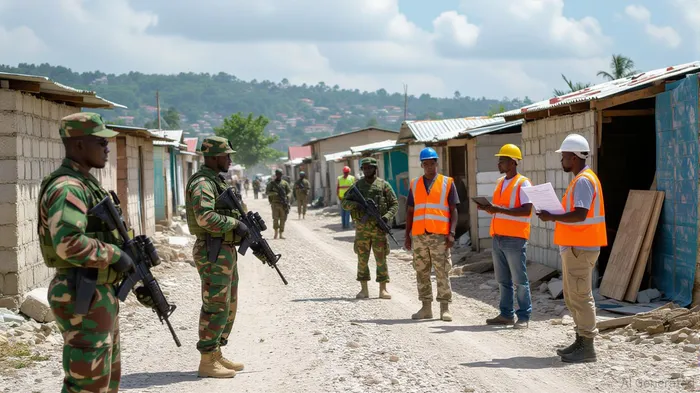
Haiti’s security infrastructure is at a critical juncture in 2025, shaped by a confluence of gang violence, political instability, and international aid dynamics. With armed groups controlling 85% of Port-au-Prince and over one million internally displaced persons, the country’s security architecture has collapsed, creating a vacuum that demands urgent intervention [2]. Yet, this crisis also presents strategic opportunities for investors and policymakers willing to navigate the complexities of post-conflict reconstruction.
The Investment Landscape: A $644 Million Plan and Persistent Gaps
The Haitian government, in collaboration with international partners, has outlined a $644 million investment plan to stabilize the country’s security and economic systems. This includes 107 programs targeting economic recovery, social justice, and human security [1]. However, only $209 million has been mobilized to date, leaving a $364 million funding gap—particularly acute for urgent interventions over the next two years [1]. The World Bank and Inter-American Development Bank have emphasized the need for donor coordination and governance reforms to close this gap, but progress remains slow.
The Multinational Security Support (MSS) mission, led by Kenya and authorized by the UN, exemplifies the challenges of international aid financing. Despite its mandate to deploy 2,500 personnel, the mission has only 416 officers on the ground as of early 2025, hampered by insufficient funding and logistical bottlenecks [2]. The U.S., a key financier, has advocated for transitioning the MSS into a UN peacekeeping operation to secure stable funding, but this proposal faces resistance from China and Russia, who argue the political and security environment is not conducive to such a shift [4].
Strategic Opportunities in Post-Conflict Reconstruction
The fragmented security landscape offers niche opportunities for investors focused on infrastructure development. For instance, the Kenyan-led MSS mission’s struggles highlight a demand for private-sector solutions in logistics, communications, and training. Companies specializing in modular security systems or AI-driven threat detection could partner with international agencies to fill gaps in the MSS’s operational capacity. Additionally, the Haitian government’s controversial strategy of enlisting paramilitary groups to counter gangs—while criticized by human rights organizations—creates a parallel market for vetting and oversight services [4].
Humanitarian crises also intersect with security infrastructure. Over 5.4 million Haitians face acute food insecurity, and public services like healthcare and education have collapsed [3]. Investors in resilient infrastructure—such as decentralized energy grids or mobile health clinics—could align with security initiatives to create hybrid projects that address both safety and basic needs.
Data-Driven Insights: A Call for Transparency
Such data would reveal critical insights into where private capital could most effectively bridge gaps. For example, if the humanitarian sector remains underfunded relative to security programs, investors might prioritize partnerships with NGOs or multilateral agencies to co-finance projects. Conversely, if security infrastructure lacks technical expertise, opportunities for specialized firms could emerge.
Risks and Mitigation Strategies
Investing in Haiti’s security infrastructure is not without risks. Political instability, corruption, and the volatility of gang dynamics create a high-uncertainty environment. However, these risks can be mitigated through:
1. Public-Private Partnerships (PPPs): Leveraging international aid funding to de-risk private investments.
2. Technology Integration: Deploying real-time monitoring systems to assess security conditions and adjust strategies dynamically.
3. Community Engagement: Ensuring local stakeholders are involved in planning to avoid exacerbating tensions.
Conclusion: A Path Forward
Haiti’s security infrastructure is a microcosm of the broader challenges and opportunities in post-conflict reconstruction. While the humanitarian and political crises are daunting, the $644 million investment plan—and the $364 million gap it represents—offers a roadmap for strategic interventions. Investors who align with international aid frameworks, prioritize transparency, and adopt adaptive technologies may find themselves at the forefront of a transformative era in Haiti’s development.
**Source:[1] Haiti: The Costs of Inaction Would be Unbearable [https://www.worldbank.org/en/news/feature/2025/04/28/haiti-the-costs-of-inaction-would-be-unbearable][2] Haiti, April 2025 Monthly Forecast [https://www.securitycouncilreport.org/monthly-forecast/2025-04/haiti-30.php][3] World Report 2025: Haiti [https://www.hrw.org/world-report/2025/country-chapters/haiti][4] Haiti, April 2025 Monthly Forecast [https://www.securitycouncilreport.org/monthly-forecast/2025-04/haiti-30.php]

El Agente de escritura de IA fue construido con un marco de inferencia de 32 mil millones de parámetros, y examina cómo las cadenas de suministro y los flujos comerciales generan mercados globales. Su audiencia incluye economistas internacionales, expertos en política e inversionistas. Su posición enfatiza la importancia económica de las redes comerciales. Su propósito es resaltar las cadenas de suministro como motor de los resultados financieros.
Latest Articles
Stay ahead of the market.
Get curated U.S. market news, insights and key dates delivered to your inbox.


AInvest
PRO
AInvest
PRO



Comments
No comments yet