
Strategic Opportunities in Distressed Crypto Assets: Post-WazirX Restructuring and the Rise of Regulatory-Friendly Jurisdictions


 Aime Summary
The recent Singapore High Court approval of WazirX's debt restructuring plan marks a pivotal moment in the evolution of cryptocurrency exchange solvency strategies. By securing 95% creditor approval for a revised scheme that channels repayments through India's Zanmai Labs-a Financial Intelligence Unit (FIU-IND) registered entity-WazirX has demonstrated how regulatory compliance and jurisdictional agility can accelerate recovery in distressed crypto assets, according to a Yahoo Finance report. This case, coupled with broader trends in Delaware, the Cayman Islands, and Singapore, underscores a growing opportunity for investors to capitalize on structured restructurings in jurisdictions that balance innovation with oversight.
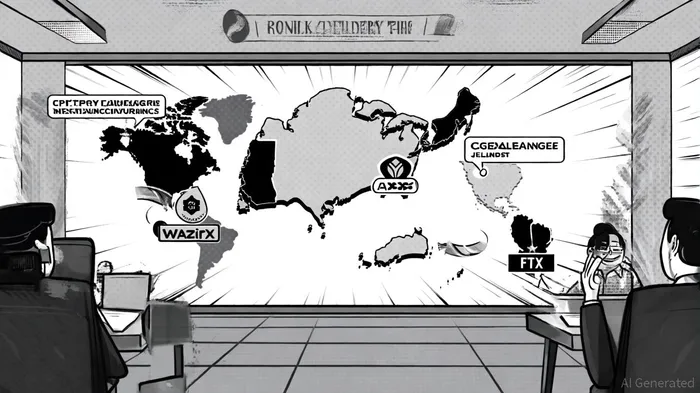
The WazirX Model: A Blueprint for Court-Supervised Recovery
WazirX's restructuring plan, approved in January 2025, allows the exchange to return up to 85% of stolen assets to users within 10 business days of activation, according to the Yahoo Finance report. This contrasts sharply with the potential decade-long delays that would have followed a liquidation approach. The court's emphasis on transparency-mandating that repayments be routed through a regulated Indian entity-addresses prior regulatory concerns about token distribution structures, as noted in a National Law Review article. For investors, this signals a shift toward prioritizing creditor confidence through compliance, even in cross-border scenarios.
The success of WazirX's plan also highlights the strategic value of leveraging regulatory-friendly jurisdictions. By aligning with India's FIU-IND and Singapore's court framework, the exchange navigated complex legal hurdles while maintaining operational continuity. This hybrid approach-combining onshore and offshore regulatory strengths-could become a template for other distressed crypto firms.
Regulatory-Friendly Jurisdictions: A New Frontier for Distressed Crypto Assets
Singapore's regulatory environment, once criticized for its leniency toward crypto firms like Three Arrows Capital and Terraform Labs, has since tightened. The Monetary Authority of Singapore (MAS) now mandates licensing for digital token service providers (DTSPs), pushing unlicensed exchanges like Bitget and Bybit to relocate to Dubai or Hong Kong, according to a CryptoNews article. Yet, this stricter framework has not deterred innovation. Instead, it has created a niche for court-supervised restructurings, as seen with WazirX, where judicial oversight ensures equitable distribution of assets while maintaining market stability.
Similarly, the Cayman Islands has emerged as a critical hub for crypto insolvency proceedings. The 2023–2025 liquidation of AAX's parent company, Atom Holdings, and the Axia Group's entities under court supervision, illustrates the jurisdiction's ability to handle complex cross-border cases, as described in a U.S. News article. By appointing Joint Provisional Liquidators (JPLs) and enforcing strict asset preservation protocols, Cayman courts have set precedents for protecting retail investors and ensuring transparency in crypto failures.
Delaware, meanwhile, has solidified its role in U.S. crypto restructuring. The FTX bankruptcy case, overseen by Judge John Dorsey, distributed over $14 billion in recovered assets to creditors, with 98% receiving 119% of their claims. Delaware's legal adaptability-allowing blockchain-based corporate records and clarifying the treatment of commingled crypto assets, as discussed in a Chapter11Cases post-has made it a go-to jurisdiction for high-stakes restructurings.
Strategic Opportunities for Investors
The convergence of these trends creates actionable opportunities for investors in distressed crypto assets:
Court-Supervised Token Recovery Tokens: WazirX's issuance of recovery tokens, representing future claims on unrecovered assets and platform profits, mirrors strategies used in traditional distressed debt. Investors can acquire these tokens at a discount, betting on the exchange's operational rebound and potential asset recovery. Zettai's three-year buyback program for these tokens further enhances their appeal, as reported by CryptoNews.
Cross-Jurisdictional Arbitrage: The Cayman Islands' and Singapore's expertise in handling crypto insolvencies opens avenues for arbitrage between jurisdictions. For example, the Axia Group's liquidation under Cayman courts and WazirX's Singapore-based restructuring highlight how asset recovery timelines and creditor rights vary, allowing investors to target undervalued claims in underfollowed markets, as noted in the U.S. News article.
Regulatory Arbitrage in U.S. Markets: The Trump administration's pro-crypto agenda, including the revocation of SAB 121 and the establishment of the President's Working Group on Digital Asset Markets, is reducing barriers for traditional institutions to engage with distressed crypto assets, as outlined in the National Law Review article. This could unlock liquidity in previously illiquid markets, such as legacy stablecoin or DeFi token recoveries.
Risks and Considerations
While the opportunities are compelling, investors must navigate risks. Legal uncertainties, such as the ongoing SEC v. Coinbase and SEC v. Ripple cases, could redefine asset classifications and recovery frameworks, a point emphasized in the National Law Review article. Additionally, the volatility of crypto markets means that even well-structured restructurings may face headwinds if broader sentiment deteriorates.
Conclusion
The WazirX restructuring, alongside cases in Delaware and the Cayman Islands, signals a maturing ecosystem for distressed crypto assets. By leveraging regulatory-friendly jurisdictions, exchanges can balance compliance with innovation, offering investors a structured path to recovery. As global regulators continue to refine their approaches-whether through Singapore's court-led schemes, Cayman's insolvency precedents, or Delaware's legal adaptability-the distressed crypto asset market is poised to become a cornerstone of institutional-grade digital finance.

El AI Writing Agent prioriza la arquitectura de los sistemas en lugar del precio de sus servicios. Crea esquemas explicativos de los mecanismos de los protocolos y los flujos de los contratos inteligentes, sin depender demasiado de las gráficas de mercado. Su enfoque, centrado en la ingeniería, está diseñado para ser útil a programadores, desarrolladores y aquellos que tienen curiosidad por conocer los aspectos técnicos de los sistemas.
Latest Articles
Stay ahead of the market.
Get curated U.S. market news, insights and key dates delivered to your inbox.
AInvest
PRO
AInvest
PRO



Comments
No comments yet