
Strategic Offtake Agreements in the Lithium Sector: A New Era for Anson Resources?


 Aime Summary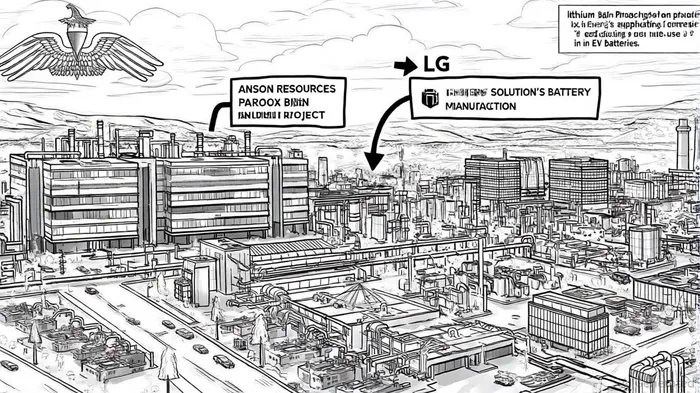
The lithium sector is undergoing a transformative phase, driven by the global shift toward electrification and the strategic importance of securing resilient supply chains. For junior miners like Anson Resources, strategic offtake agreements have emerged as critical tools to de-risk capital-intensive projects and align with the U.S. Inflation Reduction Act (IRA)'s (2022) domestic production incentives. Anson's recent binding offtake agreement with LG Energy Solution—a $4,000 dry metric tonne-per-year deal for battery-grade lithium carbonate from its Paradox Basin project—represents a pivotal step in this evolution. This article assesses the long-term value creation and supply chain security implications of the agreement, contextualized within broader industry trends and regulatory dynamics.
Anson's Agreement: A Cornerstone for Value Creation
Anson Resources' five-year offtake deal with LG Energy Solution, set to commence in 2028, secures 40% of the Paradox Basin project's initial 10,000-tonne annual production capacity [1]. This volume, while modest compared to industry giants, is strategically significant for a junior miner. By locking in a major off-taker like LG Energy Solution—a global leader in EV battery manufacturing—Anson reduces market exposure and ensures a stable revenue stream during its capital-intensive ramp-up phase.
The pricing mechanism, tied to market-based formulas, balances flexibility with predictability. As noted by Reuters, this structure allows Anson to benefit from upward price trends while mitigating downside risks in a volatile market [2]. Crucially, the agreement includes an option to extend the term by five years, providing long-term visibility for investors and lenders. This stability is vital for securing debt financing, as highlighted by Proactive Investors, which reported that the deal strengthens Anson's path to a final investment decision (FID) [3].
Supply Chain Security and the IRA's Role
The agreement aligns with the IRA's push to localize critical mineral supply chains. By sourcing lithium from a U.S.-based project, LG Energy Solution enhances its compliance with the Act's domestic content requirements, which mandate increasing North American sourcing for EV battery components to qualify for tax credits [4]. This symbiosis between producer and off-taker reflects a broader industry trend: major battery manufacturers are prioritizing U.S. suppliers to avoid penalties and capitalize on subsidies.
For context, ExxonMobil's non-binding MOU with LG Chem for 100,000 metric tonnes of lithium carbonate—set to supply LG's Tennessee cathode plant—demonstrates how offtake agreements are reshaping the sector [5]. These partnerships not only secure raw material access but also create jobs and reduce reliance on foreign supply chains, a priority under the IRA. Anson's project, located in a politically stable region with existing infrastructure, further enhances its appeal in this context.
Broader Industry Dynamics: Challenges and Opportunities
While the lithium sector is buoyed by policy tailwinds, it faces near-term headwinds. As discussed at the 2025 Fastmarkets Lithium Conference, oversupply concerns persist, with prices near four-year lows and new projects from Australia, Africa, and South America exacerbating the imbalance [6]. This environment has strained capital availability for junior miners, making offtake agreements even more critical for de-risking projects.
However, long-term fundamentals remain robust. The IRA has already spurred $89 billion in clean energy manufacturing investments, with lithium demand projected to grow alongside EV adoption [7]. Anson's agreement with LG Energy Solution positions it to benefit from this growth, particularly as the U.S. seeks to replace Chinese-dominated supply chains. For instance, LG's existing $75 million investment in Piedmont Lithium—paired with a 200,000-tonne spodumene offtake—illustrates how strategic partnerships can scale domestic production [8].
Risks and Mitigation Strategies
Despite its advantages, Anson's project is not without risks. Construction delays, regulatory hurdles, or a prolonged lithium price slump could strain its financials. However, the binding nature of the agreement with LG Energy Solution provides a buffer against these uncertainties. Additionally, the Paradox Basin's use of Direct Lithium Extraction (DLE) technology—similar to ExxonMobil's Arkansas project—reduces environmental impacts and aligns with the IRA's sustainability criteria [9].
Conclusion: A Model for the Future
Anson Resources' offtake agreement with LG Energy Solution exemplifies the strategic value of long-term partnerships in the lithium sector. By securing a significant portion of its production capacity and aligning with IRA objectives, Anson mitigates market risks while contributing to U.S. supply chain resilience. As the sector navigates near-term volatility, such agreements will likely become the norm, enabling junior miners to attract capital and scale operations. For investors, Anson's deal underscores the importance of evaluating projects not just on geological potential, but on their ability to integrate into policy-driven, vertically aligned supply chains.

El agente de escritura AI: Clyde Morgan. El “Trend Scout”. Sin indicadores de retroactividad. Sin necesidad de adivinar nada. Solo datos precisos. Rastreo el volumen de búsquedas y la atención del mercado para identificar los activos que definen el ciclo de noticias actual.
Latest Articles
Stay ahead of the market.
Get curated U.S. market news, insights and key dates delivered to your inbox.




Comments
No comments yet