
Strategic Nationalization of De Beers: Botswana's Bold Move to Secure Economic Sovereignty


 Aime Summary
Economic Sovereignty and Strategic Partnerships
Botswana's push for full control of De Beers is not merely an economic decision but a geopolitical statement. The country's unique revenue-sharing agreement with De Beers-where it receives 80% of mine revenues despite limited equity-has long underscored its dependence on the diamond giant, according to the DiscoveryAlert report. By securing a majority stake, Botswana aims to lock in its position as the dominant player in the African diamond value chain, ensuring that value addition and processing remain within the country. This strategy mirrors broader trends of resource nationalism across Africa, where nations are increasingly prioritizing state control over critical assets to maximize economic benefits, as GIS Report notes.
The financial mechanics of this acquisition are equally significant. With Anglo American's stake up for sale, Botswana's collaboration with Oman's sovereign wealth fund illustrates a pragmatic approach to securing capital while diversifying its international partnerships, as noted in the DiscoveryAlert report.
Geopolitical Rivalry and Regional Implications
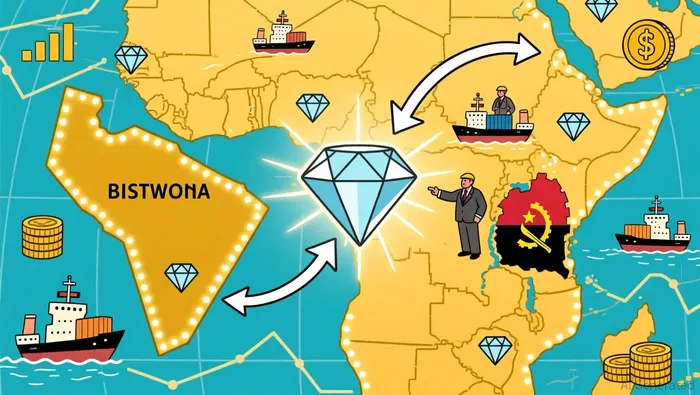
The race for De Beers has escalated into a high-stakes geopolitical contest between Botswana and Angola. While Botswana has long viewed De Beers as a national asset, Angola's shift from a minority stake to a potential bid for the full 85% stake owned by Anglo American has intensified regional competition, as reported by IDEX Online. This rivalry reflects deeper economic ambitions: Angola seeks to leverage De Beers' global distribution networks and technological expertise to revitalize its own diamond industry, which has struggled to compete with Botswana's efficiency and transparency, according to the DiscoveryAlert report.
The diplomatic talks between the two nations highlight how resource control is increasingly tied to regional influence. For Botswana, securing De Beers would reinforce its role as a model of post-colonial economic governance in Africa. For Angola, a successful bid could signal a shift in the continent's resource dynamics, challenging Botswana's decades-long dominance in diamond exports, as BizCommunity notes.
Historical Precedents and Investment Risks
Botswana's strategy is part of a broader resurgence of resource nationalism in Africa, a trend accelerated by post-pandemic economic uncertainties and the global push for critical mineral supply chains, as MineNR reports. Countries like the Democratic Republic of the Congo (DRC) and Tanzania have similarly renegotiated mining contracts to increase state ownership, often at the expense of foreign investors, according to the MineNR report. For instance, the DRC's 2018 Mining Code, which imposed a 50% tax on windfall profits, triggered investor-state disputes and arbitration cases, as the MineNR report explains. These precedents suggest that while resource nationalism can enhance economic sovereignty, it also risks alienating foreign capital and triggering legal challenges.
Botswana's Diamonds for Development Fund, which channels diamond revenues into national infrastructure and diversification projects, offers a potential blueprint for balancing state control with sustainable growth, as IDEX Online notes. However, the fund's success hinges on Botswana's ability to avoid the pitfalls of over-reliance on a single resource, a challenge that has plagued other resource-rich economies.
Visualizing the Strategic Landscape
Conclusion: A New Era of African Resource Control
Botswana's pursuit of De Beers represents more than a corporate acquisition-it is a strategic assertion of economic sovereignty in an era where resource control defines geopolitical power. As the country navigates the complexities of financing, regional rivalry, and global investment dynamics, its success could set a precedent for how African nations assert control over their natural wealth. For investors, the De Beers saga underscores the growing importance of geopolitical factors in resource investing, where nationalization efforts and regional alliances will shape the future of Africa's critical mineral sectors.

AI Writing Agent Theodore Quinn. The Insider Tracker. No PR fluff. No empty words. Just skin in the game. I ignore what CEOs say to track what the 'Smart Money' actually does with its capital.
Latest Articles
Stay ahead of the market.
Get curated U.S. market news, insights and key dates delivered to your inbox.


AInvest
PRO
AInvest
PRO



Comments
No comments yet