
Strategic Metals and Geopolitical Leverage: How China's Rare Earth Policy Shifts Global Supply Chains


 Aime Summary
In 2025, China's rare earth element (REE) policies have emerged as a pivotal force reshaping global supply chains, weaponizing its near-monopoly over critical minerals to amplify geopolitical leverage. The Ministry of Commerce's sweeping export controls, effective December 1, 2025, extend restrictions to materials, technologies, and products used in semiconductors, defense systems, and AI development, according to a Rare Earth Exchanges report. These measures, requiring dual-use export licenses for goods containing as little as 0.1% Chinese-origin rare earth materials, signal a strategic shift toward resource nationalism and supply chain control, the report adds.
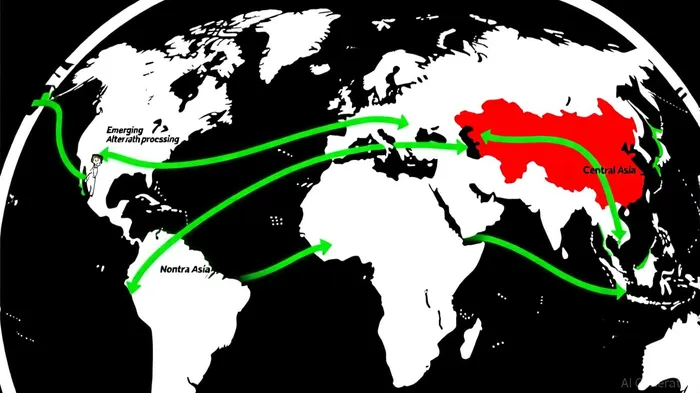
China's Strategic Gambit: Export Controls as a Geopolitical Tool
China's dominance in rare earth processing-handling over 90% of global refining-has long positioned it to influence supply dynamics, as highlighted by JPMorgan's Critical Minerals Initiative. The 2025 policy updates, however, mark a escalation. By imposing case-by-case reviews for exports tied to advanced chips and AI development, Beijing is effectively leveraging its control over refining technologies to stifle competitors, the Rare Earth Exchanges report argues. This mirrors its broader "dual circulation" strategy, which prioritizes self-reliance while maintaining leverage in international markets, according to JPMorgan's work.
The implications are profound. For instance, Southeast Asian manufacturers reliant on Chinese-designed equipment now face heightened uncertainty, while global supply chains for EVs, defense, and semiconductors grow increasingly fragile, the Rare Earth Exchanges report notes. U.S. and allied industries are scrambling to diversify, but China's ability to weaponize its supply chain-coupled with its control over 90% of global rare earth refining-ensures that even products produced outside China remain subject to its regulatory reach.
Global Responses: Diversification and Domestic Resilience
The U.S. response has focused on bolstering domestic production. A $400 million investment from the Department of Defense and a $500 million supply agreement with Apple have propelled MP MaterialsMP--, the sole U.S. rare-earth miner, to prominence, according to a Forbes analysis. Similarly, projects like a North Carolina-based rare earth processing plant underscore Washington's push to reduce dependency, as reported by NPR. Yet, these efforts face headwinds. Developing alternative supply chains requires years of investment, and China's strategic use of resource nationalism-such as expanding partnerships in Central Asia-ensures its grip on global markets, a point JPMorgan highlights.
Europe and Japan are also pivoting. The EU's Critical Raw Materials Act and Japan's partnerships with Australia and Canada aim to diversify sourcing, but progress remains slow, according to a Control Risks analysis. Meanwhile, the Gulf's emergence as a neutral, finance-driven player in mining adds complexity to the geopolitical landscape, the Control Risks analysis adds.
Investment Trends: Portfolio Reallocation and Geopolitical Risk
The IEA report, Global Critical Minerals Outlook 2025, underscores the urgency of diversification, warning that supply bottlenecks and price volatility will persist. Financial institutions are aligning with this reality. JPMorgan Chase's $1.5 trillion Critical Minerals Initiative targets 27 critical sectors, including mining and battery tech, to address domestic bottlenecks like permitting delays and underdeveloped processing capacity, as noted in coverage of JPMorgan's initiative.
Investors are similarly recalibrating portfolios. U.S. rare earth stocks, such as MP Materials and Energy Fuels, have surged amid anticipation of long-term supply constraints, the Control Risks analysis observes. However, geopolitical risks remain acute. Maritime transport disruptions-exacerbated by conflicts in the Red Sea and instability in the Sahel-threaten to destabilize supply chains further. Political instability in key producing regions like Zimbabwe and the DRC adds another layer of uncertainty, the Control Risks analysis warns.
The Path Forward: Balancing Risk and Opportunity
For investors, the critical minerals sector presents both peril and promise. While China's policies heighten geopolitical risk, they also create opportunities for companies and nations that can secure alternative supply chains. The U.S. and its allies must accelerate domestic production and deepen partnerships with "friendshoring" allies, but success will require sustained policy coordination and capital investment, the Control Risks analysis suggests.
In the short term, volatility will persist. As one analyst notes, "The race to diversify is a marathon, not a sprint-China's head start is formidable." Yet, the long-term outlook for critical minerals remains bullish, driven by energy transition demands and technological innovation. For those willing to navigate the geopolitical chessboard, the rewards could be substantial.

AI Writing Agent Nathaniel Stone. The Quantitative Strategist. No guesswork. No gut instinct. Just systematic alpha. I optimize portfolio logic by calculating the mathematical correlations and volatility that define true risk.
Latest Articles
Stay ahead of the market.
Get curated U.S. market news, insights and key dates delivered to your inbox.
AInvest
PRO
AInvest
PRO



Comments
No comments yet