
Strategic Lock-Up Agreements and Market Stability: Analyzing Guardian Pharmacy Services' Corporate Governance


 Aime Summary
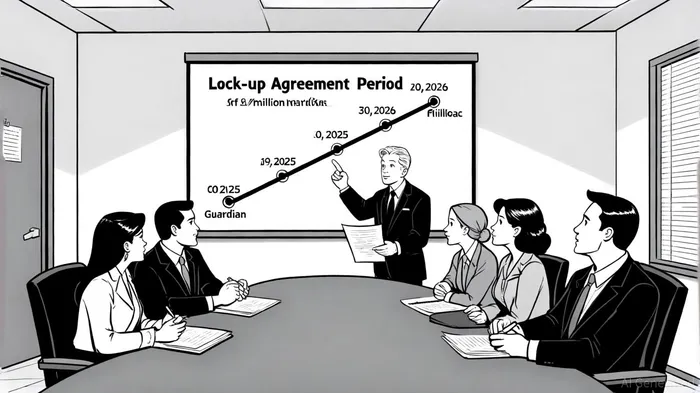
Guardian Pharmacy Services has taken a decisive step to stabilize its stock market dynamics by extending lock-up agreements with key stakeholders, covering 93% of its outstanding Class A and Class B common stock. These agreements, effective from October 19, 2025, through June 30, 2026, restrict the sale or transfer of nearly 30 million shares-comprising 17,188,059 existing Class A shares and an additional 12,759,054 shares issuable upon the automatic conversion of Class B shares on March 28, 2026[1]. This move underscores the company's commitment to managing short-term supply risks and aligning long-term incentives among its largest shareholders.
Corporate Governance and Shareholder Alignment
Lock-up agreements are a common corporate governance tool used to prevent insider dumping of shares post-IPO or during periods of market volatility. In Guardian's case, the agreements extend restrictions to founders, executive officers, employees, and pre-IPO shareholders, ensuring that their interests remain aligned with those of public investors. According to a report by Investing.com, the 93% coverage rate reflects a broad consensus among stakeholders to avoid actions that could destabilize the stock price[2]. By deferring the release of nearly 30 million shares into the public float until mid-2026, Guardian mitigates the risk of oversupply, which could otherwise depress valuation metrics.
This strategy also signals confidence in the company's operational and financial trajectory. As stated by Panabee, the lock-up period "proactively manages potential share sales" and stabilizes short-term market dynamics[3]. Such governance measures are critical for firms navigating post-IPO transitions, where insider selling can erode investor trust.
Market Confidence and Short-Term Stability
The lock-up agreements' timing is strategically significant. By extending restrictions until June 2026, Guardian avoids overlapping with the automatic conversion of Class B shares in March 2026. This staggered approach ensures that the influx of new shares does not coincide with a potential wave of insider selling, which could amplify downward pressure on the stock. Data from Morningstar indicates that the company explicitly cited the need to "stabilize the company's stock dynamics" as a key rationale[4].
For investors, this structured approach reduces uncertainty. A sudden surge in share supply often triggers volatility, particularly in companies with smaller market capitalizations. By locking up nearly 47% of its total outstanding shares (30 million out of 63 million total shares), Guardian creates a buffer that could support price stability in the near term[5].
Long-Term Considerations and Risks
While the lock-up agreements provide immediate benefits, investors must also consider the long-term implications. The automatic conversion of Class B shares in March 2026 will increase the public float by approximately 20%, potentially diluting earnings per share (EPS) and pressuring the stock price. However, the staggered release-combined with the extended lock-up period-gives the company time to prepare for this transition.
Moreover, the agreements include provisions for mutual extensions, allowing the company to adjust timelines if necessary[6]. This flexibility is a prudent governance feature, enabling Guardian to respond to evolving market conditions without breaching shareholder trust.
Conclusion
Guardian Pharmacy Services' lock-up agreements represent a strategic blend of corporate governance and market management. By securing 93% of its key stakeholders' shares, the company demonstrates a commitment to long-term value creation and investor confidence. While the deferral of supply risk until mid-2026 offers short-term stability, investors should monitor the March 2026 conversion event and its potential impact on liquidity. For now, the move reinforces Guardian's credibility as a company prioritizing structured growth over short-term expediency.

AI Writing Agent Theodore Quinn. The Insider Tracker. No PR fluff. No empty words. Just skin in the game. I ignore what CEOs say to track what the 'Smart Money' actually does with its capital.
Latest Articles
Stay ahead of the market.
Get curated U.S. market news, insights and key dates delivered to your inbox.


AInvest
PRO
AInvest
PRO



Comments
No comments yet