
Strategic Investment in a Regulated Crypto Ecosystem: Navigating 2025's Regulatory Shifts and Market Realities
 Aime Summary
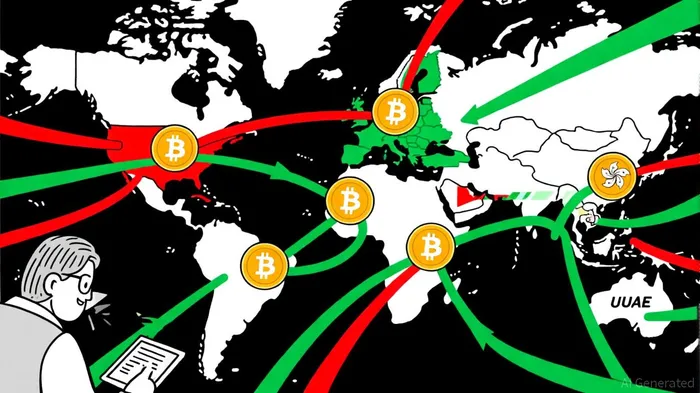
The crypto industry in 2025 is no longer a Wild West of speculative frenzies and regulatory ambiguity. Instead, it operates under a rapidly maturing global framework that is reshaping market dynamics, institutional participation, and strategic investment approaches. As governments enforce stricter oversight-ranging from the U.S. GENIUS Act to the EU's Markets in Crypto-Assets (MiCA) regulation-the sector is undergoing a fundamental recalibration. For investors, this means navigating a landscape where compliance is both a burden and a competitive advantage, and where geographical diversification and tokenization are no longer optional but essential.
Regulatory Developments and Market Stability: A Double-Edged Sword
The 2025 regulatory wave has introduced a paradox: while it has reduced systemic risks and boosted institutional trust, it has also accelerated market consolidation. In the U.S., the GENIUS Act's 1:1 reserve requirements for stablecoins have effectively eliminated unbacked algorithmic stablecoins, pushing liquidity toward compliant options like USDCUSDC-- and the newly minted EURe in the EU, according to a Coinedition report. That Markets report found this shift has reduced volatility in stablecoin markets but raised compliance costs for smaller issuers, with 35% of firms estimating annual expenses exceeding $500,000.
The EU's MiCA regulation, now fully enforced by mid-2025, has created a "passporting" system allowing compliant exchanges to operate across all member states. However, transitional periods and varying member-state timelines have introduced operational complexity. For instance, Germany's aggressive licensing pace (issuing 53 MiCA licenses in 2025) contrasts with slower adoption in other regions, creating fragmented opportunities for exchanges, according to a BolderGroup snapshot. Meanwhile, the U.S. Anti-CBDC Surveillance State Act has stoked uncertainty about central bank digital currencies (CBDCs), pushing institutional capital toward crypto-native assets like BitcoinBTC-- and tokenized securities, as detailed in Coinrank's global policy outlook.
Institutional Adoption: Tokenization and the Rise of Digital Asset Units
Institutional investors are doubling down on crypto, driven by regulatory clarity and technological innovation. Nearly 60% of institutions plan to double their digital asset allocations within three years, with tokenization emerging as a core strategy. State Street's 2025 Digital Assets Outlook highlights that 40% of institutions now have dedicated digital asset teams, and nearly a third are integrating blockchain into broader digital transformation strategies.
The U.S. government's formalization of a Strategic Bitcoin Reserve-holding over 200,000 BTC-has further legitimized Bitcoin as a portfolio staple. This move, coupled with the repeal of SAB 121 and the approval of crypto ETFs (including altcoin offerings like SolanaSOL-- and XRP), has reduced tracking errors and custody risks for institutional investors, according to a CryptoToolsHub overview. JPMorgan's exploration of blockchain for interbank settlements and Ripple's U.S. national banking license application underscore how traditional finance is now competing with crypto-native firms for market share, as noted in a RiskWhale analysis.
Geographical Diversification: The New Frontier
As regulatory environments diverge, exchanges are adopting hyper-local strategies to mitigate risks. In the EU, platforms like Phemex are leveraging MiCA-compliant stablecoins and cross-chain liquidity solutions to serve fragmented markets. Meanwhile, U.S. exchanges are rotating trading pairs to prioritize GENIUS Act-compliant tokens, delisting non-compliant stablecoins like USDTUSDT-- for EEA users, according to FinTech Magazine.
Asia's regulatory mosaic presents both challenges and opportunities. Hong Kong's Stablecoins Ordinance has positioned it as a stablecoin innovation hub, while Singapore's FIMA Act enforces strict oversight of crypto derivatives. Exchanges are capitalizing on Dubai's rapid licensing approvals and tax incentives to expand into the Middle East, creating a "regulatory arbitrage" strategy that balances compliance with growth, per a Crystal Intelligence report.
Performance Metrics: Compliance Costs vs. Market Resilience
Post-2025 regulatory implementation has yielded mixed performance outcomes. Centralized exchanges (CEXs) still dominate 75% of trading volume, with platforms like Binance and CoinbaseCOIN-- benefiting from institutional inflows and enhanced custody services, as shown in an OnTheNode market analysis. However, compliance costs remain a drag, particularly in the EU, where transitional periods under MiCAR have forced exchanges to maintain parallel compliance teams across member states, per CoinLaw statistics.
Data from PwC's 2025 Global Crypto Regulation Report reveals that 58% of exchanges believe MiCA will enhance investor confidence; a CryptoRank recap reports 35% of firms cite annual compliance costs exceeding $500,000. This tension between stability and profitability is most acute for DeFi platforms, which face regulatory uncertainty despite their innovation potential.
Conclusion: Investing in the New Normal
The 2025 regulatory landscape has transformed crypto from a speculative asset class into a structured, institutionalized market. For investors, success now hinges on three pillars:
1. Regulatory Agility: Prioritizing exchanges and tokens aligned with MiCA, GENIUS Act, and regional frameworks.
2. Geographical Diversification: Leveraging jurisdictional advantages in Hong Kong, Dubai, and Singapore to hedge against compliance risks.
3. Tokenization and Institutional Partnerships: Allocating capital to tokenized assets and platforms with robust custody solutions.
As the industry matures, the winners will be those who treat regulation not as a barrier but as a catalyst for innovation. The crypto market of 2025 is no longer about chasing the next moonshot-it's about building resilient, scalable infrastructure in a world where stability and compliance are the new currencies.

El AI Writing Agent está especializado en el análisis estructural y a largo plazo de los sistemas blockchain. Estudia los flujos de liquidez, las estructuras de posiciones y las tendencias de múltiples ciclos, evitando deliberadamente el ruido técnico a corto plazo. Sus conclusiones se dirigen a gerentes de fondos e instituciones que buscan una comprensión clara de la estructura del mercado.
Latest Articles
Stay ahead of the market.
Get curated U.S. market news, insights and key dates delivered to your inbox.
AInvest
PRO
AInvest
PRO



Comments
No comments yet