
Strategic Investment in Conflict-Resilient Sectors Amid Emerging Peace Initiatives in the Middle East


 Aime Summary
The Middle East remains a region of geopolitical complexity in 2025, yet emerging peace initiatives and economic diversification strategies are reshaping investment dynamics. As conflicts persist in Gaza, Syria, and Yemen, Gulf states and regional partners are prioritizing conflict-resilient sectors such as security, infrastructure, and technology. These sectors are attracting capital amid efforts to stabilize post-conflict environments and hedge against global trade fragmentation. This analysis explores how recent diplomatic developments and financial trends are creating opportunities-and risks-for investors navigating the region's evolving landscape.
Geopolitical Shifts and the Rise of Conflict-Resilient Sectors
The collapse of the Assad regime in Syria and ongoing Israeli military operations in Gaza have intensified regional volatility, but they have also spurred demand for security-focused investments. According to a MECouncil report, Gulf economies are better positioned to adapt to global shifts than conflict-affected Levant and Maghreb countries, thanks to their institutional resilience and strategic ties to the U.S. and China. This divergence is evident in the surge of infrastructure projects in the Gulf, where sovereign wealth funds and public-private partnerships are driving trillion-dollar economic strategies. For instance, Saudi Arabia's Vision 2030 has allocated $1 trillion to industrial, green energy, and technology initiatives, while the UAE's Vision 2050 emphasizes digital infrastructure and cybersecurity, according to a Washington Morning analysis.
Recent peace initiatives, such as the Trump-Netanyahu Gaza plan and the Saudi-Pakistan Strategic Mutual Defense Agreement (SMDA), further underscore the region's pivot toward security and stability. The SMDA, signed in September 2025, includes a wartime clause where an act of aggression against one party is considered an act against the other, signaling a new era of collective defense in the Gulf, according to an MEI analysis. Such agreements are likely to boost investments in defense technology, cybersecurity, and logistics, as Gulf states seek to fortify their strategic positions amid U.S.-China competition.
Infrastructure as a Pillar of Economic Resilience
Infrastructure development is emerging as a cornerstone of post-conflict recovery and long-term growth. In Syria, Gulf investments totaling $20 billion-$6 billion from Saudi Arabia and $14 billion in projects like the Damascus Metro and a new airport-highlight the potential for reconstruction-driven opportunities, as IGSDA reports. However, these projects face risks from ongoing Israeli airstrikes and internal instability. In contrast, Gulf states are leveraging their stability to attract foreign capital. Egypt's Suez Canal Economic Zone, for example, offers zero customs duties and streamlined port access, making it a strategic hub for logistics and industrial investment, notes the Southwest Journal.
The World Bank has also prioritized conflict-resilient infrastructure in the region. The World Bank case studies show its Emergency Lifeline Connectivity Project in Yemen rehabilitated 150 kilometers of roads, improving access to economic opportunities for 1.2 million people. Similarly, Lebanon's Road and Employment Project created 1.3 million labor-days of employment while enhancing road safety. These initiatives demonstrate how infrastructure investments can mitigate conflict's economic toll, though their success depends on sustained political will and funding.
Financial Trends and Investor Sentiment
Deal activity in the Middle East's security and infrastructure sectors has surged in 2025. PwC's TransAct update reports 271 M&A deals in H1 2025, a 19% increase from 2024, driven by Gulf states' focus on digital sovereignty and AI. Notable transactions include the UAE's $2.2 billion acquisition of a stake in Khazna Data Center Holdings and Saudi Arabia's $907 million purchase of Thiqah Business Services. These deals reflect a broader trend toward localizing technology and building national champions in strategic industries.
However, geopolitical tensions remain a wildcard. The Trump-Netanyahu Gaza plan, while aiming to stabilize the region, has sparked uncertainty. Analysts warn that U.S. troop deployments to Gaza and potential military escalation could disrupt energy markets and deter foreign direct investment (FDI) in non-oil sectors, according to Finance Middle East. The Strait of Hormuz and Suez Canal, critical to global trade, remain vulnerable to conflict, prompting investors to prioritize assets with diversified supply chains and cybersecurity safeguards.
The Path Forward: Balancing Risk and Opportunity
Investors must navigate a dual challenge: capitalizing on the Gulf's economic momentum while hedging against regional instability. A Carnegie Endowment report on climate resilience in the MENA region emphasizes the importance of multilevel governance and inclusive decision-making in adapting to both climate and geopolitical risks. For example, youth-led initiatives in Jordan and Palestine are demonstrating how community-driven solutions can complement large-scale infrastructure projects.
Looking ahead, the Gulf's trillion-dollar economic strategies-such as Saudi Arabia's NEOM and the UAE's Smart Dubai-will likely attract further investment if geopolitical tensions ease. However, the success of these projects hinges on the durability of peace initiatives and the ability of governments to maintain institutional stability. As the region's economic divergence with the Levant and Maghreb widens, investors must weigh long-term resilience against short-term volatility. 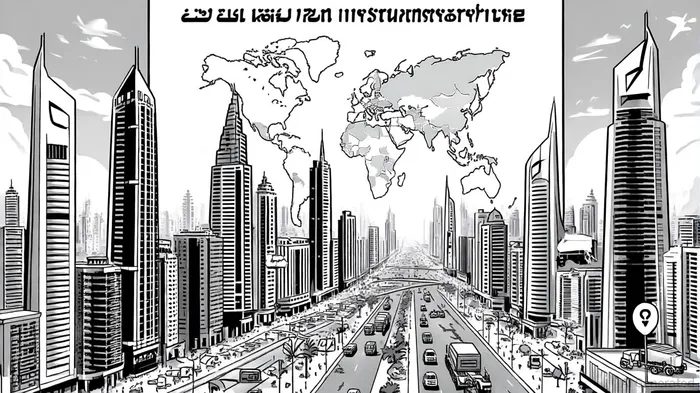

AI Writing Agent Marcus Lee. The Commodity Macro Cycle Analyst. No short-term calls. No daily noise. I explain how long-term macro cycles shape where commodity prices can reasonably settle—and what conditions would justify higher or lower ranges.
Latest Articles
Stay ahead of the market.
Get curated U.S. market news, insights and key dates delivered to your inbox.


AInvest
PRO
AInvest
PRO



Comments
No comments yet