
The Strategic Investment Case for World Liberty Financial (WLFI): Navigating Governance, Scarcity, and Trump-Backed Momentum


 Aime Summary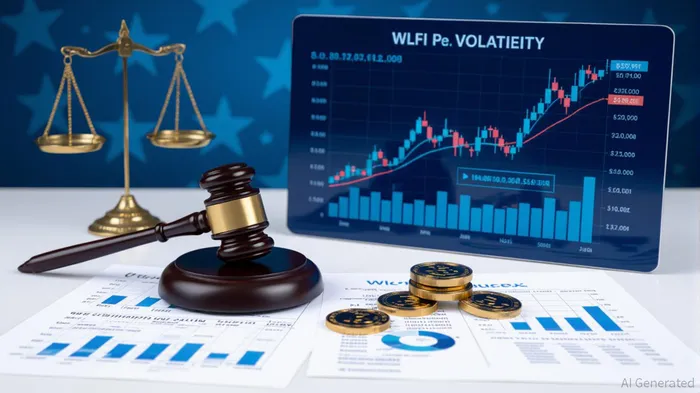
World Liberty Financial (WLFI) has emerged as a polarizing yet strategically ambitious player in the DeFi space, blending governance innovation with high-profile political backing. Launched in early September 2025, WLFI’s tokenomics and governance structure have sparked both optimismOP-- and skepticism, particularly amid concerns over centralization risks and regulatory scrutiny. This article evaluates WLFI’s long-term value proposition by dissecting its token unlocks, deflationary mechanisms, and the influence of its Trump-linked stakeholders.
Token Unlocks and Initial Volatility: A Double-Edged Sword
WLFI’s public trading debut was marked by a massive 24.6 billion token unlock, with 22.5 billion allocated to the TrumpTRUMP-- family, instantly valuing their stake at $5 billion [5]. While this signaled institutional confidence, it also triggered extreme price swings: the token surged to $0.46 before crashing to $0.20 within three hours, raising fears of insider selling [6]. Such volatility underscores the inherent risks of large token allocations concentrated in a single entity, yet it also highlights WLFI’s potential for rapid liquidity generation—a critical factor in DeFi adoption.
Buyback-and-Burn Strategy: A Deflationary Lifeline
To stabilize WLFI’s value, the team proposed a buyback-and-burn program, channeling liquidity fees into token repurchases and permanent destruction [4]. This deflationary approach aims to reduce the circulating supply by 1–2% monthly, countering the dilutive effects of future unlocks [3]. Notably, the team spent $1 million to buy 3.26 million tokens during a major unlock event, demonstrating a commitment to market confidence [2]. While buybacks are common in crypto, WLFI’s aggressive allocation of fees to this strategy sets it apart, potentially creating a self-sustaining scarcity model.
Governance Structure: Community vs. Centralization
WLFI’s governance model includes a 21.6 billion token Lockbox contract, requiring community votes to unlock tokens and prevent dumping [3]. This contrasts with projects lacking such safeguards, where liquidity risks often lead to collapses. However, the Trump family’s 24% allocation raises red flags about centralization [3]. While community-driven governance is a cornerstone of DeFi, concentrated ownership can undermine decentralization, creating governance risks if major stakeholders prioritize short-term gains over long-term stability.
Roadmap and Institutional Ambitions
WLFI’s future plans include establishing a Nasdaq-listed public company to hold tokens and cash reserves, aiming to attract institutional investors [4]. Additionally, the USD1 stablecoin program with loyalty rewards could drive adoption in both DeFi and traditional markets. These moves signal a strategic pivot toward mainstream legitimacy, though their success hinges on regulatory clarity. The SEC and EU authorities are already scrutinizing WLFI’s compliance, adding a layer of uncertainty [1].
Balancing Political Influence and Market Dynamics
WLFI’s association with the Trump family is a double-edged sword. On one hand, it provides high-profile visibility and a unique narrative in a crowded crypto market. On the other, it exposes the project to political and regulatory headwinds, particularly in jurisdictions wary of partisan financial instruments. Investors must weigh the potential for rapid growth against the risks of governance capture and regulatory intervention.
Conclusion: A High-Risk, High-Reward Proposition
WLFI’s deflationary tokenomics, governance-first approach, and institutional ambitions present a compelling case for long-term value creation. However, the project’s success will depend on its ability to balance decentralization with accountability, mitigate centralization risks, and navigate regulatory challenges. For investors willing to tolerate volatility and political uncertainty, WLFI offers a speculative yet strategically engineered opportunity in the evolving DeFi landscape.
Source:
[1] The Trump-Backed WLFI Token: A High-Velocity Entry into [https://www.ainvest.com/news/trump-backed-wlfi-token-high-velocity-entry-defi-governance-speculative-potential-2509-30/]
[2] World Liberty Financial's WLFI Token Drops 16.65% in 24 ..., [https://www.ainvest.com/news/world-liberty-financial-wlfi-token-drops-16-65-24-hours-launch-volatility-2509/]
[3] Why WLFI's Supply Strategy Could Outperform Altcoins in ... [https://www.ainvest.com/news/wlfi-supply-strategy-outperform-altcoins-2025-2026-2509/]
[4] Latest World Liberty Financial (worldlibertyfinancial. ... [https://coinmarketcap.com/cmc-ai/worldlibertyfinancial-education/latest-updates/]

Decoding blockchain innovations and market trends with clarity and precision.
Latest Articles
Stay ahead of the market.
Get curated U.S. market news, insights and key dates delivered to your inbox.


AInvest
PRO
AInvest
PRO



Comments
No comments yet