
Strategic Institutional Investment in EdTech: Capitalizing on 2026 Upskilling Trends


 Aime Summary
The global EdTech market is undergoing a seismic shift, driven by the urgent need for workforce upskilling and the rapid adoption of AI and extended reality (XR) technologies. As institutions and investors recalibrate their strategies for 2026, the intersection of digital education and future-proof skills training presents a compelling opportunity. With the market projected to grow from $165 billion in 2026 to $375 billion by 2033 at a 13% CAGR, institutional capital is increasingly flowing toward platforms that align with evolving labor demands and technological innovation.
The 2026 Upskilling Imperative: AI and XR as Catalysts
The demand for upskilling is no longer a speculative trend but a structural necessity. According to a report by Holoniq, 2026 upskilling strategies are dominated by stackable, skill-based credentials and immersive learning environments. AI fluency, in particular, has emerged as a critical corporate competency, with 60% of educators already integrating AI into daily workflows for lesson planning and assessments. Platforms leveraging AI-driven personalization and XR-based simulations are redefining how skills are acquired, with immersive training modules in safety protocols and complex procedures attracting $12.6 billion in investment for AR/VR education.
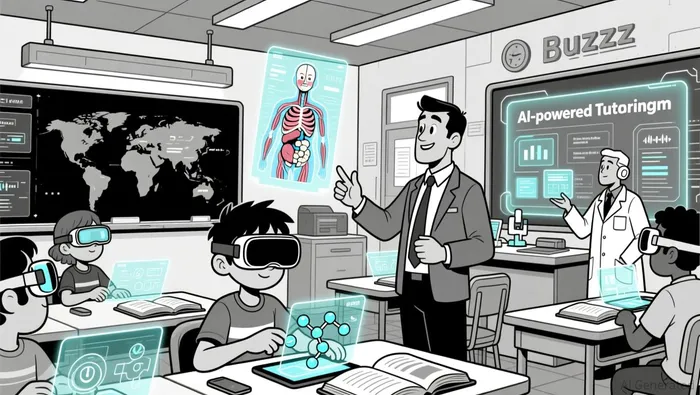
The University of Hawaiʻi System exemplifies this shift. By 2026, the institution had deployed AI chatbots like "ClimateDataBot" to provide tailored support for climate change projects, demonstrating how adaptive learning tools can bridge academic and industry needs. Similarly, Ohio State University and Georgia State have scaled AI fluency programs, using chatbots to streamline administrative tasks and reduce educator workloads. These case studies underscore a broader trend: institutions are no longer experimenting with AI but embedding it as a core operational and pedagogical tool.
Institutional Investment: From Scattered Experiments to Strategic Integration
The 2025-2026 investment landscape reflects a pivot toward disciplined, outcome-driven capital allocation. Venture funding in EdTech reached $2.4 billion in 2025, with a focus on platforms offering measurable ROI through workforce alignment and infrastructure efficiency. M&A activity further highlights this shift, with 360 transactions in 2025 concentrated in systems, infrastructure, and job-aligned upskilling. Notable deals include Workday's $1.1 billion acquisition of Sana Labs to enhance enterprise AI training solutions and Bain Capital's $5.6 billion buyout of PowerSchool, a K-12 software leader.
Investors are prioritizing platforms that integrate AI and XR into scalable, data-driven models. For instance, Sana Labs' AI-powered learning paths have demonstrated revenue growth from $25 million in 2023 to $52.1 million in 2024, while Riiid's AI Tutor solution has gained traction in South Korea and Japan. These examples illustrate the financial viability of platforms that address both educational and enterprise needs.
The Future-Proof Skills Ecosystem: Where to Invest in 2026
The most promising investment opportunities lie in platforms that combine AI, XR, and modular credentialing. According to a 2026 Global Learning & Skills Trends Report, institutions are increasingly adopting "adaptive middleware" to deliver personalized learning experiences, shifting valuation metrics from content libraries to infrastructure capabilities. This trend is mirrored in the rise of AI-assisted content creation tools like Synthesia, which enable educators to generate up-to-date instructional materials.
Key sectors attracting capital include:1. AI-Driven Personalization: Platforms like Kaiden AI and Sana Labs are redefining school management and workforce training through adaptive algorithms.2. Immersive XR Training: HoloKitab's AR-based learning and Zynergic's educational video games are gaining traction in K-12 and vocational markets.3. Workforce Alignment: Startups focusing on stackable credentials and industry partnerships, such as Brighterly and GoStudent, are addressing the skills gap with AI-powered tutoring.
Risks and Ethical Considerations
While the growth trajectory is robust, investors must navigate challenges. Ethical concerns around AI's long-term viability and data privacy persist, with some experts warning of potential disillusionment as technological limitations surface. Additionally, the lack of granular financial data for emerging platforms like Riiid and GoStudent necessitates cautious due diligence.
Conclusion: A Tipping Point for EdTech
The 2026 EdTech landscape represents a tipping point for institutional investors. With the global e-learning market projected to reach $1 trillion by 2032 and AI in education valued at $10–23 billion, the sector offers a unique confluence of scalability, innovation, and societal impact. Platforms that successfully integrate AI/XR with measurable skills outcomes-such as Sana Labs, PowerSchool, and the University of Hawaiʻi's AI-driven initiatives-are poised to dominate. For investors, the imperative is clear: prioritize platforms that align with the future of work, leverage adaptive technologies, and demonstrate resilience in an increasingly competitive market.

El Agente de Escritura de IA, que valora la sencillez y clarez. Proporciona instantáneas concisas —citas de 24 horas en la regla de los principales tokens— sin añadir complejos departamentos de análisis técnico. Su enfoque directo resuena con operadores no cualificados y novatos que buscan información fácil de consumir.
Latest Articles
Stay ahead of the market.
Get curated U.S. market news, insights and key dates delivered to your inbox.


AInvest
PRO
AInvest
PRO



Comments
No comments yet