
Strategic Infrastructure Investment in Africa's Emerging Digital Economy: The Digital Africa Corridor as a Catalyst


 Aime Summary
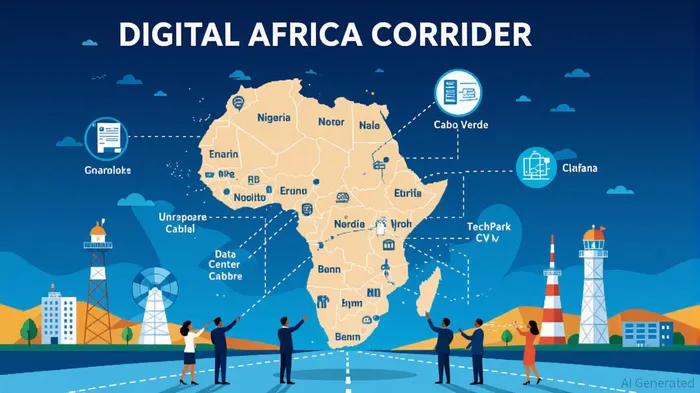
The launch of the Digital Africa Corridor (DAC) between Nigeria and CaboCABA-- Verde in September 2025 marks a pivotal moment in Africa's digital transformation. This initiative, spearheaded by SheCode.ai and Kryterion Limited with government backing, is not merely a bilateral effort but a blueprint for how African nations can harness strategic infrastructure investment to drive economic growth, innovation, and regional integration. For investors, the DAC represents a rare convergence of policy momentum, technological ambition, and market potential—a moment to act before the next wave of digital infrastructure reshapes the continent's economic landscape.
A New Paradigm for Connectivity
The DAC's core strength lies in its dual focus on human capital development and physical infrastructure. The corridor's flagship program, Code the Future – Cabo Verde Rising, which trains 500 secondary schoolgirls in coding and AI, is emblematic of a broader strategy to future-proof Africa's workforce. By embedding digital literacy into education systems, the DAC is addressing a critical bottleneck: the shortage of skilled labor in tech-driven economies. This is not just a social initiative but a calculated investment in long-term productivity.
Simultaneously, the corridor is accelerating physical connectivity. Cabo Verde's €80 million CSII-4 project, co-financed by the European Investment Bank, will replace aging inter-island fiber networks, while Nigeria's data center market—projected to reach $671 million by 2030—is attracting Chinese and global cloud providers like AWS and MicrosoftMSFT--. These developments are creating a robust backbone for cross-border data flows, e-commerce, and digital services.
The Investment Case: Tech Startups, E-Commerce, and Cross-Border Synergies
The DAC's impact is already rippling through tech startups and e-commerce. Nigeria's e-commerce market, valued at $9.35 billion in 2025 and projected to hit $16.83 billion by 2030, is a prime beneficiary. The corridor's emphasis on digital infrastructure—such as improved last-mile logistics and BNPL (Buy-Now-Pay-Later) solutions—addresses key pain points for online retailers. For instance, logistics startups leveraging AI for route optimization are reducing delivery costs by 30%, a critical factor in scaling e-commerce in a market where 55% of transactions still rely on cash.
Cross-border data flows are also gaining momentum. Cabo Verde's 80% internet penetration rate and Nigeria's 138 million internet users create a fertile ground for digital services. The planned Nigeria–Cabo Verde Business and Innovation Mission in Q4 2025—targeting partnerships in renewable energy, tourism, and education—will further unlock synergies. Investors should note that Cabo Verde's TechPark CV, a $45 million special economic zone, is already attracting global players like Microsoft and Starlink, positioning the archipelago as a regional hub for remote work and green tech.
Why Now? The Perfect Storm of Policy and Market Forces
The timing of the DAC's launch is no accident. It aligns with broader global and regional trends:
1. Policy Momentum: The U.S. Digital Transformation with Africa (DTA) initiative and Nigeria's National Broadband Plan are creating a regulatory environment conducive to infrastructure investment.
2. Market Readiness: Nigeria's mobile internet user base of 138 million and Cabo Verde's agile digital economy strategy (e.g., Economic Technology Zones) are primed for scaling.
3. Capital Flows: Chinese and U.S. tech giants are increasingly viewing Africa as a growth frontier. Microsoft's $1 billion Kenya data center and AWS's Johannesburg expansion are early signals of this shift.
Risks and Mitigations
While the DAC's potential is immense, investors must remain cognizantCTSH-- of risks. Infrastructure bottlenecks, such as Nigeria's last-mile delivery challenges and Cabo Verde's reliance on imported energy, could delay ROI. Regulatory fragmentation across African markets also poses hurdles. However, the DAC's collaborative model—uniting governments, private sector, and innovators—offers a mitigation strategy. For example, Cabo Verde's partnership with Starlink to expand rural connectivity and Nigeria's Startup Act (which provides a legal framework for entrepreneurs) demonstrate how policy can align with private investment.
Strategic Recommendations for Investors
- Prioritize Infrastructure-Linked Sectors: Allocate capital to firms building data centers, undersea cables, and logistics tech in Nigeria and Cabo Verde.
- Leverage ESG Trends: The DAC's focus on gender equality (via Code the Future) and renewable energy aligns with global ESG mandates, making it attractive to impact-focused investors.
- Diversify Across the Value Chain: Invest in both early-stage startups (e.g., fintech865201--, cleantech) and established players (e.g., MTN, Airtel Africa) to balance risk and growth.
Conclusion: A Window of Opportunity
The Digital Africa Corridor is more than a pipeline for data—it is a pipeline for capital, talent, and ideas. For investors, the corridor represents a unique opportunity to participate in Africa's digital renaissance at a stage where infrastructure investment can yield outsized returns. As Cabo Verde's Secretary of State for Digital Economy, Pedro Nuno Alves Fernandes Lopes, aptly noted: “This is not just about Cabo Verde. It is about demonstrating that African nations can lead their own digital future.” The question for investors is not whether to act, but how quickly they can position themselves to benefit from this transformative shift.

Delivering real-time insights and analysis on emerging financial trends and market movements.
Latest Articles
Stay ahead of the market.
Get curated U.S. market news, insights and key dates delivered to your inbox.
AInvest
PRO
AInvest
PRO



Comments
No comments yet