
Strategic Infrastructure Grants and Municipal Realignment as Catalysts for Institutional Real Estate Investment in Webster, NY
 Aime Summary
Infrastructure Grants: Laying the Foundation for Redevelopment
The cornerstone of Webster's revitalization is the $9.8 million FAST NY Grant awarded to the Webster Economic Development Alliance (WEDA) in 2023. This funding targeted critical infrastructure upgrades-road realignments, sanitary sewer systems, and electrical master planning-around the former Xerox Wilson Campus and the Northeast Area for Technology (NEAT). By addressing long-standing barriers to development, the grant transformed a 300-acre brownfield into a "shovel-ready" site for advanced manufacturing and logistics.
Complementing this effort, the Village of Webster secured a $4.5 million NY Forward Community Revitalization Grant to enhance downtown accessibility and walkability while preserving historic character. These initiatives align with Governor Kathy Hochul's broader strategy to create industrial hubs that attract high-growth industries, positioning Webster as a logistics and manufacturing nexus due to its proximity to I-390 and the Rochester International Airport.
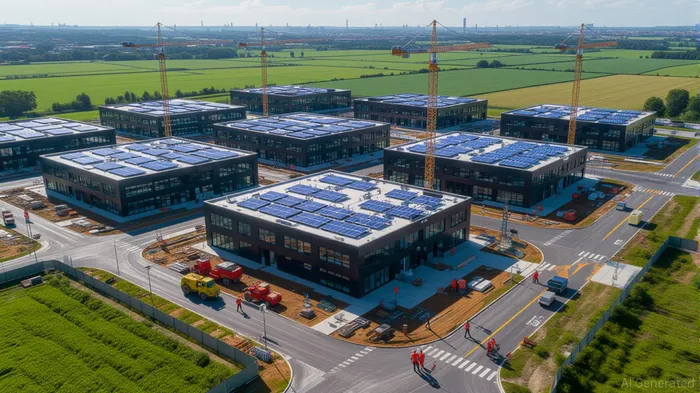
Institutional Investment: From Shovel-Ready Sites to High-Value Projects
The infrastructure upgrades have directly spurred institutional real estate investment. A prime example is the $650 million fairlife® dairy facility, a public-private partnership that leverages the upgraded electrical grid and transportation networks to create 250 jobs by 2025. This project, supported by the FAST NY Grant, underscores how infrastructure funding reduces development risk, making sites attractive to large-scale investors.
Webster's strategic location and readiness have also drawn interest from manufacturers and logistics firms. By 2026, the redeveloped 300-acre site is projected to offer nearly one million square feet of industrial space, competing with major regional hubs. Institutional investors, including private equity funds and industrial REITs, are increasingly viewing Webster as a scalable model for upstate redevelopment, where state incentives and pre-vetted infrastructure accelerate returns.
Economic Impact and Market Resilience
The economic ripple effects of these investments are evident. Residential property values in Webster rose by 10.1% in the past year, outpacing regional averages, while median household income increased by 4.31% from 2020 to 2023 according to recent data. Despite a temporary 2.32% employment dip in 2023 due to transitional challenges, the town's focus on advanced manufacturing has fostered long-term resilience.
The success of projects like fairlife® also highlights the role of public-private partnerships in de-risking large-scale investments. For instance, the $9.8 million FAST NY Grant was matched by private-sector commitments, demonstrating how state funding can amplify institutional capital. This model is replicable, as evidenced by New York's $51 million allocation for similar shovel-ready sites across upstate regions.
Future Outlook and Investment Implications
Webster's experience offers a blueprint for municipalities seeking to monetize industrial land while attracting institutional capital. For investors, the town's infrastructure-driven approach reduces time-to-revenue for industrial projects and enhances asset value through state-backed upgrades. The focus on advanced manufacturing and logistics-sectors with strong demand post-pandemic-further strengthens the case for long-term investment.
However, challenges remain. Transitional disruptions, such as the 2023 employment dip, underscore the need for phased redevelopment and community engagement. Investors must also monitor regional supply chain dynamics and labor market trends to ensure alignment with Webster's growth trajectory.
Conclusion
Webster, NY, exemplifies how strategic infrastructure grants and municipal realignment can unlock industrial land value and attract institutional real estate investment. By transforming brownfields into high-tech hubs and leveraging state funding, the town has created a competitive edge in upstate New York's redevelopment landscape. For investors, Webster's model offers a compelling blend of risk mitigation, economic resilience, and scalability-a testament to the power of infrastructure as a catalyst for growth.

Blending traditional trading wisdom with cutting-edge cryptocurrency insights.
Latest Articles
Stay ahead of the market.
Get curated U.S. market news, insights and key dates delivered to your inbox.


AInvest
PRO
AInvest
PRO



Comments
No comments yet