
The Strategic Value of Industrial Real Estate in Post-Pandemic Economic Shifts


 Aime Summary
Infrastructure as a Catalyst for Industrial Real Estate Growth
Infrastructure investment has become a linchpin for unlocking industrial real estate potential, particularly in post-industrial zones. Cities like Webster, New York, exemplify this trend. Between 2023 and 2025, Webster leveraged over $38 million in federal and state grants to modernize transportation networks, upgrade wastewater systems, and revitalize downtown areas. These upgrades transformed underutilized industrial sites into mixed-use developments, attracting manufacturing firms, logistics operators, and residential tenants. The result? A 15% increase in property values within three years, demonstrating how targeted infrastructure spending can catalyze economic activity and asset appreciation according to CREDaily.
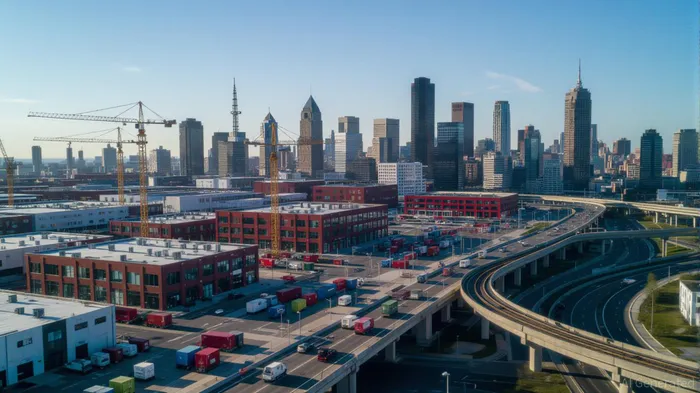
Similar strategies are unfolding nationwide. Ohio's $100 million Residential Development Revolving Loan Program and $121.5 million Brownfield initiatives highlight a growing alignment between infrastructure policy and real estate value creation. By prioritizing shovel-ready projects-sites pre-approved for development-governments and private investors are minimizing delays and maximizing returns. This synergy between public funding and private capital is critical in an era where time-to-market directly impacts competitive advantage according to CREDaily.
Economic Resilience: Structural Demand and Technological Adaptation
Industrial real estate's resilience stems from structural demand drivers that transcend cyclical economic fluctuations. The reconfiguration of global supply chains, accelerated by nearshoring and reshoring trends, has intensified demand for industrial spaces near ports and transportation hubs. For instance, properties adjacent to U.S. ports have maintained low vacancy rates (below 5%) despite broader market cooling, underscoring their strategic importance in maintaining supply chain integrity amid trade uncertainties according to JPMorgan.
Simultaneously, e-commerce's dominance-projected to account for 22% of U.S. retail sales by 2026-has fueled demand for last-mile distribution centers. This trend is further amplified by AI-driven logistics networks, which optimize inventory management and predictive maintenance, enhancing the operational efficiency of industrial assets according to JPMorgan. According to a report by JPMorgan, industrial real estate owners leveraging proptech solutions have seen a 12% reduction in maintenance costs and a 15% increase in tenant retention, reinforcing the sector's long-term viability according to JPMorgan.
The Path Forward: Rate Cuts, Tariff Clarity, and Vacancy Normalization
While the industrial real estate market has stabilized compared to the hypergrowth of 2019–2022, challenges remain. Vacancy rates have risen to 9.1% in 2025, but analysts predict a decline by 2026 as new supply slows and macroeconomic conditions stabilize according to CREDaily. This normalization is further supported by anticipated Federal Reserve rate cuts, which could lower borrowing costs and spur investor activity.
Tariff policy clarity will also play a pivotal role. A report by CREDaily notes that uncertainty around U.S.-China trade relations has already driven a 20% increase in pre-leasing activity for industrial properties in 2025, as companies hedge against potential disruptions according to CREDaily. Investors who position themselves in regions with robust infrastructure-such as Webster, NY-stand to benefit from both immediate demand and long-term appreciation.
Conclusion: A Model for Future-Proof Investment
The strategic value of industrial real estate lies in its ability to adapt to macroeconomic shifts while delivering consistent returns. By prioritizing infrastructure-linked development, investors can capitalize on underappreciated sectors poised for expansion. Webster's success story-transformed by grants and PPPs-offers a replicable model for regions seeking to leverage public funding for private gain. As global supply chains evolve and technology reshapes logistics, industrial real estate remains a linchpin of economic resilience, offering a compelling case for long-term asset appreciation.

Combinando la sabiduría tradicional en el comercio con las perspectivas de vanguardia relacionadas con las criptomonedas.
Latest Articles
Stay ahead of the market.
Get curated U.S. market news, insights and key dates delivered to your inbox.


AInvest
PRO
AInvest
PRO



Comments
No comments yet