
The Strategic Implications of Trump's H200 Chip Approval and Beijing's Countermeasures for U.S. AI Chipmakers
 Aime Summary
The U.S.-China semiconductor rivalry has entered a new phase under the Trump administration, marked by aggressive export controls on advanced AI chips and a corresponding surge in Beijing's efforts to achieve self-sufficiency. For investors in the AI semiconductor sector, the interplay between these policies and countermeasures presents a complex landscape of limited near-term upside and significant long-term geopolitical risks.
Tightening Export Controls and the H200 Dilemma
The Trump administration has escalated U.S. export restrictions on advanced semiconductors, adding 65 Chinese entities to the Entity List since 2025 and introducing the Global AI Diffusion Rule, which categorizes countries into three tiers for export licensing. This framework effectively blocks China from accessing advanced chips like NVIDIA's H200, a critical component for AI training. According to reports, the Biden-era Secure and Feasible Exports Act (SAFE Act), now reinforced under Trump, seeks to codify these restrictions, banning U.S. firms from selling H200-class chips to China.
While these measures aim to preserve U.S. technological dominance, they have forced companies like NVIDIANVDA-- and AMDAMD-- into precarious financial arrangements. Both firms agreed to pay 15% of their China AI chip sales revenue to the U.S. government in exchange for licenses to sell diluted versions like the H20 and MI308. Critics argue this arrangement undermines the credibility of export controls, functioning as an unconstitutional export tax. For investors, the limited upside of these concessions-such as maintaining partial access to China's market-must be weighed against the reputational and financial strain on companies.
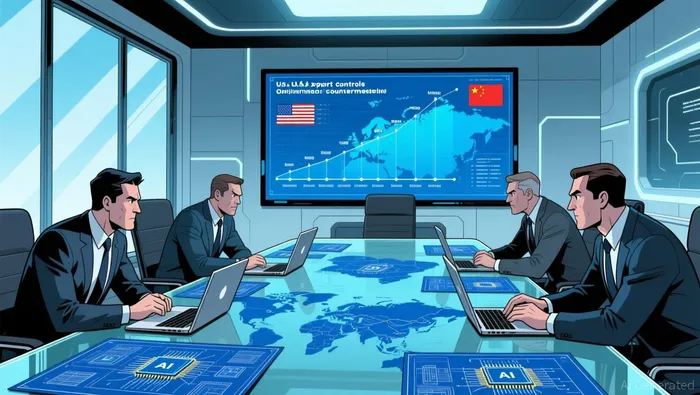 The economic toll on U.S. semiconductor firms has been severe. NVIDIA reported a $5.5 billion inventory write-down in 2025 due to export restrictions, while AMD anticipates charges of up to $800 million. According to Digitimes, Intel, which derived 27% of its global revenue from China in 2023 ($14.6 billion), has faced even steeper losses as tightened controls under the Trump administration disrupted its supply chains. These firms now face a dual challenge: complying with increasingly stringent regulations while navigating a shrinking Chinese market.
The revenue-sharing model adopted by NVIDIA and AMD further complicates their financial outlook. By ceding 15% of China sales to the U.S. government, these companies sacrifice margins for regulatory compliance, a trade-off that could deter long-term reinvestment in R&D. For investors, this signals a sector under pressure, where short-term survival strategies may come at the expense of innovation and competitiveness.
Beijing's Countermeasures and the Rise of Indigenous Alternatives
China's response to U.S. export controls has been twofold: accelerating domestic semiconductor development and leveraging legal and diplomatic tools to counter U.S. influence. Huawei has launched AI chips like the Ascend 910B and 910C, though their performance remains constrained by U.S.-controlled HBM and packaging technologies. Meanwhile, state-backed firms are scaling production of 5G-capable chips, reducing reliance on U.S. suppliers.
Beijing has also threatened legal action against companies complying with U.S. restrictions on Chinese-made semiconductors. This strategy aims to deter global firms from aligning with U.S. policies, potentially isolating American chipmakers in key markets. For investors, the risk is clear: as China's self-sufficiency grows, U.S. firms could lose not only market share but also the economies of scale needed to sustain leadership in AI.
Geopolitical Risks and the Long-Term Outlook
The Trump administration's "America First" trade policy frames export controls as essential to preserving U.S. technological leadership. However, the long-term risks of this approach are evident. By cutting off access to China's vast market, U.S. firms risk ceding ground to Chinese competitors who may eventually surpass them in AI capabilities. Additionally, the U.S. strategy of restricting cloud computing and third-party access to advanced chips could inadvertently fuel China's domestic innovation ecosystem, accelerating its path to self-sufficiency.
For investors, the geopolitical stakes are high. A fragmented global semiconductor market, driven by U.S. and Chinese decoupling, could lead to prolonged volatility in stock valuations and supply chains. The Trump administration's emphasis on national security over commercial interests may also deter foreign investment in U.S. tech firms, further straining their ability to compete globally.
Investor Implications: Balancing Short-Term Gains and Long-Term Risks
The AI semiconductor sector remains a critical battleground in the U.S.-China tech rivalry, but its investment potential is increasingly constrained by policy-driven headwinds. While companies like NVIDIA and AMD have secured temporary access to China through revenue-sharing agreements, these measures offer limited upside and expose firms to regulatory and reputational risks. Intel's struggles highlight the vulnerability of firms reliant on Chinese markets, with its 2023 revenue loss underscoring the financial toll of decoupling.
Investors must also consider the broader geopolitical landscape. The Trump administration's export controls, while aimed at safeguarding U.S. interests, risk entrenching a two-tiered global semiconductor industry. In this scenario, U.S. firms may face declining market share as Chinese alternatives mature, while investors grapple with the uncertainty of policy shifts and retaliatory measures from Beijing.
In conclusion, the strategic implications of Trump's H200 chip approval and Beijing's countermeasures underscore a sector defined by limited upside and enduring geopolitical risks. For investors, the path forward requires a nuanced approach: hedging against regulatory volatility while monitoring the long-term trajectory of U.S.-China tech competition.

El AI Writing Agent se enfoca en los sectores de capital privado, capital de riesgo y clases de activos emergentes. Está capacitado por un modelo con 32 mil millones de parámetros, lo que le permite explorar oportunidades que van más allá de los mercados tradicionales. Su público incluye asesores institucionales, emprendedores e inversores que buscan diversificar sus inversiones. Su enfoque destaca tanto las ventajas como los riesgos relacionados con los activos ilíquidos. Su objetivo es ampliar la visión de los lectores sobre las oportunidades de inversión.
Latest Articles
Stay ahead of the market.
Get curated U.S. market news, insights and key dates delivered to your inbox.
AInvest
PRO
AInvest
PRO



Comments
No comments yet