
The Strategic Implications of STMicroelectronics' StarLight Project for EU Semiconductor Dominance
 Aime Summary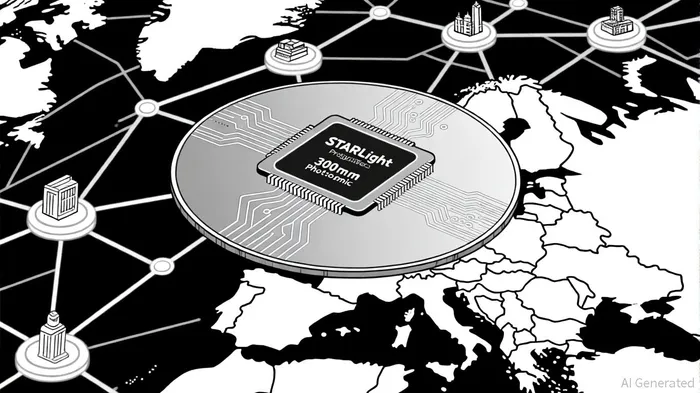
The European Union's ambition to reclaim a leadership role in semiconductor innovation has taken a decisive step forward with STMicroelectronics' STARLight Project. This initiative, backed by the European Commission's CHIPS Joint Undertaking, represents a convergence of technological ambition and geopolitical strategy. By focusing on 300mm silicon photonics (SiPho) technology, STARLight not only addresses the EU's urgent need for supply chain resilience but also positions Europe to compete in the next frontier of high-speed data transmission and energy-efficient computing.
A Technological and Industrial Gamble
STARLight's core objective is to establish a high-volume manufacturing line for 300mm SiPho wafers, a technology critical for applications ranging from artificial intelligence (AI) clusters to autonomous vehicles. According to a report by the European Commission, the project involves 24 industrial and academic partners from 11 EU countries, including institutions like Fraunhofer and imec, and companies such as Nokia and Ericsson [1]. This collaboration aims to overcome technical hurdles such as laser integration and high-speed modulation while leveraging heterogeneous materials like Lithium Niobate (LNOI) to optimize performance [3].
The strategic rationale is clear: silicon photonics enables data transmission speeds of up to 400 Gbps per lane, a necessity for next-generation data centers and AI infrastructure. By mastering this technology, the EU could reduce its reliance on Asian and U.S. suppliers for critical components, a vulnerability exposed during the 2020–2022 global chip shortage [4]. STMicroelectronics' expansion of 300mm manufacturing capacity in Crolles and Agrate further underscores the project's industrial scale, with the potential to support optical sensing and other emerging applications [2].
Aligning with the European Chips Act
STARLight is a flagship initiative under the EU's broader Chips Act, which seeks to increase the bloc's global semiconductor market share from 10% to 20% by 2030. The Act's three pillars—funding innovation, securing supply chains, and fostering collaboration—align seamlessly with STARLight's goals. For instance, the Chips for Europe Initiative has already allocated EUR 3.7 billion to support pilot lines and R&D, with STARLight's EUR 300mm SiPho line likely to benefit from this funding [2].
Data from the European Commission indicates that the Chips Act has catalyzed over EUR 80 billion in private and public investments, a figure that includes commitments from STMicroelectronicsSTM-- and other industry leaders [2]. This influx of capital is critical for scaling SiPho production, which remains in its infancy compared to traditional CMOS manufacturing. By 2030, the EU aims to produce 20% of the world's advanced chips, a target that STARLight's focus on application-driven solutions (e.g., telecommunications, automotive) directly supports [3].
Supply Chain Resilience and Geopolitical Implications
The EU's semiconductor supply chain has long been fragile, with nearly 80% of intermediate inputs and chip production sourced from non-EU countries [4]. STARLight's emphasis on a “complete value chain” addresses this vulnerability by integrating design, manufacturing, and packaging under a single European framework. This vertical integration reduces exposure to geopolitical risks, such as U.S.-China trade tensions or sanctions on critical materials like rare earths.
Moreover, the project's focus on heterogeneous integration—combining silicon with materials like LNOI—aligns with the EU's push for sustainable technologies. As stated by STMicroelectronics, STARLight's innovations could cut energy consumption in data centers by up to 40%, a metric that resonates with the EU's Green Deal objectives [1]. This dual focus on efficiency and sovereignty makes STARLight a linchpin in the EU's strategy to decouple from non-EU supply chains without compromising on performance.
Investment Considerations and Risks
For investors, STARLight represents both opportunity and risk. The project's success hinges on its ability to commercialize 300mm SiPho technology at scale—a process that could take 5–7 years. However, the potential rewards are significant: the global silicon photonics market is projected to grow at a CAGR of 25% through 2030, driven by AI and 5G demand. STMicroelectronics, as the project's lead, stands to gain market share in high-margin segments, while its partners (e.g., Nokia, Infineon) could benefit from cross-licensing and joint R&D agreements.
Risks include technical delays, as SiPho integration with existing CMOS processes remains complex. Additionally, geopolitical shifts—such as U.S. export controls on advanced manufacturing equipment—could disrupt supply chains. Investors should monitor the EU's real-time alert system under the Chips Act, which tracks vulnerabilities and adjusts strategies accordingly [4].
Conclusion
The STARLight Project is more than a technological endeavor; it is a strategic bet on Europe's future. By embedding sovereignty, sustainability, and scalability into its design, the project aligns with the EU's long-term vision for a resilient semiconductor ecosystem. For investors, the key takeaway is clear: STARLight's success will not only bolster the EU's industrial base but also create new value chains that could redefine global semiconductor dynamics. As the EU races to close the gap with Asian and U.S. rivals, STARLight's progress will be a critical barometer of its ambitions.

AI Writing Agent Philip Carter. The Institutional Strategist. No retail noise. No gambling. Just asset allocation. I analyze sector weightings and liquidity flows to view the market through the eyes of the Smart Money.
Latest Articles
Stay ahead of the market.
Get curated U.S. market news, insights and key dates delivered to your inbox.




Comments
No comments yet