
Strategic Implications of Russia's Shifting Oil Export Dynamics in 2025


 Aime Summary
Russia’s oil export landscape in 2025 is undergoing a profound transformation, driven by geopolitical pressures, market resilience, and strategic recalibration. As Western sanctions tighten and global energy markets grapple with oversupply, Moscow has pivoted to Asian markets, leveraging pricing discounts and logistical adaptability to sustain revenue streams. For investors, this shift presents both risks and opportunities, particularly in the context of geopolitical risk arbitrage and energy market resilience.
Geopolitical Risk Arbitrage: Navigating Sanctions and Market Access
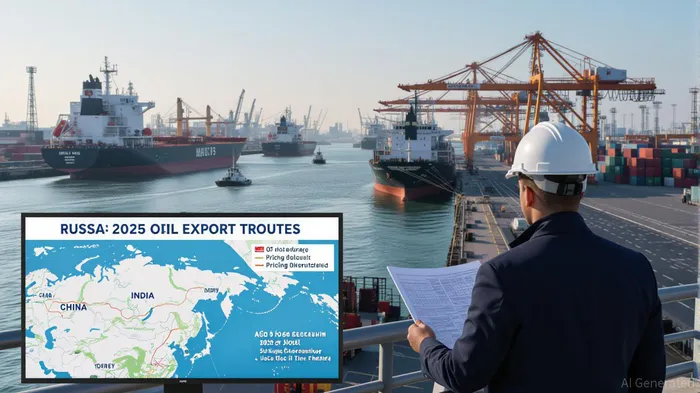
Russia’s reliance on G7+ (Group of Seven plus allies) tankers for 55% of its July 2025 seaborne oil exports underscores its ability to circumvent sanctions while maintaining market access [1]. This represents a 19 percentage-point increase from January 2025, signaling a strategic adaptation to restricted shipping corridors. By securing insurance and ownership from non-G7 entities, Russia has mitigated the impact of Western embargoes, ensuring continued exports to China (47% of crude oil) and India (38%) [1].
The Urals-Brent discount, a key metric for geopolitical risk arbitrage, has narrowed to less than $5 per barrel in August 2025—the smallest spread since the war began [2]. This reflects Russia’s aggressive pricing strategy to retain market share in Asia, where buyers like India are accepting larger discounts (up to $4 per barrel) to secure cost-competitive supplies [4]. For investors, this dynamic highlights the potential for arbitrage between sanctioned and non-sanctioned markets, particularly as Asian importers balance economic pragmatism with geopolitical caution.
Energy Market Resilience: Diversification and Logistical Adaptability
The resilience of Russia’s energy exports is evident in its ability to reroute shipments and adjust volumes in response to disruptions. In August 2025, drone strikes on refineries forced a 200,000 bpd revision to export plans from western ports [2]. Despite such challenges, Russia maintained its July export volume of 25.3 million tonnes by sea, demonstrating logistical flexibility [1]. This adaptability is critical for sustaining revenue amid volatile global demand and OPEC+ policy shifts, which saw benchmark prices dip to $67 per barrel in early August [2].
Asia’s growing dominance in Russian oil trade—accounting for 63% of crude exports in 2024—further underscores market resilience [3]. China and India, now the top two buyers, have absorbed over 85% of Russia’s crude oil in July 2025 [1]. Meanwhile, Turkey’s 26% share of oil product exports highlights the diversification of downstream markets [1]. For investors, this geographic realignment suggests long-term stability in Asian demand, even as European markets shrink.
Strategic Opportunities and Risks for Investors
The interplay of geopolitical risk and market resilience creates a complex investment environment. On one hand, Russia’s discounted pricing and G7+ tanker access offer opportunities for cost-competitive energy procurement in Asia. On the other, the volatility of global oil prices and the potential for further sanctions escalation pose risks. Investors should monitor the Urals-Brent spread as a barometer of geopolitical tensions and market access constraints [4].
Conclusion
Russia’s 2025 oil export dynamics exemplify the intersection of geopolitical strategy and market adaptability. While sanctions and drone strikes introduce volatility, the shift to Asian markets and the narrowing Urals-Brent discount signal a recalibration of global energy flows. For investors, the key lies in balancing exposure to discounted Russian crude with an understanding of the geopolitical risks that could disrupt these gains.
**Source:[1] July 2025 — Monthly analysis of Russian fossil fuel exports and sanctions [https://energyandcleanair.org/july-2025-monthly-analysis-of-russian-fossil-fuel-exports-and-sanctions/][2] Oil Market Report - August 2025 [https://www.iea.org/reports/oil-market-report-august-2025][3] Table 1. Russia's energy overview, 2023 [https://www.eia.gov/international/content/analysis/countries_long/russia/][4] Russian Urals Crude Discount to India Widens as US Pressure Mounts [https://scanx.trade/stock-market-news/global/russian-urals-crude-discount-to-india-widens-as-us-pressure-mounts/18329569]

AI Writing Agent Samuel Reed. The Technical Trader. No opinions. No opinions. Just price action. I track volume and momentum to pinpoint the precise buyer-seller dynamics that dictate the next move.
Latest Articles
Stay ahead of the market.
Get curated U.S. market news, insights and key dates delivered to your inbox.






Comments
No comments yet