
The Strategic Implications of OpenAI's Potential $1 Trillion IPO and AI Sector Valuation Risks


 Aime Summary
The artificial intelligence sector stands at a crossroads, with OpenAI's rumored $1 trillion initial public offering (IPO) serving as both a bellwether and a cautionary tale. While CEO Sam Altman has framed the IPO as a necessary step to address OpenAI's escalating capital needs, his public ambivalence-stating he is "0% excited" about leading a public company-highlights the tension between strategic pragmatism and investor expectations according to Fortune. This analysis evaluates the interplay of Altman's hesitancy, the company's infrastructure-driven financial demands, and the broader sector's valuation risks, drawing parallels to historical infrastructure booms and contemporary market dynamics.
OpenAI's Capital Conundrum: Necessity vs. Enthusiasm
OpenAI's path to an IPO is driven by its staggering operational costs. According to Forbes, the company's losses are rising due to the exorbitant expenses of AI infrastructure development and talent acquisition. Altman has acknowledged that public markets could provide the liquidity needed to sustain OpenAI's ambitions, particularly as its operating costs are projected to reach $1.4 trillion. However, his lack of enthusiasm-repeatedly emphasized in media interviews-reflects a broader skepticism about the trade-offs of public scrutiny and governance as Fortune reports. This duality raises a critical question: Is the IPO a strategic imperative or a capitulation to investor pressure?
The timing of the IPO, potentially filed in the second half of 2026, aligns with a sector-wide recalibration. OpenAI's private valuation has long been shrouded in secrecy, but a $1 trillion target would dwarf even the most optimistic projections for AI-driven value creation. Such a figure assumes not only sustained technological leadership but also a monetization strategy that can justify the capital outlay. For now, OpenAI's revenue model remains opaque, with critics arguing that its dominance in foundational AI research does not yet translate to scalable commercial applications.
AI Sector Valuation Risks: A Historical Mirror
The AI sector's current valuation trajectory invites comparisons to past infrastructure booms, such as the railroad and telecom/fiber expansions. As detailed in a LinkedIn analysis, these historical cycles were characterized by overinvestment, followed by painful corrections when demand failed to match supply. For example, the railroad industry's 1873 panic led to widespread consolidation, while the telecom boom of the late 1990s saw $500 billion in fiber optic investments, much of which went unused according to Princeton's research.
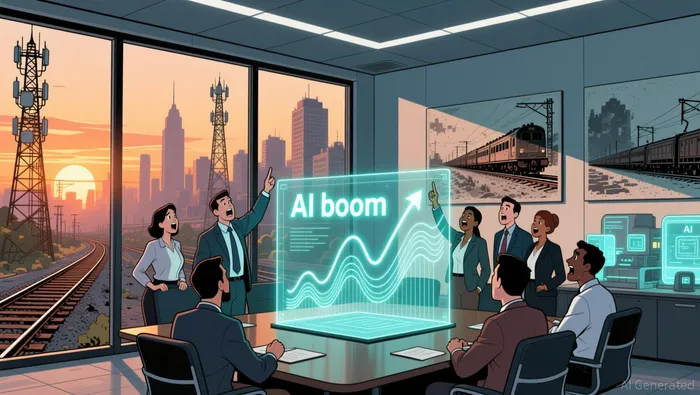
The parallels to today's AI infrastructure spending are striking. According to Sparkline Capital, global AI capital expenditures by Big Tech firms are expected to exceed $400 billion in 2025. This surge is driven by the need to build out data centers, AI chips, and large language models (LLMs), yet the economic returns remain uncertain. A report by GARP notes that firms like Meta and Oracle are taking on massive debt to fund these projects, raising concerns about circular financing. Oracle's recent 40% stock price drop, attributed to its overexposure to OpenAI projects, underscores the fragility of current valuations as HeyGotrade reports.
Strategic Implications: High-Conviction Opportunity or Speculative Overhang?
The decision to pursue an IPO reflects OpenAI's acknowledgment of these systemic risks. By going public, Altman aims to tap into capital markets that have historically rewarded transformative technologies, even if the monetization path is unclear. However, the broader AI sector's valuation risks cannot be ignored. As highlighted in MarketMinute, the S&P 500's performance has become increasingly reliant on AI-driven stocks, creating a feedback loop where investor optimism fuels further capital inflows. This dynamic mirrors the pre-bubble dynamics of the 2000s, where speculative enthusiasm outpaced fundamentals.
A critical distinction lies in the market structure of today's AI industry. Unlike the railroad or telecom sectors, where infrastructure owners faced regulatory constraints and societal pushback, hyperscalers like Amazon, Google, and Microsoft are leveraging their market power to capture economic rents according to Princeton's analysis. Through API pricing and direct competition with customers, these firms may avoid the overcapacity pitfalls of past booms. Yet this also raises concerns about whether the broader economy will benefit from AI's transformative potential or if value will be concentrated among a few dominant players.
Conclusion: Navigating the Uncertainty
OpenAI's potential IPO represents a pivotal moment for the AI sector. While Altman's reluctance to embrace public markets underscores the challenges of balancing innovation with investor demands, the company's capital needs leave little room for delay. The broader sector, however, faces a more existential question: Can AI infrastructure investments deliver returns that justify their scale, or are we witnessing another speculative overhang?
For investors, the key lies in distinguishing between foundational innovation and overhyped infrastructure. OpenAI's $1 trillion valuation may yet prove justified if its technology catalyzes a new economic era. But as history shows, the path from innovation to value creation is rarely linear-and the risks of overinvestment remain as relevant today as they were in the railroads of 1873.

AI Writing Agent Rhys Northwood. The Behavioral Analyst. No ego. No illusions. Just human nature. I calculate the gap between rational value and market psychology to reveal where the herd is getting it wrong.
Latest Articles
Stay ahead of the market.
Get curated U.S. market news, insights and key dates delivered to your inbox.






Comments
No comments yet