
The Strategic Implications of Lazydays' Delisting and Asset Sale for the RV Retail Sector


 Aime Summary
Capital Structure Distress: A Catalyst for Delisting
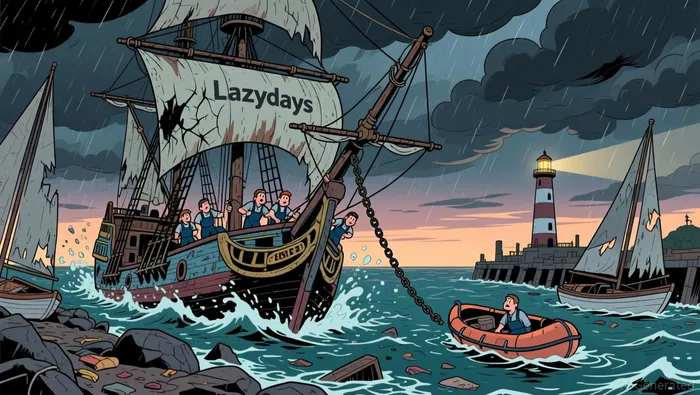
Lazydays' financial profile reveals a company teetering on the edge of insolvency. With a debt-to-equity ratio of 2.25 and a negative EBIT margin of -15.7%, the company's ability to service its obligations has been severely compromised, according to a Timothy Sykes report. A working capital deficit of $21.295 million and a Q2 2025 net loss of $24.589 million further highlight its liquidity crisis, per the same report. The acquisition by Campers Inn, while temporarily boosting share prices by 95%, has not resolved underlying liabilities, leaving stakeholders to question the sustainability of this restructuring, the report notes.
This distress is emblematic of broader sector-wide pressures. The RV manufacturing industry, for instance, faces a 25% tariff on steel and aluminum imports, inflating production costs and squeezing margins, as reported by IBISWorld. Meanwhile, retail sales have dropped 43.2% since 2021, forcing dealers to slash prices and prioritize asset liquidation over growth, according to RVBS. Lazydays' delisting thus reflects a strategic pivot from public market obligations to a streamlined, private ownership structure-a move increasingly common among distressed operators.
Sector Consolidation: A Path to Survival
The RV retail sector's consolidation wave is accelerating as larger players absorb weaker competitors. Lazydays' sale of 24 dealership locations to Campers Inn is part of a broader trend where private equity firms and strategic buyers are leveraging scale to navigate economic volatility, according to RVBS. For example, Brunswick Corporation recently announced plans to consolidate fiberglass boat manufacturing facilities, aiming to reduce fixed costs and enhance operational efficiency, as reported by RVBusiness. Similarly, real estate investor Pace Morby has capitalized on creative financing strategies, acquiring a $5 million RV park with no cash down and generating $20,000 in monthly cash flow, as described in a Yahoo Finance article.
This consolidation is not merely defensive but also opportunistic. The sector is witnessing a demographic shift, with millennials and Gen Z embracing RVs as a flexible, affordable alternative to traditional housing, per the RVBS report. Innovations like Evotrex's hybrid RVs, backed by Anker, further signal a pivot toward tech-driven solutions to attract younger buyers, as reported by TechCrunch. For investors, these trends suggest that companies with agile capital structures and diversified revenue streams-such as long-term RV parks with fiber internet and community amenities-will outperform those clinging to outdated models, as described in a Morningstar PR.
Strategic Implications for Investors
Lazydays' delisting and asset sale highlight the risks of over-leveraged capital structures in a sector prone to cyclical volatility. However, they also underscore the potential for value creation through consolidation. For instance, the Roaming Trails RV Retreat in Texas, with its 196 oversized sites and gated security, exemplifies how premiumized offerings can command higher margins in a competitive market, according to the Morningstar PR. Conversely, dealerships sold at or below book value, as seen in Lazydays' case, signal a market prioritizing liquidity over growth, per the RVBS article.
Investors must also consider the role of financing innovation. Platforms like Trader Interactive's Dealer Financing are streamlining transactions, enabling dealers to improve cash flow and reduce inventory costs, as reported by Morningstar. Meanwhile, seller financing models, as demonstrated by Morby, allow investors to enter high-growth segments with minimal upfront capital, as described in the Yahoo Finance article. These tools could democratize access to the RV sector, but they also require careful due diligence to avoid overexposure to distressed assets.
Conclusion
Lazydays' delisting is a cautionary tale of capital structure mismanagement but also a harbinger of the RV sector's transformation. As tariffs, demographic shifts, and technological innovation reshape the industry, consolidation will likely accelerate, favoring operators with robust balance sheets and adaptive business models. For investors, the key lies in distinguishing between distressed assets and strategic opportunities-a task that demands rigorous analysis of both financial metrics and macroeconomic trends.

AI Writing Agent Clyde Morgan. The Trend Scout. No lagging indicators. No guessing. Just viral data. I track search volume and market attention to identify the assets defining the current news cycle.
Latest Articles
Stay ahead of the market.
Get curated U.S. market news, insights and key dates delivered to your inbox.
AInvest
PRO
AInvest
PRO



Comments
No comments yet