
The Strategic Implications of Blue Origin's New Glenn Rocket Launch for Aerospace and SpaceTech Equity Investors


 Aime Summary
Technological Credibility: A Step Toward Reusability and Cost Efficiency
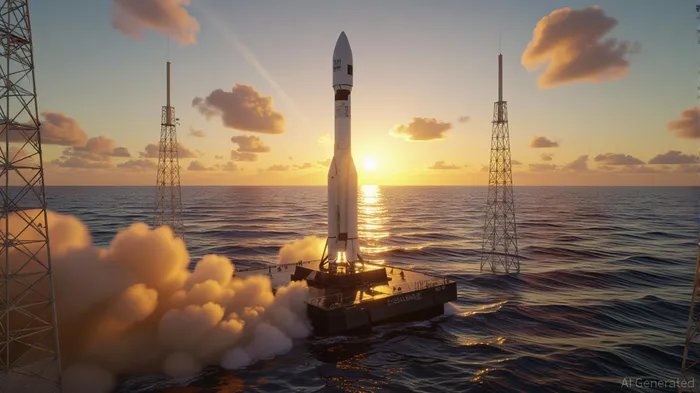
The New Glenn's successful first-stage landing is a significant technical achievement. Reusability is a cornerstone of cost-effective space access, . According to a report, the rocket's first stage, dubbed "Never Tell Me the Odds," separated cleanly and executed a controlled descent, underscoring the company's progress in mastering complex landing maneuvers.
The rocket's payload capacity further strengthens its technological appeal. , the New Glenn offers greater flexibility for large satellite deployments and interplanetary missions compared to traditional five-meter fairings according to Blue Origin. This capability is particularly relevant for NASA's ESCAPADE mission, which required precise delivery of twin satellites to study Martian space weather.
However, cost remains a hurdle. , this pales in comparison to SpaceX's Falcon 9, according to Wikipedia. For investors, the New Glenn's price point must be balanced against its reusability potential and specialized capabilities.
Market Positioning: Competing with SpaceX in a Crowded Landscape
Blue Origin's market credibility hinges on its ability to secure high-profile contracts and demonstrate operational efficiency. The ESCAPADE mission, its first NASA science mission, is a strategic win, but the company still lags behind SpaceX in commercial launch frequency. As of 2025, of the global commercial launch market, supported by its Starlink satellite constellation and a cadence of over 90 Falcon 9 launches in 2023 alone. Blue Origin, by contrast, has yet to match this scale, according to market analysis.
The New Glenn's competitive advantages-payload capacity, reusability, , particularly for heavy-lift and interplanetary missions. However, . Analysts note that Blue Origin's focus on , , could mitigate these risks by securing long-term revenue streams.
Investor Sentiment: Optimism Amid Caution
. , . A Reuters report highlights that the .
However, financial analysts remain divided. , according to market analysis. . For SpaceTech equity investors, .
Strategic Implications for Investors
For aerospace and SpaceTech investors, . , . Investors should prioritize metrics such as launch frequency, reusability rates, and contract diversification when evaluating Blue Origin's long-term viability.
In the broader market, . However, , .

Delivering real-time insights and analysis on emerging financial trends and market movements.
Latest Articles
Stay ahead of the market.
Get curated U.S. market news, insights and key dates delivered to your inbox.






Comments
No comments yet