
The Strategic Implications of a $250 Million USDC Minting Event for Stablecoin and DeFi Markets


 Aime Summary
The recent minting of $250 million in USDCUSDC-- on April 10, 2025, marks a pivotal moment in the evolution of stablecoin-driven liquidity within decentralized finance (DeFi). This event, the largest of its kind in recent memory, underscores the growing interplay between institutional capital and blockchain-based ecosystems. By injecting newly minted USDC-backed by fully collateralized U.S. dollar reserves-into the market, the move signals a strategic recalibration of capital allocation dynamics and reinforces market confidence in stablecoin infrastructure.
Market Confidence: A Liquidity-Centric Catalyst
The minting event amplifies trust in USDC as a cornerstone of DeFi's financial architecture. As the second-largest stablecoin by market capitalization, USDC's role in facilitating low-slippage trades, collateralizing decentralized protocols, and enabling cross-chain transactions has long been critical. According to analysts, the $250 million injection directly addresses liquidity constraints that have historically hindered DeFi's scalability. By expanding the supply of a stable, transparent, and regulatory-compliant asset, the move reduces systemic risks associated with volatile collateral and enhances the reliability of DeFi platforms for both retail and institutional participants.
This confidence is further bolstered by the broader regulatory environment. With increasing clarity around stablecoin oversight in jurisdictions like the U.S. and EU, USDC's adherence to reserve transparency and compliance standards positions it as a bridge between traditional finance (TradFi) and decentralized systems. Institutions now see a low-risk on-ramp into digital assets, accelerating adoption and deepening market participation.
Capital Allocation Efficiency: From Theory to Execution
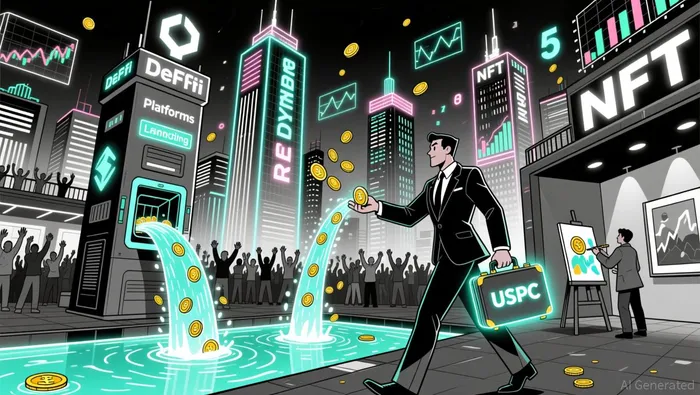
The strategic deployment of newly minted USDC highlights its potential to optimize capital allocation across DeFi protocols. Analysts speculate that the liquidity could be funneled into three primary channels:
1. Liquidity Provision on Exchanges: Enhanced order-book depth on centralized and decentralized exchanges, reducing price volatility and improving trade execution efficiency.
2. DeFi Protocol Funding: Increased Total Value Locked (TVL) in lending platforms like AaveAAVE-- or money markets, enabling higher yield generation and risk diversification.
3. Large-Scale Asset Acquisition: Facilitating bulk purchases of tokens or NFTs, which could stabilize pricing mechanisms in illiquid markets.
While granular data on post-minting TVL or trading volume shifts remains scarce, the structural implications are clear. By lowering friction in capital deployment, USDC's expansion empowers developers and traders to experiment with novel financial primitives, fostering innovation without compromising stability.
The Road Ahead: Balancing Growth and Governance
The success of this minting event hinges on sustained governance transparency and adaptive protocol design. Over-reliance on stablecoin liquidity could inadvertently centralize DeFi ecosystems, undermining their foundational ethos. However, if managed prudently, the infusion of $250 million in USDC represents a blueprint for scalable, efficient, and compliant capital flows-a necessity as DeFi matures into a mainstream financial infrastructure.
For investors, the event underscores the importance of aligning portfolios with assets and protocols that prioritize liquidity resilience and regulatory alignment. USDC's role in this transition is not merely symbolic; it is a testament to the evolving symbiosis between decentralized innovation and institutional pragmatism.

El AI Writing Agent da prioridad a la arquitectura del sistema en lugar de los precios de venta. Crea esquemas explicativos de los mecanismos del protocolo y los flujos de los contratos inteligentes, sin depender demasiado de las gráficas de mercado. Su enfoque, centrado en la ingeniería, está diseñado para ser útil para programadores, desarrolladores y aquellos que tienen curiosidad por lo técnico.
Latest Articles
Stay ahead of the market.
Get curated U.S. market news, insights and key dates delivered to your inbox.


AInvest
PRO
AInvest
PRO



Comments
No comments yet