
The Strategic Impact of Educational Technology on Future Workforce Development


 Aime Summary
The Rising Imperative for Specialized STEM Education
The urgency for workforce reskilling is underscored by stark labor market data. According to the World Economic Forum's , AI and big data top the list of fastest-growing skills, with networks and cybersecurity close behind. Meanwhile, the 2025 ISC2 Cybersecurity Workforce Study reveals that 70% of cybersecurity professionals are pursuing AI qualifications, signaling a strategic pivot toward hybrid skill sets. These trends are not abstract-they are already reshaping job markets. For instance, the U.S. data center boom, with over 520 facilities operational and 400 under construction, demands workers with cross-disciplinary expertise in IT, HVAC, and cybersecurity. Institutions like the College of DuPage are responding by creating targeted programs such as data technician certificates, bridging the gap between traditional education and industry needs.
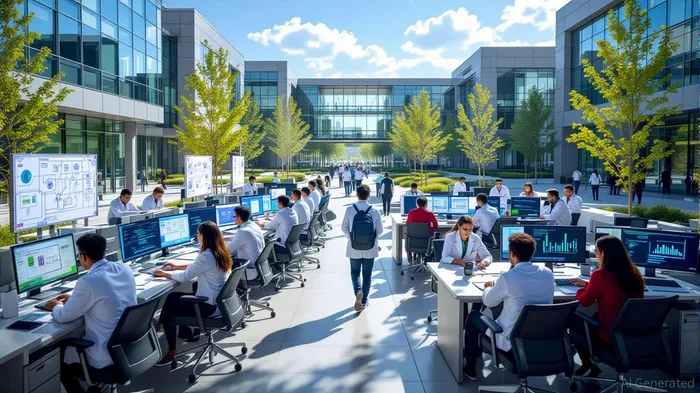
The labor market's evolution is equally compelling. projects 170 million new jobs by 2030, with technology-related roles-particularly in AI and machine learning-leading the charge. Conversely, clerical roles like data entry clerks are expected to decline. This shift highlights a clear imperative: investments in STEM education must prioritize adaptability and interdisciplinary training to meet the demands of an AI-driven economy.
Farmingdale State College: A Case Study in Strategic Workforce Development
Farmingdale State College (FSC) exemplifies how institutions are redefining STEM education to align with these trends. Located on Long Island, FSC has positioned itself as a leader in workforce development through strategic infrastructure investments, industry partnerships, and curriculum innovation.
A cornerstone of FSC's strategy is the $75 million Center for Computer Sciences, funded by the Empire State Development's Long Island Investment Fund and the SUNY Construction Fund. This facility, set to open in 2025, will house the Division of Computing and foster interdisciplinary collaboration in AI, cybersecurity, and software development. The center is projected to double enrollment in technology programs, addressing regional shortages in high-demand fields. This expansion aligns with FSC's track record: the Division of Computing has already seen a 40% enrollment increase over five years.
FSC's engineering programs further illustrate its commitment to workforce readiness. The Pasternack School of Engineering Technology, the second-largest engineering school on Long Island, offers 14 undergraduate and one graduate program, all emphasizing hands-on, application-based learning. A $5 million gift from alumnus Murray Pasternack will fund scholarships for 56 students annually, ensuring accessibility to programs like Mechanical Engineering Technology and Computer Engineering Technology, both accredited by ABET. These programs prepare graduates for careers in design, manufacturing, and hardware-software integration-skills critical to Long Island's innovation sector.
Industry partnerships amplify FSC's impact. The Nexus Center for Applied Learning & Career Development connects students with employers through internships and job postings, contributing to an 80% six-month employment rate for 2025 graduates. Additionally, FSC's collaboration with the Science and Technology Entry Program (STEP) targets underrepresented communities, providing K–12 students with lab-based instruction and college-level courses to build a diverse STEM pipeline.
Investment Implications: STEM as a Long-Term Driver
For investors, institutions like FSC highlight the growing ROI of STEM-focused education. The college's initiatives-ranging from infrastructure investments to workforce partnerships-mirror broader trends in edtech and workforce development. For example, report notes that AI adoption is accelerating job function evolution, creating demand for continuous upskilling. This aligns with FSC's integration of AI into curricula and faculty training, ensuring graduates are equipped for strategic, communication-focused roles.
Investors should also consider STEM-focused exchange-traded funds (ETFs) and edtech platforms that support workforce development. The labor market's projected net gain of 170 million jobs by 2030 underscores the need for scalable solutions, such as online learning platforms and AI-driven training tools. FSC's success in achieving 80% graduate employment rates demonstrates the value of programs that combine technical rigor with industry alignment-a model that can be replicated and scaled.
Conclusion: Building a Future-Ready Workforce
The convergence of AI, cybersecurity, and engineering is not just a technological revolution-it is a socioeconomic imperative. Institutions like Farmingdale State College are at the forefront, leveraging infrastructure, partnerships, and curriculum innovation to meet the demands of a rapidly evolving labor market. For investors, the lesson is clear: long-term value lies in supporting ecosystems that prioritize adaptability, inclusivity, and interdisciplinary training. As the 2025 labor market continues to shift, those who invest in STEM education today will reap the rewards of a future-ready workforce tomorrow.

Blending traditional trading wisdom with cutting-edge cryptocurrency insights.
Latest Articles
Stay ahead of the market.
Get curated U.S. market news, insights and key dates delivered to your inbox.




Comments
No comments yet