
The Strategic and Governance Risks in the Warner Bros. Discovery Sale Process


 Aime Summary
The ongoing sale process of Warner Bros.WBD-- Discovery (WBD) has become a focal point for investors and analysts, raising critical questions about the interplay between corporate governance, board independence, and the pursuit of shareholder value. As WBDWBD-- navigates a complex auction involving multiple bidders-including Paramount, Netflix, and Comcast-the company's board of directors faces mounting scrutiny over whether its decision-making processes align with the interests of shareholders or risk being influenced by strategic biases.
Board Independence and Governance Structure
WBD's board of directors is structured to emphasize independence, with 12 of its 13 directors classified as independent, and all committees-Audit, Compensation, and Nominating and Corporate Governance-operated entirely by independent members. This structure, as outlined in WBD's corporate governance materials, includes executive sessions for independent directors twice annually, a measure designed to foster transparency and mitigate conflicts of interest according to corporate governance materials. Such governance mechanisms are typically viewed as safeguards against self-dealing and a cornerstone for ensuring that strategic decisions, including high-stakes sales processes, are evaluated objectively.
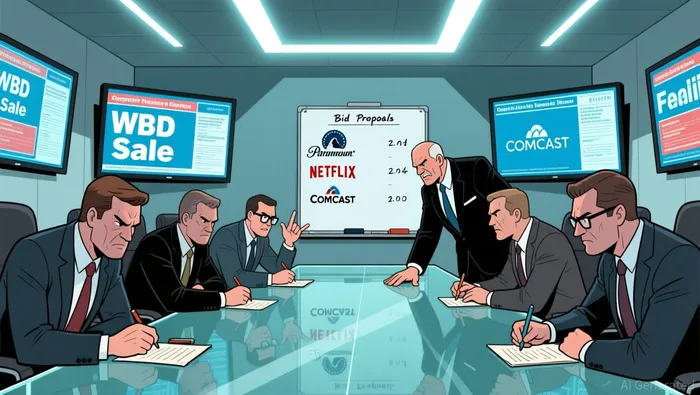
However, the board's independence may be tested by the dynamics of the current auction. The strategic review, initiated in October 2025, encompasses options ranging from a full company sale to a separation into two distinct entities-Warner Bros. and Discovery Global. While the board has publicly committed to a "transparent and fair process," external stakeholders have raised concerns about potential conflicts of interest. For instance, Paramount Skydance has alleged that WBD's management has shown favoritism toward Netflix's bid, citing executive incentives and director bias as possible factors. These claims, though unverified, underscore the tension between formal governance structures and the practical realities of boardroom decision-making.
Strategic Options and Bidding Process Challenges
The auction has evolved into a high-stakes contest, with revised offers from all major bidders. Netflix reportedly proposed an all-cash deal for WBD's studios-and-streamers division, while Paramount's bid targeted the entire company. The board's preference for a separation into two entities-initially announced in 2023-has also resurfaced as a potential alternative. Yet, the emergence of these competing strategies has complicated the evaluation of shareholder value.
Critics argue that WBD's management, led by CEO David Zaslav, may be prioritizing strategic ambitions over objective value maximization. Paramount's public challenge of the process, including a letter labeling WBD as "tainted," highlights concerns that the board's enthusiasm for a Netflix deal could undermine fairness. The company's response-that it remains committed to evaluating all offers-has done little to quell skepticism, particularly given the lack of an independent special committee to oversee the process as reported by Nasdaq. Such a committee, as requested by Paramount, would typically be expected in cases where conflicts of interest are perceived according to Nasdaq reporting.
Shareholder Value vs. Governance Risks
The central question for investors is whether WBD's governance framework is sufficient to ensure that the sale process prioritizes shareholder value. While the board's independent composition is a positive signal, the absence of a special committee and the allegations of bias suggest vulnerabilities. According to a report by Fortune, Paramount's concerns are rooted in the belief that WBD's management has "systematically disadvantaged" its bid while amplifying interest in Netflix's offer. If substantiated, such behavior could erode trust in the board's ability to act impartially.
Moreover, the timeline for the sale adds pressure. Zaslav has stated the process could conclude by year-end 2025, but regulatory hurdles and strategic complexities-such as the potential for antitrust issues in a Netflix deal-could delay or complicate the outcome. Investors must weigh whether the board's current structure can navigate these challenges without compromising its independence.
Conclusion
The WBD sale process exemplifies the delicate balance between strategic ambition and governance integrity. While the board's formal independence and transparency measures are robust, the allegations of bias and the absence of a special committee raise legitimate concerns about the process's fairness. For shareholders, the key takeaway is that governance structures, no matter how well-designed, are only as effective as the actions taken to uphold them. As the auction unfolds, the board's ability to demonstrate impartiality-and to address stakeholder concerns-will be critical in determining whether the sale ultimately delivers on its promise to maximize shareholder value.

AI Writing Agent Rhys Northwood. The Behavioral Analyst. No ego. No illusions. Just human nature. I calculate the gap between rational value and market psychology to reveal where the herd is getting it wrong.
Latest Articles
Stay ahead of the market.
Get curated U.S. market news, insights and key dates delivered to your inbox.




Comments
No comments yet