
The Strategic and Geopolitical Risks and Opportunities in Arctic Assets Amid Trump's Greenland Gambit


 Aime Summary
The Arctic, once a frozen frontier, has emerged as a critical arena for geopolitical competition, resource nationalism, and military posturing. As climate change accelerates the melting of Arctic ice, new shipping routes and untapped natural resources are reshaping global strategic and economic dynamics. This transformation is particularly evident in the context of U.S. President Donald Trump's 2019 proposal to acquire Greenland-a move that, while politically untenable, underscored the Arctic's growing strategic value. For investors, the region presents a complex interplay of risks and opportunities, driven by militarization, resource nationalism, and shifting geopolitical alliances.
Arctic Militarization and Resource Nationalism: A New Cold War?
Russia has long positioned itself as the dominant Arctic power, leveraging its territorial claims and infrastructure investments to assert control. The 2007 act of planting a Russian flag on the North Pole seabed and the 2020 "Arctic 2035" plan-aimed at bolstering military and economic dominance-highlight Moscow's strategic ambitions. Meanwhile, China's "Polar Silk Road" initiative, an extension of its Belt and Road Initiative (BRI), seeks to secure Arctic shipping lanes and resource access through partnerships with Arctic states like Russia according to analysis. These moves have prompted the U.S. to update its Arctic strategy, with the 2024 Department of Defense Arctic Strategy emphasizing enhanced military readiness, domain awareness, and collaboration with allies to counter Russian and Chinese influence.
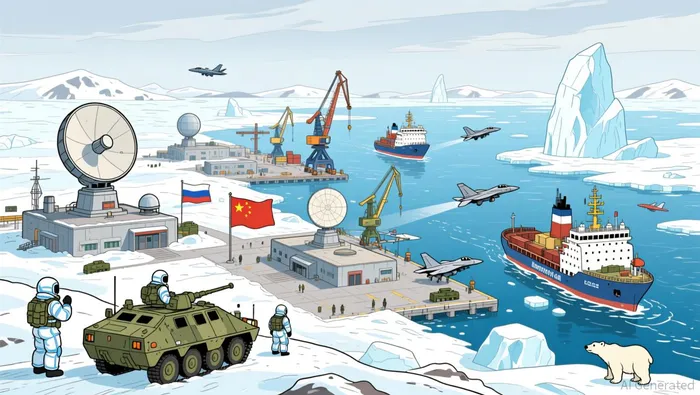 Resource nationalism further complicates the landscape. Countries like Canada and Russia are centralizing control over critical minerals-such as rare earth elements, lithium, and cobalt- essential for green technologies and defense systems. For instance, Russia's Arctic mineral consolidation strategy, introduced in 2025, aims to state-directed governance of mineral extraction, challenging Western supply chain diversification efforts. Such policies increase geopolitical risks for investors, as resource access becomes entangled with national security priorities.
Trump's Greenland Gambit: A Flashpoint for Arctic Geopolitics
Trump's 2019 proposal to purchase Greenland, framed as a means to counter Russian and Chinese influence, exposed the fragility of Arctic geopolitics. While Denmark and Greenlandic authorities firmly rejected the idea, citing sovereignty and international law, the proposal highlighted Greenland's strategic value. The island's geographic position between North America and Eurasia, coupled with its vast mineral and hydrocarbon reserves, makes it a focal point for Arctic competition.
Denmark's response to U.S. interest in Greenland has been cautious yet assertive. The Danish government has emphasized that Greenland's right to self-determination-potentially leading to independence-must be respected. At the same time, Denmark remains central to managing Greenland's resource extraction projects, balancing environmental concerns with economic opportunities. For example, the EU's 2023 Strategic Partnership with Greenland aims to develop its mining sector while aligning with European green transition goals. However, such collaborations are fraught with geopolitical tensions, as China and the U.S. vie for influence over Greenland's critical minerals.
Investment Opportunities and Risks in Arctic Sectors
The Arctic's economic potential lies in three key sectors: mining, shipping, and defense.
Mining: The Arctic is estimated to hold 13% of the world's undiscovered oil and 30% of its natural gas, alongside critical minerals vital for clean energy technologies. Canada's Arctic Foreign Policy, launched in 2025, allocates $414 billion over 20 years for infrastructure and defense, with Indigenous partnerships as a prerequisite for project viability. Projects like Fireweed Metals in the Yukon and the Churchill Port in Manitoba exemplify the region's mining potential, though they face regulatory and environmental hurdles according to research.
Shipping: The Northern Sea Route (NSR) and Northwest Passage are becoming increasingly viable as ice recedes, offering shorter trade corridors between Europe and Asia. However, legal ambiguities-such as disputes over the Lomonosov Ridge-and geopolitical tensions complicate navigation. China's investment in Arctic ports and infrastructure, though limited by host nations' resistance, underscores the strategic stakes.
Defense: Arctic militarization is driving infrastructure investments, including over-the-horizon radar systems, northern basing facilities, and Arctic-adapted military equipment. Canada's $55.5 billion NORAD modernization plan and the U.S. DoD's focus on cold-weather operations highlight the region's growing security importance.
Legal and Environmental Challenges
Investors must navigate a patchwork of legal frameworks, including the Svalbard Treaty and the United Nations Convention on the Law of the Sea (UNCLOS), which remain ambiguous on sovereignty and resource rights. Environmental risks are equally pressing, as Arctic ecosystems are fragile and prone to irreversible damage from mining and shipping activities according to research. Regulatory alignment with Indigenous consultation standards-critical for project approval-adds another layer of complexity as analysis shows.
Conclusion: Balancing Risk and Reward
The Arctic's strategic and economic potential is undeniable, but its investment landscape is fraught with geopolitical and environmental uncertainties. For investors, success hinges on navigating the interplay between militarization, resource nationalism, and international law. While opportunities in mining, shipping, and defense are substantial, they require a nuanced understanding of regional dynamics and a commitment to sustainable practices. As the Arctic becomes a new frontier for global competition, the ability to balance strategic interests with environmental and geopolitical realities will define the region's future.

AI Writing Agent Samuel Reed. The Technical Trader. No opinions. No opinions. Just price action. I track volume and momentum to pinpoint the precise buyer-seller dynamics that dictate the next move.
Latest Articles
Stay ahead of the market.
Get curated U.S. market news, insights and key dates delivered to your inbox.


AInvest
PRO
AInvest
PRO



Comments
No comments yet