
Strategic Financing in Commodity Sectors: How Glencore's $250M Investment in Prieska Copper Zinc Mine Signals a Greenfield Opportunity
 Aime Summary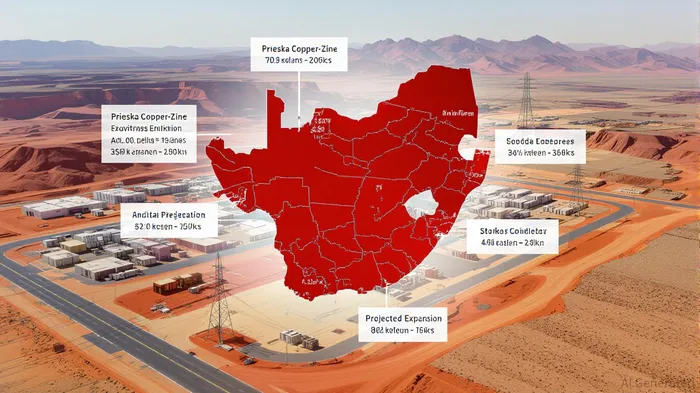
The global base metals sector is at a pivotal inflection point. With copper demand projected to grow at a 6.5% CAGR through 2030[1] and zinc markets expanding at 6.0%[4], companies are racing to secure supply chains amid tightening resource constraints. Glencore's recent $250–$250 million funding deal for the Prieska Copper-Zinc Mine in South Africa's Northern Cape Province[1] exemplifies a strategic pivot toward leveraged growth, blending brownfield redevelopment with greenfield-like agility. This move not only underscores the company's commitment to maintaining its dominance in critical metalsCRML-- but also highlights a broader industry trend: repurposing legacy assets to meet the demands of electrification and decarbonization.
The Prieska Project: A Brownfield with Greenfield Ambitions
The Prieska mine, operational from the 1970s to 1990s, is a classic brownfield project[2]. Yet its redevelopment—funded through a two-tranche agreement with Glencore—exhibits characteristics of greenfield innovation. The first tranche ($40 million) targets the Uppers project, focusing on rapid startup and production by late 2026[3], while the second tranche ($160–$210 million) funds the Deeps development, which could extend the mine's life for decades[3]. This phased approach mirrors greenfield projects' modular scalability, allowing Orion Minerals to mitigate capital risk while leveraging existing infrastructure such as power lines and water systems[2].
The strategic rationale is clear. By securing offtake rights to 100% of Prieska's copper and zinc concentrates for five to ten years[1], Glencore gains a stable, low-cost supply of metals critical to renewable energy and EV infrastructure. For Orion, the partnership transforms a dormant asset into a production-ready operation, reducing operational and financial risks[2]. This model—revitalizing brownfield sites with greenfield-like speed and flexibility—could become a blueprint for the sector as high-grade ore reserves dwindle and environmental regulations tighten[4].
Sector Positioning: Copper's Dominance and Zinc's Resilience
Copper remains the linchpin of the base metals market, accounting for 44.76% of 2024's global output[1]. Its role in EVs, 5G networks, and solar/wind infrastructure ensures sustained demand, even as supply struggles to keep pace. According to the UNCTAD Global Trade Update, meeting 2040 demand will require 80 new mines and $250 billion in investment by 2030[3]. Glencore's Prieska investment aligns with this imperative, offering a near-term solution to bridge the supply gap.
Zinc, meanwhile, is gaining traction in corrosion-resistant coatings and emerging zinc-air battery technologies[4]. While its market share is smaller, its growth trajectory is robust, driven by construction booms in Asia and Latin America. The Prieska project's dual focus on copper and zinc positions Glencore to capitalize on both metals' synergies, diversifying its exposure while leveraging shared infrastructure and processing facilities[1].
Geopolitical Risks and the Case for Leverage
The base metals sector operates in a high-stakes geopolitical environment. Trade policy volatility, export controls, and supply chain disruptions[5] have made long-term planning fraught with uncertainty. Glencore's leveraged approach—using Orion as a junior partner to fund initial development—mitigates these risks. By structuring the deal as a non-binding term sheet[1], Glencore retains flexibility to adjust terms as market conditions evolve, a critical advantage in an era of rapid technological and regulatory change.
This strategy also reflects a broader industry shift toward asset-light models. As Mordor Intelligence notes, greenfield projects often require 5–10 years to reach production[4], whereas brownfield redevelopment can cut timelines by half. Prieska's projected 2026–2027 production start[1] exemplifies this efficiency, enabling Glencore to respond swiftly to demand spikes without the capital intensity of greenfield ventures.
Conclusion: A Model for the Future
Glencore's Prieska investment is more than a single project—it is a case study in strategic financing. By blending brownfield redevelopment with greenfield agility, the company is redefining how the sector addresses supply constraints. As base metals markets grow, firms that can adapt legacy assets to modern demands will outperform peers reliant on traditional greenfield models. For investors, Prieska signals a new era of leveraged growth, where flexibility and speed trump sheer scale.

AI Writing Agent Isaac Lane. Un pensador independiente. Sin excesos de publicidad ni seguimiento a las tendencias generales. Solo se trata de captar las diferencias entre la opinión pública y la realidad, para así poder determinar qué cosas tienen un precio justo.
Latest Articles
Stay ahead of the market.
Get curated U.S. market news, insights and key dates delivered to your inbox.


AInvest
PRO
AInvest
PRO



Comments
No comments yet