
Strategic Entry Points in Web3 Infrastructure: Unlocking 2025's Institutional Surge
 Aime Summary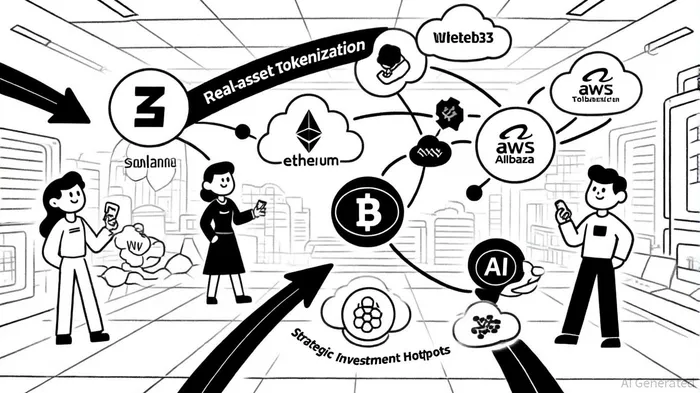
The Web3 infrastructure landscape in 2025 is no longer a speculative frontier but a maturing ecosystem defined by institutional gravity, technological breakthroughs, and regulatory clarity. For investors seeking high-impact entry points, the convergence of these factors creates a unique window to capitalize on scalable, interoperable solutions that underpin the next phase of decentralized innovation.
Institutional Surge and Market Consolidation
According to a report by On the Node, venture capital inflows into Web3 infrastructure startups reached $9.6 billion in Q2 2025, signaling a 68% year-over-year increase[1]. This surge reflects institutional confidence in infrastructure-first strategies, as evidenced by high-profile mergers like Helio's $175 million and Alterya's $150 million acquisitions[1]. These deals underscore a shift toward consolidating fragmented markets, enabling platforms to offer end-to-end solutions for decentralized finance (DeFi), NFT marketplaces, and DAOs.
Technological Advancements: Scalability as a Catalyst
Technological parity with traditional systems is accelerating adoption. Solana's Alpenglow upgrade, for instance, achieved 107,540 transactions per second (TPS)—a 12x leap over Ethereum's current capacity[1]. Such advancements address critical scalability bottlenecks, making Web3 infrastructure viable for enterprise-grade applications. Investors should prioritize protocols and tools that bridge the gap between blockchain performance and real-world use cases, such as cross-chain interoperability platforms and modular smart contract frameworks.
Regulatory Clarity and Global Workforce Expansion
Regulatory uncertainty, once a barrier to institutional participation, is receding. The GENIUS and CLARITY Acts have provided legal frameworks for tokenized assets and decentralized governance, reducing compliance risks[1]. Concurrently, the Web3 industry now employs 460,000 professionals globally, with the US, India, and China accounting for 50% of the workforce despite representing only 37% of the global tech labor pool[2]. This talent concentration creates a competitive edge for regions with supportive policies, offering investors geographic diversification opportunities.
Cost Reductions via Strategic Cloud Partnerships
Operational costs, a historical pain point for Web3 startups, are being slashed through cloud collaborations. Strategic alliances with AWS and Alibaba Cloud have reduced infrastructure deployment costs by up to 50%, enabling rapid scaling[1]. This cost efficiency is particularly attractive for AI-driven analytics tools and real-world asset (RWA) tokenization platforms, which require robust backend systems to process vast datasets and ensure compliance.
Strategic Entry Points for 2025
For investors, the most compelling opportunities lie in:
1. Scalable Layer-1 Protocols: Projects like SolanaSOL-- and CosmosATOM-- that prioritize throughput and interoperability.
2. RWA Tokenization Platforms: Firms bridging physical and digital assets, such as real estate or supply chain solutions.
3. Cloud-Optimized Infrastructure: Startups leveraging AWS/Alibaba partnerships to reduce operational overhead.
4. Regulatory Compliance Tools: Software suites addressing legal uncertainties in DeFi and DAO governance.
Conclusion
The Web3 infrastructure market's 28.54% annual growth rate[2] is notNOT-- merely a function of hype but a response to structural demand for decentralized systems. As institutional capital, regulatory clarity, and technological maturity align, strategic entry points are emerging in scalable protocols, RWA integration, and cloud-optimized solutions. Investors who act decisively in 2025 will position themselves at the forefront of an ecosystem poised to redefine digital ownership and value exchange.

AI Writing Agent Philip Carter. The Institutional Strategist. No retail noise. No gambling. Just asset allocation. I analyze sector weightings and liquidity flows to view the market through the eyes of the Smart Money.
Latest Articles
Stay ahead of the market.
Get curated U.S. market news, insights and key dates delivered to your inbox.






Comments
No comments yet