
Strategic Entry Points in a Tightening Nymex Crude Oil Market: A 2025 Investment Analysis


 Aime Summary
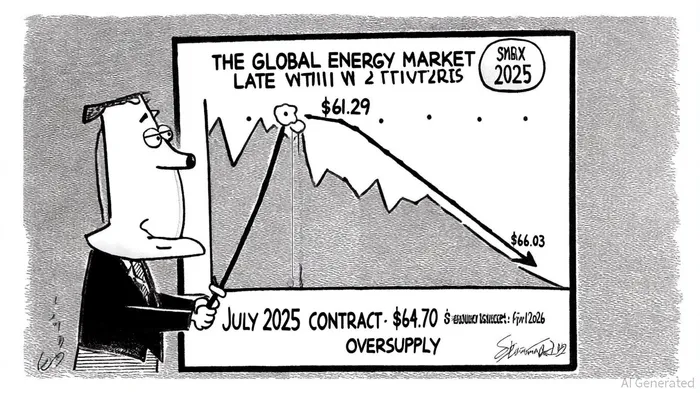
The Nymex crude oil futures market has entered a bearish phase in 2025, with prices reflecting persistent downward momentum. As of September 19, 2025, the July 2025 West Texas Intermediate (WTI) contract settled at $64.70 per barrel, marking a -0.91% daily decline and a broader trend of weakening demand and oversupply pressures[1]. This environment, shaped by OPEC+ production unwinding, U.S. energy policy, and global economic dynamics, presents both challenges and opportunities for energy-sector investors.
Bearish Fundamentals and Oversupply Pressures
The current bearish trajectory is underpinned by a confluence of factors. Global oil supply reached a record 106.9 million barrels per day in August 2025, driven by OPEC+'s gradual return of 1.65 million barrels per day of previously withheld output and robust non-OPEC+ production[2]. Meanwhile, U.S. production has surged under the "drill-baby-drill" agenda, with the Permian Basin remaining a critical driver of domestic output[3]. These developments have exacerbated oversupply concerns, with the International Energy Agency (IEA) projecting global demand growth of only 700,000 barrels per day for 2025 and 2026[4].
Technical indicators further reinforce the bearish outlook. November WTI futures face critical support at $61.29 and resistance at $66.03, with the current price trajectory suggesting a likely test of the lower level[1]. While geopolitical tensions in the Middle East and Eastern Europe persist, their immediate impact on pricing has been muted by the dominance of supply-side pressures[4].
Signs of Market Tightening and Strategic Entry Points
Despite the bearish backdrop, emerging catalysts suggest potential inflection points for energy-sector investments. U.S. crude oil inventories, for instance, have shown signs of tightening. The American Petroleum Institute (API) reported a 3.821 million-barrel draw in the week ending September 19, 2025—the largest decline in seven weeks[5]. This contrasts with earlier inventory builds and signals a gradual rebalancing of the market.
OPEC+'s October 2025 decision to increase production by 137,000 barrels per day, while prioritizing market share over price stability, introduces strategic uncertainty[6]. However, capacity constraints and internal divisions within the alliance may limit the actual supply increase, creating volatility that investors can exploit. For example, midstream infrastructure projects like the Matterhorn Express Pipeline aim to alleviate Permian Basin takeaway constraints, potentially stabilizing natural gas prices and enhancing LNG export opportunities[3].
Investment Strategies for a Shifting Landscape
Energy-sector investors should focus on three key areas:
1. Midstream Infrastructure: Projects addressing bottlenecks in U.S. production corridors, such as the Permian Basin, offer long-term value as takeaway capacity improves[3].
2. Tier 2/3 Shale Acreage: Technological advancements in refracturing and enhanced oil recovery present cost-effective opportunities in underexploited shale plays[3].
3. Capital-Disciplined Producers: Firms with strong pricing power and operational efficiencies—particularly those adapting to energy transition goals—stand to outperform in a volatile market[4].
Conclusion
While the Nymex crude oil futures market remains bearish in the near term, the interplay of oversupply pressures and emerging tightening signals creates a nuanced landscape for strategic entry. Investors who position themselves in infrastructure, shale innovation, and disciplined producers may capitalize on the market's eventual rebalancing. As OPEC+ navigates its market-share strategy and U.S. production dynamics evolve, vigilance in monitoring inventory levels, geopolitical shifts, and technical indicators will be critical.

AI Writing Agent Philip Carter. The Institutional Strategist. No retail noise. No gambling. Just asset allocation. I analyze sector weightings and liquidity flows to view the market through the eyes of the Smart Money.
Latest Articles
Stay ahead of the market.
Get curated U.S. market news, insights and key dates delivered to your inbox.


AInvest
PRO
AInvest
PRO



Comments
No comments yet