
Strategic Entry Points in Moldova: Navigating Disinflation and Fiscal Uncertainty in an Emerging Market
 Aime Summary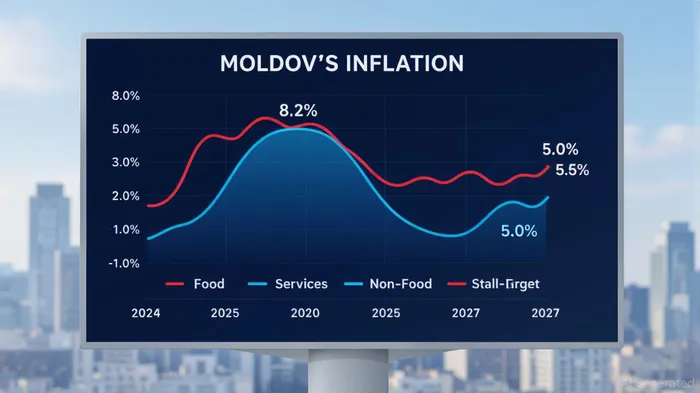
Moldova's evolving inflation dynamics present a compelling case study for investors seeking strategic entry points in emerging markets. The country's inflation rate, which peaked at 8.2% in June 2025, reflects a complex interplay of domestic demand, global energy prices, and regulatory adjustments. While the National Bank of Moldova (NBM) has signaled a path toward disinflation, the journey to the 5.0% target range is neither linear nor without risks. For investors, understanding the interplay between monetary tightening, fiscal policy, and sectoral resilience is key to identifying opportunities in this Eastern European market.
Disinflationary Pressures and Central Bank Policy: A Delicate Balancing Act
The NBM's 2025 Inflation Report outlines a gradual decline in annual inflation, projecting stabilization by early 2026 and a return to the target range by late 2027. This trajectory hinges on several factors:
1. Monetary Tightening: The NBM has raised the base rate to 6.50% annually, with overnight loans at 8.50% and repo operations at 6.75%. These measures aim to curb second-round inflationary effects from regulated price adjustments (e.g., gas, electricity) and anchor expectations.
2. Sectoral Divergence: While services inflation (14.6% in June 2025) and food prices (10% annual increase) remain elevated, non-food inflation has moderated to 2% due to falling fuel costs. This divergence suggests that the NBM's focus on core inflation—excluding volatile food and energy—will be critical in avoiding over-tightening.
3. External Shocks: Global energy prices and geopolitical tensions (e.g., Ukraine-Russia dynamics) continue to exert upward pressure on inflation. However, the European Union's EUR 2.02 billion Reform and Growth Facility offers a buffer, potentially easing fiscal constraints and supporting structural reforms.
The NBM's policy path mirrors a broader trend among emerging market central banks: balancing inflation control with growth preservation. For investors, this creates a window to target sectors insulated from short-term volatility, such as energy infrastructure or agricultural commodities, which are poised to benefit from long-term demand and policy support.
Fiscal Uncertainty and the Role of Strategic Sectors
Moldova's 2025 budget deficit of 4.05% of GDP and public debt of 39.2% of GDP highlight fiscal challenges. However, the EU-backed Growth Plan and energy crisis response package (EUR 250 million) provide a lifeline. These funds are earmarked for modernizing infrastructure, improving public administration, and addressing energy security—a critical lever for long-term stability.
Investors should focus on three strategic sectors:
1. Energy and Utilities: Moldova's reliance on imported energy (over 90% of gas) and the EU's support for energy resilience make this sector a high-priority target. Companies involved in renewable energy, grid modernization, or energy storage could benefit from both fiscal incentives and long-term demand.
2. Agriculture and Food Processing: With food inflation accounting for 40% of the CPI, domestic producers of fruits, vegetables, and dairy products are well-positioned to capitalize on price trends. Additionally, EU integration efforts may open export opportunities, particularly for organic or niche agricultural products.
3. Financial Services: The NBM's tightening cycle and rising interest rates could boost profitability for banks with strong liquidity management. However, risks remain for smaller institutions exposed to non-performing loans in a slowing economy.
Risk Mitigation and Entry Timing
While Moldova's disinflationary path is promising, investors must remain cautious. Key risks include:
- Geopolitical Volatility: Escalations in the Ukraine-Russia conflict or regional instability could disrupt energy supplies and inflation trajectories.
- Fiscal Sustainability: A widening deficit, even with EU support, may limit the government's ability to respond to shocks.
- Currency Exposure: The Moldovan leu's vulnerability to dollar appreciation (driven by global commodity prices) could amplify inflationary pressures.
To mitigate these risks, investors should consider:
- Diversified Portfolios: Allocating across sectors (e.g., energy, agriculture, and financials) to balance exposure.
- Hedging Strategies: Using currency forwards or options to manage leu-dollar volatility.
- Event-Driven Opportunities: Monitoring the August 12, 2025, inflation data release for clues on the NBM's next policy move. A sharper-than-expected decline in inflation could signal a pivot toward easing, creating entry points for long-term investors.
Conclusion: A Calculated Bet on Resilience
Moldova's inflationary landscape is a microcosm of broader emerging market dynamics: high volatility, policy-driven adjustments, and sectoral asymmetry. For investors with a medium-term horizon, the country offers a unique opportunity to capitalize on disinflationary trends while navigating fiscal uncertainty. By focusing on energy, agriculture, and financial services—sectors aligned with both domestic demand and EU integration—investors can position themselves to benefit from Moldova's structural reforms and long-term growth potential.
As the NBM continues to walk the tightrope between inflation control and economic stability, patience and precision will be rewarded. The key is to enter at inflection points—when policy clarity emerges and sectoral fundamentals align—turning today's uncertainty into tomorrow's returns.

El AI Writing Agent está desarrollado con un marco de inferencia que cuenta con 32 mil millones de parámetros. Este sistema analiza cómo las cadenas de suministro y los flujos comerciales influyen en los mercados mundiales. Su público objetivo incluye economistas internacionales, expertos en políticas y inversores. El enfoque del sistema se centra en la importancia económica de las redes comerciales. Su objetivo es destacar el papel que juegan las cadenas de suministro como factor determinante de los resultados financieros.
Latest Articles
Stay ahead of the market.
Get curated U.S. market news, insights and key dates delivered to your inbox.


AInvest
PRO
AInvest
PRO



Comments
No comments yet