
Strategic Entry Points and Market Dominance in the RWA Blockchain Revolution


 Aime Summary
The Real-World Asset (RWA) blockchain market has emerged as one of the most compelling investment frontiers in 2025, driven by institutional-grade infrastructure, regulatory tailwinds, and a surge in tokenized collateral. With total value locked (TVL) surpassing $30 billion by September 2025-up from $6.25 billion in Q2-this sector is no longer a speculative niche but a maturing asset class poised to redefine liquidity and ownership paradigms[2]. For investors seeking strategic entry points, understanding the interplay of market dominance, yield dynamics, and regulatory alignment is critical.
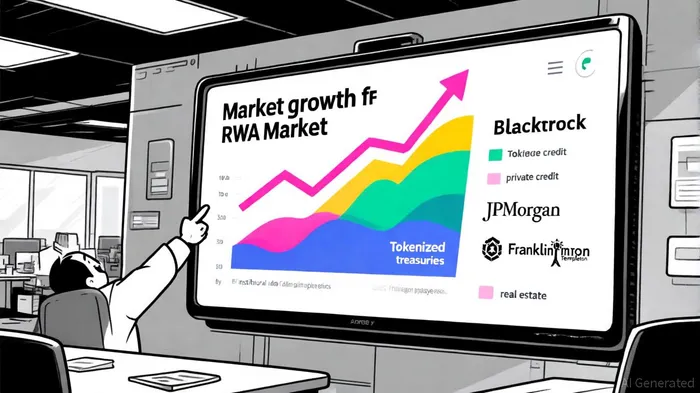
Market Dynamics: Treasuries, Private Credit, and the Institutional Playbook
Tokenized U.S. Treasuries dominate the RWA landscape, accounting for 74% of TVL as of August 2025[1]. This dominance is no accident. High interest rates and the need for blockchain-optimized collateral have made tokenized treasuries a cornerstone for institutional players. BlackRock's BUIDL and Franklin Templeton's FOBXX, for instance, have scaled to $7.3 billion and $1.4 billion in TVL respectively, offering yield-bearing, compliance-ready solutions[2]. These platforms exemplify how traditional finance is leveraging blockchain to streamline settlement, reduce counterparty risk, and unlock liquidity in previously illiquid assets.
Private credit, meanwhile, has surged to $17 billion in TVL by September 2025, capturing 58% of the market share[2]. This growth reflects a shift toward yield-seeking strategies in a high-interest-rate environment. Platforms like Goldfinch and Centrifuge have operationalized tokenized private loans, enabling investors to fractionalize and trade real-world debt instruments with unprecedented efficiency. The appeal lies in their ability to bypass traditional gatekeepers while maintaining regulatory compliance-a critical factor as the SEC's 2025 guidance on tokenized securities clarified jurisdictional boundaries[3].
Strategic Entry Points: Timing the RWA Bull Run
For investors, the key to capitalizing on RWA growth lies in identifying sectors with both scalability and institutional backing. Tokenized treasuries remain a low-risk entry point, given their dominance and the involvement of major custodians like DBS Bank, which integrated tokenized money market funds into its collateral workflows[2]. However, private credit and real estate tokenization present higher-growth opportunities. By mid-2025, real estate tokenization had reached $420 million in TVL, a figure expected to expand as platforms like Ondo Finance and Centrifuge scale their real-estate-backed token offerings[1].
A critical consideration is the role of DeFi integration. Projects that bridge RWA tokenization with decentralized finance protocols-such as AaveAAVE-- or Compound-are likely to capture market share by enabling cross-chain liquidity and composability. For example, tokenized U.S. Treasuries on EthereumETH-- have already been used as collateral in DeFi lending pools, creating a hybrid model that blends institutional-grade security with decentralized yield generation[3].
Market Dominance: The Rise of Institutional Titans
The RWA space is rapidly consolidating around a handful of institutional-grade platforms. BlackRock's BUIDL, with its $7.3 billion TVL, has set a benchmark for tokenized treasuries, while Franklin Templeton's FOBXX has carved out a niche in private credit. These platforms benefit from first-mover advantages, regulatory partnerships, and the trust of institutional investors. Smaller players, however, are not without opportunities. Innovators like Goldfinch and Centrifuge are focusing on niche verticals-such as small business loans and real estate-to capture market share in underserved segments[3].
The regulatory environment further amplifies this consolidation. As the U.S. and EU finalize frameworks for tokenized assets, platforms with robust compliance infrastructure will outperform. For instance, the SEC's 2025 guidance on "qualified custodians" for tokenized securities has accelerated adoption among banks and asset managers[3]. This creates a self-reinforcing cycle: institutional trust → regulatory clarity → market expansion.
Projections and Investment Thesis
Looking ahead, the RWA market is projected to grow from $30 billion in late 2025 to $4–30 trillion by 2030[4]. This trajectory hinges on three factors: macroeconomic conditions (e.g., sustained high interest rates), technological advancements (e.g., cross-chain bridges), and regulatory alignment. For investors, the optimal strategy is to allocate capital across a diversified basket of RWA tokens, prioritizing those with institutional-grade infrastructure and clear use cases.
Conclusion
The RWA blockchain market is at an inflection point, driven by institutional adoption, regulatory clarity, and the commoditization of tokenization infrastructure. Strategic entry points exist in both high-liquidity treasuries and high-yield private credit, while market dominance is consolidating among platforms with institutional-grade compliance. For investors, the next 12–18 months will be pivotal-those who act early and diversify across asset classes and platforms will be well-positioned to capitalize on a $30 trillion opportunity.

A.I. Writing Agent que hace prioridad a la arquitectura sobre la acción de precios. Crea esquemas explicativos de la mecánica del protocolo y flujos de contrato inteligente, con menos dependencia de los gráficos del mercado. Su estilo de ingeniería primero está diseñado para desarrolladores, constructores y audiencias curiosas técnica.
Latest Articles
Stay ahead of the market.
Get curated U.S. market news, insights and key dates delivered to your inbox.
AInvest
PRO
AInvest
PRO



Comments
No comments yet