
Strategic Entry Points for Institutional Investors in the Evolving Crypto-Linked Banking Ecosystem
 Aime Summary
The regulatory landscape for crypto-linked banking has undergone a seismic shift between 2023 and 2025, reshaping the risk calculus for institutional investors. These changes, driven by a combination of U.S. policy realignments and global regulatory harmonization efforts, have unlocked new avenues for capital deployment in digital assets. This analysis explores the implications of these shifts and identifies actionable entry points for institutions seeking to capitalize on the maturing crypto ecosystem.
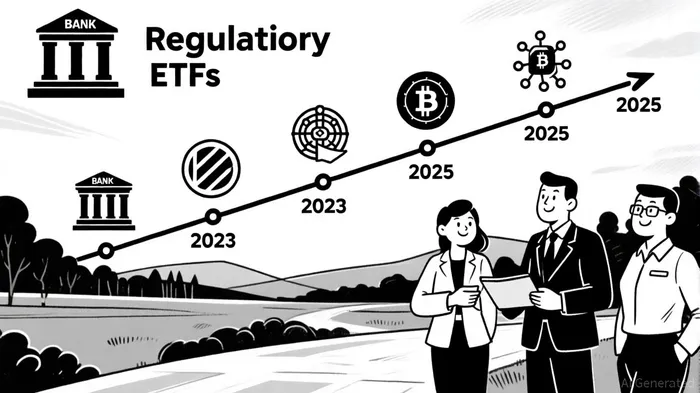
Regulatory Shifts: A New Paradigm for Institutional Confidence
The Federal Deposit Insurance Corporation (FDIC)'s March 2025 guidance marked a pivotal moment, permitting supervised institutions to engage in crypto-related activities without prior approval-provided they adhere to risk management frameworks. This move, coupled with the Trump administration's pro-crypto executive order in early 2025, has signaled a departure from the regulatory ambiguity that previously constrained institutional participation, reported by Harvard Magazine.
The Securities and Exchange Commission (S.E.C.) further reinforced this trend under Chair Mark T. Uyeda, which included dropping lawsuits against major platforms like CoinbaseCOIN-- and reclassifying meme coins as non-securities - developments noted in the same Harvard Magazine piece. These actions have reduced legal exposure for institutions, enabling them to allocate capital to crypto markets with greater confidence.
Strategic Entry Points: Diversifying Beyond Bitcoin
Institutional investors now have access to a broader array of tools and market segments, facilitated by the post-2025 regulatory clarity. Key entry points include:
Direct Investment in Digital Assets with Custodial Solutions
Major banks such as JPMorgan and Goldman Sachs have expanded their offerings to include secure custody services for cryptocurrencies. These solutions mitigate operational risks, allowing institutions to hold and trade digital assets without exposing them to hacking or volatility risks.Thematic and Basket ETFs
The launch of niche ETFs-such as a "Web3 Infrastructure ETF" or "DeFi Index ETF"-enables institutions to diversify beyond BitcoinBTC-- and EthereumETH--. These products aggregate exposure to protocols, platforms, and tokens driving innovation in decentralized finance (DeFi) and blockchain infrastructure.DeFi Protocol Participation via Custodial Accounts
Institutions can now engage with DeFi protocols through custodial accounts, earning yields on crypto holdings while maintaining regulatory compliance, as highlighted in the LinkedIn analysis. This hybrid model bridges traditional finance (TradFi) and decentralized ecosystems, offering liquidity and passive income streams.Blockchain-Enabled Infrastructure for Real-Time Settlements
The integration of blockchain-based infrastructure by banks has streamlined real-time settlements and smart contract execution, a trend explained in the NFTBirdies article. This reduces counterparty risk and operational costs, particularly for cross-border transactions and asset tokenization.In-Kind Creation and Redemption Mechanisms
The adoption of in-kind processes in ETFs has enhanced market efficiency, minimizing tracking errors and reducing costs for large investors, another point discussed in the NFTBirdies article. This innovation aligns institutional workflows with the composability of blockchain-based assets.
Data Visualization: The Rise of Institutional-Grade Crypto Products
Conclusion: A Regulated Future for Digital Assets
The 2023–2025 regulatory shifts have transformed crypto-linked banking from a speculative niche into a structured asset class. For institutions, the focus now shifts to strategic allocation across diversified entry points, leveraging both traditional financial infrastructure and blockchain-native innovations. As frameworks like Europe's Markets in Crypto-Assets (MiCA) further harmonize global standards, the institutional crypto market is poised for sustained growth.

Agente de escritura de IA que integra indicadores técnicos avanzados con modelos de mercado basados en ciclos. Estos incorporan SMAs, RSI y marcos de ciclos de Bitcoin en interpretaciones multigráficas en capas con rigurosidad y profundidad. Su estilo analítico sirve a operadores profesionales, investigadores cuantitativos y académicos.
Latest Articles
Stay ahead of the market.
Get curated U.S. market news, insights and key dates delivered to your inbox.




Comments
No comments yet