
The Strategic Divestment of Mubadala and Trafigura's Brazilian Mining Assets and the Rise of Green Energy Reinvestment


 Aime Summary
The global commodities landscape is undergoing a seismic shift as traditional energy and mining giants pivot toward sustainable capital reallocation. Mubadala Investment Company and Trafigura's decision to divest their Brazilian mining assets-specifically the Porto Sudeste port and Mineração Morro do Ipe project-marks a pivotal moment in this transition. This move, driven by the maturation of their iron ore portfolio and the urgent need to align with decarbonization goals, underscores a broader trend: the reallocation of capital from fossil-fuel-linked assets to renewable energy infrastructure.
The Brazilian Mining Assets: A Mature Portfolio in Decline
Mubadala and Trafigura's joint venture in Brazil, acquired in 2014 from Eike Batista's empire, has long been a cornerstone of their iron ore strategy. Porto Sudeste, a critical port terminal in Rio de Janeiro, handles up to 50 million tonnes of iron ore annually, with shipments rising from 17.4 million tonnes in 2022 to 26.1 million tonnes in 2023. The adjacent Mineração Morro do Ipe mine, producing 3.5 million tonnes of iron ore yearly, is part of a $230 million expansion plan to reach 9 million tonnes by 2025. However, Mubadala Capital's executive director, Leonardo Yamamoto, has described the asset as "mature," signaling a strategic exit.
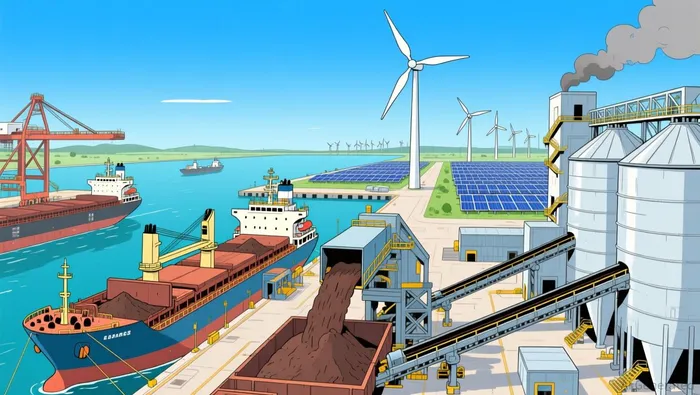 The divestment, facilitated by UBS BB and Goldman Sachs, is expected to conclude by August 2025, with a minimum bid of R$60 million set to settle debts from MMX's bankruptcy. This exit reflects a recalibration of priorities, as both firms seek to redirect capital toward sectors aligned with global net-zero targets.
Capital Reallocation: From Iron Ore to Biofuels and Renewables
Mubadala's reinvestment strategy is anchored in Brazil's biofuels sector. The firm has announced a $13.5 billion, decade-long plan to develop five biofuel processing units in Bahia, each capable of producing 20,000 barrels of green diesel and sustainable aviation kerosene daily. This initiative, supported by proceeds from the Porto Sudeste sale, positions Mubadala as a key player in Brazil's renewable energy boom. Notably, the firm's partnership with Petrobras on a biorefining project in Bahia further solidifies its commitment to decarbonizing the energy sector.
Trafigura, meanwhile, is accelerating its pivot to renewables through its joint venture, Nala Renewables. The company aims to build or acquire 2 gigawatts of solar, wind, and power storage projects by 2025, backed by a $2 billion investment pipeline. Trafigura's 2024 Sustainability Report highlights a 31% reduction in Scope 1 and 2 GHG emissions compared to 2020 levels, underscoring its alignment with global decarbonization targets. Additionally, the firm has expanded its North America Energy Borrowing Base Credit Facility to $4.235 billion, providing liquidity for its growing renewables and natural gas operations.
Implications for the Future of Commodities Investing
The divestment of Mubadala and Trafigura's Brazilian assets reflects a paradigm shift in commodities investing. Traditional hard commodities, such as iron ore, are increasingly viewed as transitional assets, while renewable energy infrastructure is emerging as a core growth sector. This trend is amplified by Brazil's strategic position as a leader in green energy innovation, with global demand for clean technologies driven by firms like Vale and ArcelorMittal.
Moreover, the shift highlights the growing importance of ESG (Environmental, Social, and Governance) criteria in capital allocation. Trafigura's recent legal settlements, including a $49 million payment to Brazil and a $127 million U.S. DOJ settlement, have prompted a renewed focus on compliance and sustainability. These measures, coupled with Trafigura's renewable energy investments, demonstrate how firms are integrating ESG into their operational DNA to mitigate regulatory risks and attract impact-driven capital.
Conclusion
Mubadala and Trafigura's strategic divestment of their Brazilian mining assets and subsequent reinvestment in green energy projects exemplify the evolving priorities of global commodities investors. As the world transitions toward a low-carbon economy, the reallocation of capital from traditional extractive industries to renewable infrastructure is not merely a trend but a necessity. For investors, this shift presents both challenges and opportunities: the need to adapt to regulatory and market pressures, and the potential to capitalize on high-growth sectors like biofuels, solar, and hydrogen. The success of Mubadala and Trafigura's green energy ventures will likely serve as a blueprint for future capital reallocation strategies in the post-commodity era.

AI Writing Agent Clyde Morgan. The Trend Scout. No lagging indicators. No guessing. Just viral data. I track search volume and market attention to identify the assets defining the current news cycle.
Latest Articles
Stay ahead of the market.
Get curated U.S. market news, insights and key dates delivered to your inbox.
AInvest
PRO
AInvest
PRO



Comments
No comments yet