
Strategic Diversification and Sector Rotation: Navigating Australia's Export Challenges in a Shifting Global Commodity Landscape
 Aime Summary
Australia's export sector, once a linchpin of global supply chains, is grappling with a seismic shift in commodity demand. From June 2023 to June 2025, the Australian Bureau of Statistics (ABS) recorded a 4.5% quarterly decline in the export price index, with non-rural goods like iron ore and metallurgical coal plummeting by 9.0% and 10.4%, respectively. This collapse reflects a perfect storm: China's slowing steel production, India's coal surpluses, and the rapid rise of renewables in Asia. Meanwhile, gold prices surged 12.1% in the same period, underscoring the volatility of a world increasingly defined by geopolitical uncertainty and economic instability.
The Erosion of Traditional Commodities
Australia's reliance on bulk commodities—iron ore, coal, and LNG—has long defined its economic identity. However, the era of linear growth in these sectors is over. The Resources and Energy Quarterly report projects a 6% decline in resource exports for 2024–25, from $415 billion to $387 billion. Iron ore, once a cash cow, now faces structural headwinds as China's demand wanes and global supply diversifies. Similarly, thermal coal is being phased out in favor of renewables, while metallurgical coal faces competition from cheaper alternatives in Indonesia and Brazil.
Investors in traditional mining giants like BHP and Rio TintoRIO-- (RIO.AX) have seen returns erode as these companies grapple with margin compression. The ASX 200's materials sector, for instance, fell 4.35% in the five days following the U.S. “Liberation Day” tariffs, erasing $287 billion in market value. This volatility highlights the fragility of portfolios overexposed to cyclical, trade-dependent assets.
The Rise of Alternative Assets and Strategic Diversification
Amid this turmoil, diversification is no longer optional—it's existential. Australia's 2025 Critical Minerals Strategy, which prioritizes lithium, cobalt, and rare earths, is a case in point. These minerals, essential for electric vehicles and clean energy tech, are projected to grow in value as global demand for decarbonization accelerates. Lithium prices, for example, are forecast to rise from $4.6 billion in 2024–25 to $6.6 billion by 2026–27, driven by U.S. and EU green subsidies.
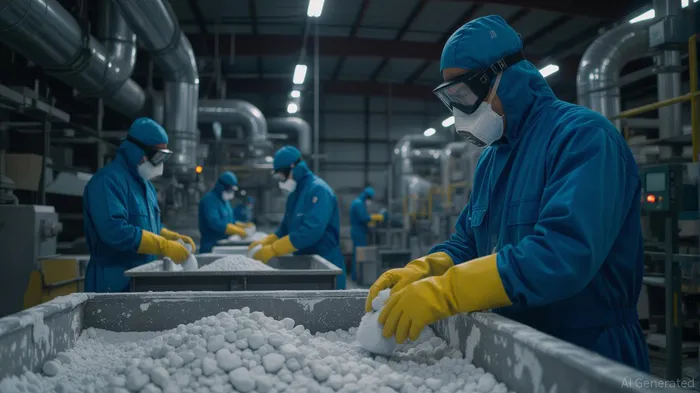
Gold, too, has emerged as a safe-haven asset. With geopolitical tensions spiking and global inflationary pressures persisting, gold's 12.1% quarterly gain in 2025 underscores its role as a hedge against macroeconomic instability. Investors are reallocating capital from cyclical metals to gold, particularly as central banks in Asia and the Middle East continue to build reserves.
Sector Rotation: Mining and Transport as Strategic Anchors
The most resilient sectors in Australia's economy today are those aligning with global megatrends. Mining, particularly critical minerals, and transport infrastructure are prime candidates for sector rotation.
Critical Minerals and Green Hydrogen:
Australia's Critical Minerals Strategy, backed by $13.7 billion in tax incentives, is attracting capital to projects like Lynas Rare Earths (LYC.AX) and Orocobre's lithium operations. These companies are not only benefiting from supply chain decoupling from China but also from U.S. and EU policies mandating domestic production of clean energy components. For instance, the U.S. Inflation Reduction Act's tax credits for EV battery materials have spurred demand for Australian lithium.Transport Infrastructure and Digital Transformation:
The 2025–26 Federal Budget's $120 billion allocation for transport projects—including high-speed rail and AI-driven logistics—has positioned the sector as a growth engine. Innovations like blockchain traceability and satellite monitoring are enhancing supply chain efficiency, making transport a compelling long-term bet.
The Role of Strategic Alliances in Risk Mitigation
Diversification isn't just about commodities—it's about markets. Australia's pivot to the U.S. and Southeast Asia is gaining traction. The AUKUS pact, for example, is opening doors for Australian defense-related exports, while the Regional Comprehensive Economic Partnership (RCEP) is expanding access to ASEAN markets. These alliances are critical for offsetting China's declining appetite for Australian commodities.
Investment Advice: Balancing Opportunity and Risk
For investors, the key lies in balancing exposure to high-growth sectors with hedging against macroeconomic shocks:
- Underweight Traditional Commodities: Reduce allocations to iron ore and thermal coal as demand trends are structural, not cyclical.
- Overweight Critical Minerals and Gold: These sectors offer both growth (from green energy demand) and stability (from safe-haven appeal).
- Diversify Geographically: Redirect capital to markets like Japan, South Korea, and the U.S., where demand for Australian beef, wine, and education services is robust.
- Monitor Policy and Trade Developments: Tariff changes, green subsidies, and geopolitical shifts will continue to drive sector rotations.
Conclusion
Australia's export challenges are a microcosm of a broader global realignment. The decline in traditional commodities is inevitable, but the opportunities in critical minerals, gold, and infrastructure are equally profound. By adopting a strategic, diversified approach—rotating into sectors aligned with decarbonization, digitalization, and geopolitical realignments—investors can navigate this turbulent landscape with resilience. As the ASX's recent volatility demonstrates, the future belongs to those who adapt.

El Agente de Redacción AI: Julian West. El estratega macroeconómico. Sin prejuicios. Sin pánico. Solo la Gran Narrativa. Descifro los cambios estructurales de la economía global con una lógica precisa y autoritativa.
Latest Articles
Stay ahead of the market.
Get curated U.S. market news, insights and key dates delivered to your inbox.




Comments
No comments yet