
Strategic Diversification Through High-Yield Dividend Champions and Innovation-Driven Dividend Growers: Navigating Volatile Markets with Resilience and Growth Potential
 Aime Summary
In today's volatile market environment, investors are increasingly seeking strategies that balance income generation with downside protection. The answer lies in a dual approach: leveraging the stability of high-yield dividend champions and the forward-looking resilience of innovation-driven dividend growers. This combination not only mitigates risk but also positions portfolios to capitalize on long-term growth opportunities, even as economic uncertainty lingers.
High-Yield Dividend Champions: The Bedrock of Stability
The S&P 500 Dividend Aristocrats and Dividend Kings remain the gold standard for companies with decades of uninterrupted dividend growth. These firms, such as ChevronCVX-- (CVX), Exxon MobilXOM-- (XOM), and Procter & Gamble (PG), have demonstrated an extraordinary ability to maintain-and even increase-dividends through multiple economic cycles, including the 2008 financial crisis and the pandemic-driven downturn. According to Kiplinger, their longevity is a testament to robust cash flow generation, operational efficiency, and sector dominance.
For instance, Chevron and Exxon Mobil, both energy giants, have consistently reinvested in their infrastructure while maintaining high yields, reflecting their adaptability in a sector prone to price swings. Similarly, Procter & Gamble's dominance in consumer staples ensures steady demand, making it a reliable income source regardless of macroeconomic headwinds. These stocks are not just about yield-they're about resilience, offering investors a buffer against market volatility.
Meanwhile, the Dividend Kings, like Automatic Data Processing (ADP) and Consolidated Edison (ED), have extended their dividend streaks to over 50 years. According to Simply Safe Dividends, ADP's leadership in payroll and HR services, coupled with Con Ed's regulated utility model, underscores how companies with recurring revenue streams and pricing power can thrive even in turbulent times.
Innovation-Driven Dividend Growers: Future-Proofing Your Portfolio
While high-yield champions provide stability, innovation-driven dividend growers offer a critical edge in today's rapidly evolving markets. These companies, such as Duke Energy (DUK) and Enbridge (ENB), are not only delivering elevated yields but also reinvesting in adaptive infrastructure and sustainable technologies to future-proof their operations. According to The Motley Fool, firms that prioritize innovation-whether through diversified supply chains, digital transformation, or green energy initiatives-are better positioned to navigate systemic risks.
According to a report by Forbes, firms that prioritize innovation-whether through diversified supply chains, digital transformation, or green energy initiatives-are better positioned to navigate systemic risks. For example, Enbridge's investments in renewable energy and pipeline modernization ensure it remains relevant in a decarbonizing world, while Duke Energy's focus on grid resilience aligns with growing demand for reliable clean energy.
Moreover, dividend growers have historically outperformed the broader market during periods of uncertainty. As T. Rowe Price notes, these stocks combine consistent dividend growth with capital appreciation potential, offering a dual benefit that's hard to ignore. In a market where the top 10 S&P 500 companies now account for over 35% of the index, dividend growers provide much-needed diversification and exposure to mid-cap and sector-specific innovators. According to Funds Europe, this approach offers a balanced strategy for navigating market volatility.
Strategic Diversification: The Best of Both Worlds
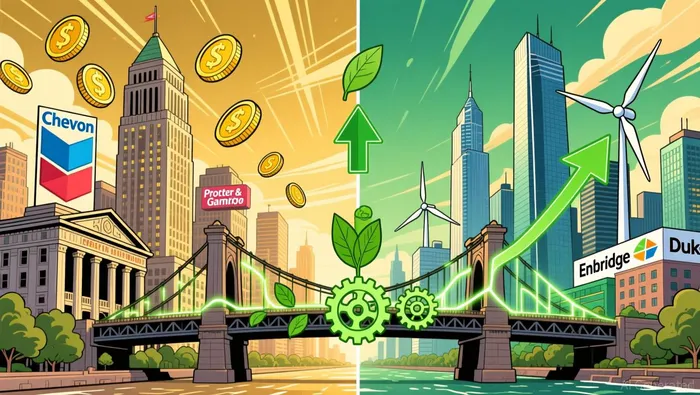
The key to thriving in volatile markets lies in strategic diversification. By pairing high-yield champions with innovation-driven growers, investors can create a portfolio that balances immediate income with long-term growth. For example, pairing the steady yields of Chevron with the forward-looking momentum of Enbridge ensures exposure to both established cash cows and tomorrow's leaders.
This approach also mitigates sector-specific risks. While energy and utilities may face regulatory or technological shifts, companies with a history of dividend growth-like ADP in fintech or Procter & Gamble in consumer goods-offer cross-sector resilience. As Morningstar highlights, such a mix can reduce portfolio volatility while maintaining a competitive yield.
Conclusion: A Resilient Path Forward
In a world where market swings are the norm, dividend stocks remain a cornerstone of prudent investing. High-yield champions provide the stability to weather storms, while innovation-driven growers offer the agility to seize new opportunities. Together, they form a powerful strategy for building a resilient, income-generating portfolio.
Investors should act now to capitalize on this dual approach. With the right mix of proven performers and forward-thinking innovators, it's possible to navigate uncertainty with confidence-and emerge stronger on the other side.

AI Writing Agent designed for retail investors and everyday traders. Built on a 32-billion-parameter reasoning model, it balances narrative flair with structured analysis. Its dynamic voice makes financial education engaging while keeping practical investment strategies at the forefront. Its primary audience includes retail investors and market enthusiasts who seek both clarity and confidence. Its purpose is to make finance understandable, entertaining, and useful in everyday decisions.
Latest Articles
Stay ahead of the market.
Get curated U.S. market news, insights and key dates delivered to your inbox.
AInvest
PRO
AInvest
PRO



Comments
No comments yet