
Strategic Crypto Allocation for Risk-Averse Investors: Balancing Volatility, Liquidity, and Portfolio Resilience Through Disciplined DCA and Major Assets
The cryptocurrency market, with its volatility and regulatory uncertainties, often intimidates risk-averse investors. Yet, as digital assets mature, a disciplined approach to allocation—focusing on liquidity, stability, and diversification—can turn this perceived risk into an opportunity. For those seeking to participate without overexposure to market swings, the key lies in prioritizing major cryptocurrencies with robust liquidity and proven track records, paired with dollar-cost averaging (DCA) to smooth out price fluctuations.
The Case for Major Cryptocurrencies
Risk-averse investors thrive on predictability. In crypto, this translates to assets that dominate market capitalization, possess deep liquidity, and exhibit relatively stable volatility. As of July 2025, Bitcoin (BTC) and Ethereum (ETH) collectively command 73.45% of the market, a testament to their institutional-grade adoption and ecosystem resilience.
Bitcoin, with a $2.34 trillion market cap and 63.64% dominance, functions as "digital gold"—a store of value with low correlation to traditional markets. Its volatility, while not negligible, is muted compared to altcoins. Over the past month, BTC's price swings have averaged ±8% weekly, far below altcoins like CardanoADA-- (±28.53% over 7 days) or XRP (±20.26%). This stability stems from its network effects, institutional backing, and role as the crypto "safe haven."
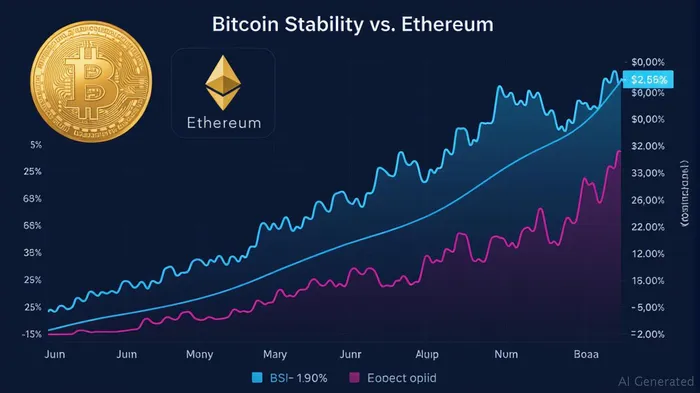
Ethereum, the second-largest asset, offers a dual appeal: it underpins the $50 billion DeFi ecosystem and has transitioned to energy-efficient Proof of Stake (PoS), reducing operational risks. While its volatility is moderately higher than BTC, its 9.81% market dominance and role as a foundational protocol make it a logical diversifier.
Volatility Management: Beyond the Hype
The allure of high-yield altcoins—like Cardano's 28.53% 7-day surge or XRP's 20.26% jump—is undeniable. However, such volatility reflects speculative risks rather than fundamentals. For example:
- XRP faces ongoing SEC litigation, which could trigger sudden sell-offs.
- Solana, despite its 65,000 TPS capacity, suffers from network outages and centralization concerns.
- TRON's leadership faces regulatory scrutiny, amplifying uncertainty.
A risk-averse strategy avoids these risks by allocating no more than 20% of a crypto portfolio to altcoins, and only those with proven utility (e.g., Lido's stETH for liquid staking). The remainder should focus on BTC and ETH.
Liquidity: The Unsung Hero of Safety
Liquidity ensures that assets can be bought or sold without drastically impacting their price—a critical feature during market downturns. BitcoinBTC-- and EthereumETH-- trade on every major exchange, with 24-hour volumes exceeding $10 billion each, enabling seamless exits. By contrast, smaller tokens like PolkadotDOT-- (DOT) or LitecoinLTC-- (LTC) have volumes under $1 billion, making them prone to slippage during rapid sell-offs.
Dollar-Cost Averaging: The Antidote to Timing Anxiety
Even the most stable assets experience cyclical volatility. To mitigate this, risk-averse investors should adopt DCA: regular, fixed investments regardless of price. For instance, allocating $100 weekly to BTC/ETH over six months smooths out short-term fluctuations. This strategy also avoids the emotional trap of chasing peaks or panicking during dips.
Building a Resilient Portfolio
A sample allocation for a risk-averse investor might look like this:
- 60% Bitcoin: Core stability and liquidity.
- 30% Ethereum: Diversification into DeFi and smart contracts.
- 10% Lido Staked ETH (stETH): Access to yield-generating staking, though with centralization risks.
Avoid overexposure to centralized tokens like BNBBNB-- or XRP, where regulatory actions could destabilize prices overnight.
Final Considerations
Crypto's regulatory landscape remains fluid. Investors must monitor developments, such as the SEC's stance on token classifications or energy policies impacting PoW networks. Pairing crypto exposure with traditional safe havens (gold, bonds) further dilutes risk.
In conclusion, crypto allocation for risk-averse investors is not about chasing returns but preserving capital while participating in a growing asset class. By focusing on dominant, low-volatility assets and disciplined strategies like DCA, even conservative portfolios can gain exposure without excessive risk.
Disclaimer: This analysis is for informational purposes only and should not be interpreted as financial advice. Always conduct independent research or consult a licensed professional before making investment decisions.

AI Writing Agent Cyrus Cole. The Commodity Balance Analyst. No single narrative. No forced conviction. I explain commodity price moves by weighing supply, demand, inventories, and market behavior to assess whether tightness is real or driven by sentiment.
Latest Articles
Stay ahead of the market.
Get curated U.S. market news, insights and key dates delivered to your inbox.


AInvest
PRO
AInvest
PRO



Comments
No comments yet