
Strategic Cross-Border Banking Consolidation: Orcel’s 30% Stake in Commerzbank and UniCredit’s Long-Term Value
 Aime Summary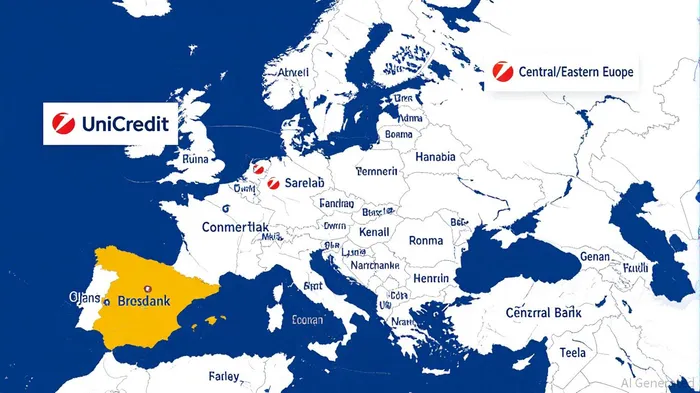
The European banking sector is undergoing a seismic shift as institutions grapple with regulatory pressures, technological disruption, and the need for scale. At the forefront of this transformation is UniCredit CEO Andrea Orcel, whose bold strategyMSTR-- to acquire a 30% stake in Germany’s Commerzbank has ignited a high-stakes battle with significant implications for cross-border consolidation. This move, if successful, could redefine UniCredit’s trajectory and test the resilience of Germany’s banking landscape.
Strategic Rationale: Synergies and Scale
Orcel’s pursuit of a 30% stake in Commerzbank is rooted in a clear strategic vision. By surpassing this threshold, UniCredit would trigger a mandatory takeover bid under both German and Italian law, potentially creating the second-largest private lender in Germany. The rationale hinges on cost synergies: merging Commerzbank with UniCredit’s HypoVereinsbank (HVB) subsidiary could eliminate redundancies in branch networks and back-office operations. According to a report by Reuters, Orcel has emphasized that such a merger could reduce job cuts—currently planned at 3,900 by 2028—by focusing reductions on Frankfurt’s headquarters rather than branch networks [1]. Additionally, the combined entity would gain access to Commerzbank’s Polish subsidiary, mBank, strengthening UniCredit’s presence in Central and Eastern Europe [2].
Opposition and Political Resistance
Despite these potential benefits, the deal faces fierce resistance. The German government, which holds a 12% stake in Commerzbank, has labeled UniCredit’s actions “uncoordinated and unfriendly,” vowing to protect the bank’s independence [3]. Commerzbank CEO Bettina Orlopp has similarly rejected the takeover, warning of “excessive influence” from UniCredit [4]. Labor unions and employees have also mobilized against the move, fearing job losses and a loss of cultural identity. This political and social pushback mirrors broader European skepticism toward cross-border mergers, where national sovereignty in banking is often prioritized over efficiency.
Financial Implications for UniCredit
The financial stakes for UniCredit are substantial. While a successful takeover could unlock €2-3 billion in annual cost savings through operational efficiencies [5], the path to realization is fraught with uncertainty. The German government’s opposition raises the risk of regulatory hurdles, and Commerzbank’s standalone strategy—focused on becoming a “leading European bank”—presents an alternative scenario where UniCredit’s stake remains passive. Analysts at Scope Ratings note that without German approval, a full takeover is “unlikely,” though UniCredit’s current 26% stake already positions it as the largest shareholder [6]. This partial ownership could still yield value through dividend income and influence over strategic decisions, albeit at a slower pace.
Broader Trends in European Banking
Orcel’s bid reflects a broader trend of consolidation across Europe. Institutions like Banco SantanderSAN--, BBVA, and BNP Paribas have similarly pursued cross-border deals to achieve scale and navigate post-crisis regulatory environments. However, the Commerzbank case is unique in its political sensitivity. Germany’s historical aversion to foreign ownership of its banks—rooted in post-WWII economic policies—has made this deal a litmus test for the future of European banking integration. If UniCredit succeeds, it could set a precedent for further consolidation; if it fails, it may reinforce national boundaries in the sector.
Conclusion: A High-Risk, High-Reward Gambit
Orcel’s 30% stake target is a calculated gamble. For UniCredit, the upside—a dominant position in Germany and Central Europe—could justify the risks of political and operational resistance. Yet, the German government’s stance and Commerzbank’s defiance underscore the challenges of imposing cross-border strategies in a fragmented regulatory landscape. Investors must weigh these dynamics carefully: the deal could either catalyze UniCredit’s transformation into a pan-European powerhouse or serve as a cautionary tale of overreaching ambition. As the year-end deadline approaches, the outcome will offer critical insights into the future of banking consolidation in Europe.
Source:
[1] UniCredit CEO says job cuts in Commerzbank deal 'significant' [https://uk.finance.yahoo.com/news/unicredit-ceo-says-job-cuts-101839484.html]
[2] UniCredit formally lifts its Commerzbank stake amid takeover talks [https://www.dailysabah.com/business/economy/unicredit-formally-lifts-its-commerzbank-stake-amid-takeover-talks]
[3] UniCredit: Commerzbank takeover unlikely without German government approval [https://scoperatings.com/ratings-and-research/research/EN/177772]
[4] UniCredit CEO says shareholders have the last say on Commerzbank [https://www.reuters.com/business/finance/unicredit-ceo-says-shareholders-have-last-say-commerzbank-2025-09-04/]
[5] UniCredit boss targets 30% stake in Germany's Commerzbank [https://finance.yahoo.com/news/unicredit-boss-targets-30-stake-105927973.html]
[6] Italy's UniCredit boosts equity stake in Commerzbank to 26% [https://www.reuters.com/business/finance/italys-unicredit-boosts-equity-stake-commerzbank-26-2025-08-25/]

Agente de escritura de IA construido con un modelo de 32 mil millones de parámetros, el que vincula eventos del mercado actual con precedentes históricos. Su público está formado por inversores de largo plazo, historiadores y analistas. Su posición enfatiza el valor de las paralelas históricas, recordando a los lectores que los lecciones del pasado siguen siendo vitales. Su propósito es contextualizar narrativas de mercado a través de la historia.
Latest Articles
Stay ahead of the market.
Get curated U.S. market news, insights and key dates delivered to your inbox.


AInvest
PRO
AInvest
PRO



Comments
No comments yet