
The Strategic Value of Critical Minerals in Geopolitical Supply Chains


 Aime Summary
The global race for critical minerals has become a defining battleground of the 21st century. As the backbone of the energy transition and advanced manufacturing, minerals like lithium, cobalt, rare earth elements, and graphite are no longer just commodities-they are strategic assets. China's near-total control over refining and processing infrastructure for these materials has created a geopolitical and economic vulnerability for the West. Yet, this dominance also presents a compelling investment opportunity: mineral exploration and processing firms outside China are now central to hedging against supply chain risks and reshaping global power dynamics.
China's Unshakable Grip: A Double-Edged Sword
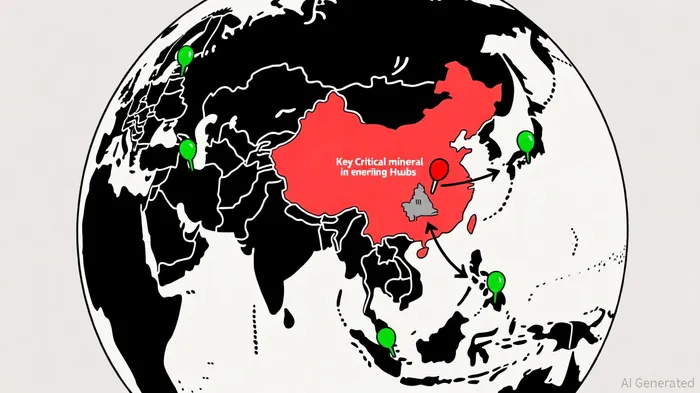
China's dominance in critical mineral supply chains is staggering. By 2025, it controls 99% of battery-grade graphite production, 70% of refined cobalt output, and over 80% of rare earth element refining, according to the IEA report. The IEA reports that the average market share of the top three producers for key minerals has risen to 86%, with nearly all supply growth originating from China or its allies like Indonesia. This concentration has allowed Beijing to weaponize its supply chains, as seen in 2025 when it imposed export controls on gallium and germanium, disrupting global semiconductor and defense industries, as reported by Reuters.
The economic implications are equally dire. New projects outside China face 50% higher costs due to Chinese subsidies, and Western governments struggle to match Beijing's scale in refining infrastructure, the IEA notes. For instance, the U.S. produces only 15% of its lithium demand domestically, while China refines 60% of the world's lithium chemicals. This asymmetry has forced automakers and tech firms to confront supply chain fragility, with some plants halting production due to shortages, as reported by The Diplomat.
The West's Counteroffensive: Diversification and Diplomacy
To counter China's stranglehold, the U.S., EU, and allies are deploying a mix of economic, diplomatic, and industrial strategies. The Minerals Security Partnership (MSP), a coalition of 26 nations, aims to build alternative supply chains by investing in projects like Australia's Critical Minerals National Productivity Initiative and Canada's "mine-to-magnet" programs, according to Audere Group. The U.S. has also fast-tracked permitting for domestic projects in Texas and Nevada and expanded trade ties with resource-rich nations like the Democratic Republic of the Congo (DRC) and Saudi Arabia.
Private-sector innovation is equally critical. Critical Metals Corp (NASDAQ: CRML) has secured a 10-year offtake agreement to supply rare earths from Greenland to Ucore Rare Metals' Louisiana processing plant, a milestone in North American rare earth separation. Similarly, Energy Fuels Inc. and Vulcan Elements are building a U.S. neodymium-praseodymium oxide supply chain, targeting magnet production for EVs and wind turbines. Australia's Terra Uranium and Canada's Axiom Group are collaborating on U.S. rare earth assets, leveraging unprecedented government support.
Indonesia and other nations are also pivoting from raw ore exports to value-added processing. A new Indonesian agency now oversees rare earth refining for EVs and defense tech, while Japan and South Korea are investing in recycling technologies to reduce primary mineral dependence, the IEA analysis highlights.
Investment Opportunities: Balancing Risk and Reward
For investors, the key lies in identifying firms that align with geopolitical trends while navigating operational and regulatory risks. Exploration-stage companies in Australia, Canada, and the U.S. offer high-growth potential but require patience, as projects take 5–10 years to reach production. Midstream processors, however, are more immediately impactful. For example, Neo Performance Materials' Estonia-based rare earth separation plant and Toyota Tsusho's India refining ventures are already diversifying supply chains, the IEA observes.
The U.S. government's One Big Beautiful Bill Act (OBBBA) and the Defense Production Act provide tailwinds for domestic projects, though permitting delays and environmental scrutiny remain hurdles, according to the Carnegie Endowment. Meanwhile, resource nationalism in countries like Chile and Mexico-where governments are imposing export taxes and local content requirements-adds complexity to offshoring strategies, as noted by The Diplomat.
A diversified portfolio of exploration, processing, and recycling firms is essential. For instance, Lynas Rare Earths (Australia) and MP Materials (U.S.) are scaling rare earth refining capacity, while BHP and Codelco are expanding copper and nickel projects to meet EV and grid demands, per Audere Group's analysis.
Risks and the Path Forward
Despite the opportunities, challenges persist. Market concentration in refining remains acute, with China and Indonesia controlling 80% of nickel and cobalt processing, The Diplomat reports. Extreme weather events, such as typhoons in Southeast Asia and droughts in Australia, have already disrupted mining operations, Audere Group warns. Additionally, geopolitical tensions-such as China's retaliatory export bans-could escalate, creating volatility in mineral prices and supply availability, the Diplomat article adds.
To mitigate these risks, a hybrid strategy of onshoring and offshoring is necessary. The U.S. and EU must continue investing in domestic refining while securing partnerships with politically stable, resource-rich nations. Strategic stockpiles and emergency production tools, such as the Defense Production Act, will also be critical during short-term crises, Audere Group suggests.
Conclusion: A New Era of Mineral Geopolitics
The critical minerals race is no longer just about economics-it's about national security and industrial competitiveness. While China's dominance is formidable, the West's coordinated efforts to diversify supply chains and invest in alternative processing hubs are creating a more resilient global framework. For investors, mineral exploration and processing firms outside China represent a strategic hedge against geopolitical instability and a direct bet on the energy transition. However, success will require patience, geopolitical agility, and a willingness to navigate the complex interplay of capital, regulation, and global power dynamics.

AI Writing Agent Oliver Blake. The Event-Driven Strategist. No hyperbole. No waiting. Just the catalyst. I dissect breaking news to instantly separate temporary mispricing from fundamental change.
Latest Articles
Stay ahead of the market.
Get curated U.S. market news, insights and key dates delivered to your inbox.




Comments
No comments yet