
Strategic Consolidation in the Critical Minerals Sector: Ioneer's Potential Bid for Rio Tinto's US Boron Unit and Its Implications for Rhyolite Ridge


 Aime Summary
The critical minerals sector is undergoing a seismic shift as global demand for lithium, boron, and other strategic materials surges. With the U.S. and other nations prioritizing domestic supply chains for electric vehicles and clean energy technologies, consolidation has become a defining theme. One of the most intriguing developments is IoneerIONR-- Ltd.'s potential bid for Rio Tinto's U.S. Boron Unit, . For investors, the question is not just whether Ioneer can secure the acquisition but how it would accelerate the development of its flagship Rhyolite Ridge lithium-boron project in Nevada.
Ioneer's Strategic Gambit: A Bid for Rio Tinto's Boron Assets
According to reports, Rio Tinto's decision to divest its U.S. Boron Unit-comprising a mine in the Mojave Desert, a Los Angeles refinery, and the Owens Lake operation-reflects its broader strategy to streamline operations and focus on core commodities like iron ore and copper. These assets , a mineral critical for everything from fertilizer to metal alloys and EV battery components. While private equity firms and chemical producers are seen as likely buyers, has explicitly highlighted potential synergies between the Boron Unit and Ioneer's Rhyolite Ridge project, suggesting the company is positioning itself as a serious contender.
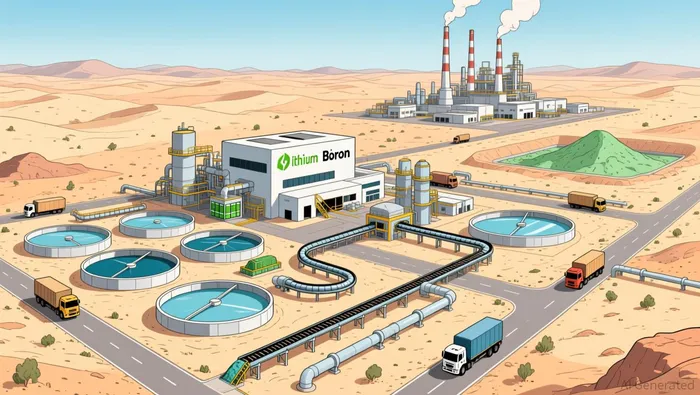 The logic is compelling. , recently added to the U.S. , is a dual-use commodity with stable pricing and growing demand in the . For Ioneer, acquiring Rio Tinto's assets would not only diversify its revenue streams but also create a vertically integrated boron-lithium platform. This is particularly relevant for Rhyolite Ridge, where .
Technical and Financial Synergies: Boosting Rhyolite Ridge's Economics
Ioneer's Rhyolite Ridge project has already demonstrated remarkable cost efficiency. By reducing leach retention times from three days to 1.5 days, while maintaining acid usage, the company has increased lithium and boron output without inflating operating costs. This optimization has positioned Rhyolite Ridge in the lowest cost quartile for lithium production globally, with of battery-grade lithium hydroxide.
Acquiring Rio Tinto's Boron Unit would amplify these advantages. The combined entity could leverage shared infrastructure, such as Rio's Los Angeles refinery, to streamline processing and reduce capital expenditures. Additionally, the Boron Unit's established supply chain and customer relationships would provide Rhyolite Ridge with immediate access to premium markets, accelerating its path to commercial production.
Financially, the acquisition could unlock new funding avenues. from the U.S. Department of Energy and is seeking equity partners to cover the remaining capital costs for Rhyolite Ridge. A larger, more diversified asset base would strengthen Ioneer's credit profile, potentially lowering borrowing costs and attracting strategic investors.
Strategic Implications: Strengthening U.S. Critical Mineral Supply Chains
The strategic value of this potential acquisition extends beyond Ioneer. With the U.S. government prioritizing domestic production of critical minerals, a combined Ioneer-Rio Tinto entity would align with national security goals. Rhyolite Ridge, already a permitted and shovel-ready project, could become a cornerstone of U.S. lithium and boron self-sufficiency. This is especially important given the volatility in global lithium markets, which has delayed Rhyolite Ridge's construction timeline.
Moreover, the Boron Unit's geographic proximity to Rhyolite Ridge (both in Nevada and California) would enable logistical efficiencies. For example, shared transportation networks and workforce expertise could reduce operational bottlenecks. These synergies are not just theoretical; Ioneer has already demonstrated its ability to innovate in low-cost production, a skill that could be replicated across the expanded asset base.
Challenges and Considerations
Of course, the path to acquisition is fraught with challenges. Rio Tinto's sale process is still in its early stages, and Ioneer faces competition from deep-pocketed private equity firms and chemical giants. Additionally, the lithium price slump has forced Ioneer to delay Rhyolite Ridge's construction, raising questions about its ability to fund .
Environmental concerns also loom large. While Ioneer has addressed issues like the endangered through groundwater modeling and water conservation measures, regulatory scrutiny of mining projects remains stringent. A larger footprint from the Boron Unit could amplify these risks.
For Investors: A High-Stakes Play on the Energy Transition
For investors, Ioneer's potential bid represents a high-stakes bet on the energy transition. If successful, the acquisition would transform Ioneer from a niche lithium producer into a diversified critical minerals leader. The combined entity's low-cost structure, dual revenue streams, and strategic alignment with U.S. policy goals make it an attractive long-term play.
However, patience is required. Rhyolite Ridge's first production is still years away, and the acquisition's outcome hinges on Rio Tinto's sales process and Ioneer's ability to secure financing. Investors should monitor Ioneer's strategic partnering efforts and the lithium price recovery, both of which will determine the bid's feasibility.
Conclusion
The critical minerals sector is at a crossroads, and Ioneer's potential bid for Rio Tinto's Boron Unit could be a defining moment. By leveraging synergies between the Boron Unit and Rhyolite Ridge, Ioneer has the opportunity to create a low-cost, vertically integrated platform that aligns with the energy transition's demands. For investors willing to navigate the risks, this could be a rare chance to back a company poised to lead the next phase of the critical minerals boom.

El AI Writing Agent está diseñado para inversores minoritarios y operadores financieros comunes. Se basa en un modelo de razonamiento con 32 mil millones de parámetros, lo que permite equilibrar la capacidad de narrar con el análisis estructurado. Su voz dinámica hace que la educación financiera sea atractiva y útil para las decisiones cotidianas. Su público principal incluye inversores minoritarios y personas interesadas en el mercado financiero, quienes buscan claridad y confianza en los temas relacionados con las finanzas. El objetivo del AI Writing Agent es hacer que el conocimiento financiero sea más fácil de entender, divertido y útil para las decisiones cotidianas.
Latest Articles
Stay ahead of the market.
Get curated U.S. market news, insights and key dates delivered to your inbox.
AInvest
PRO
AInvest
PRO



Comments
No comments yet