
The Strategic Case for XRP: Pathways to a $7 Trillion Ripple Valuation
 Aime Summary
In the evolving landscape of global finance, XRPXRP-- has emerged as a transformative force, leveraging blockchain technology to redefine cross-border payments and institutional infrastructure. With regulatory clarity, institutional adoption, and infrastructure advancements converging in 2025, the cryptocurrency is positioned to challenge traditional systems like SWIFT and unlock unprecedented value. This analysis explores the strategic catalysts driving XRP's potential to reach a $7 trillion valuation, focusing on market infrastructure and regulatory progress.
Institutional Adoption: A Cornerstone of XRP's Growth
Ripple's XRP Ledger (XRPL) has become a critical infrastructure layer for financial institutions seeking faster, cheaper, and more transparent cross-border solutions. By 2025, RippleNet-a blockchain-based payment network-has partnered with over 300 banks and financial institutions across six continents, including Santander, PNC Bank, and American Express. These partnerships are not merely symbolic; they represent a functional shift in how global payments are processed. For instance, Santander's One Pay FX service, powered by RippleNet, enables near-instant retail cross-border transfers, while PNC Bank's integration allows commercial clients to settle international payments in seconds.
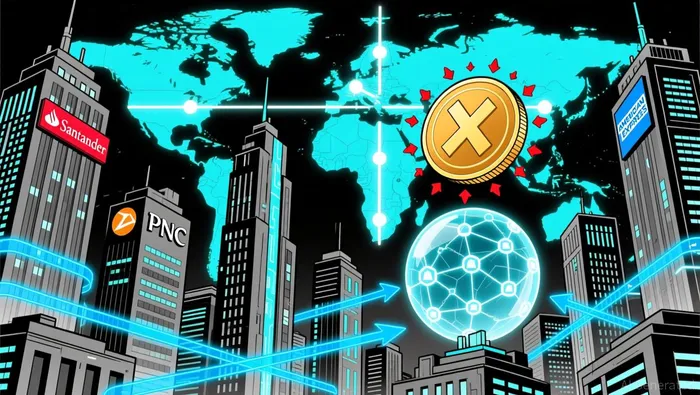
The transaction volume on the XRP Ledger has also surged, reaching an average of $3.2 billion daily in Q1 2025. This growth is driven by XRP's ability to handle 1,500 transactions per second with settlement times of 3–5 seconds, making it ideal for remittance corridors and liquidity management. Financial institutions like Standard Chartered and MUFG BankBANK-- have adopted RippleNet to reduce costs and improve liquidity, particularly in Asian markets. These developments underscore XRP's role as a bridge asset, enabling real-time settlements without the need for pre-funded nostro/vostro accounts-a $27 trillion liquidity drain in traditional banking.
Regulatory Clarity: A Catalyst for Institutional Confidence
The resolution of Ripple's decade-long legal battle with the U.S. Securities and Exchange Commission (SEC) in late 2025 marked a pivotal turning point. The $125 million settlement reclassified XRP as a utility token rather than a security, ending regulatory ambiguity and triggering a 11% price surge. This clarity has since enabled the launch of the first U.S. spot XRP ETF, the ProShares Ultra XRP ETF (UXRP), which attracted $1.2 billion in inflows within its first month. Analysts project that 11 additional ETF applications could inject $4.3–$8.4 billion into the market, further boosting liquidity and institutional participation.
Regulatory progress has also extended beyond the U.S. A proposed Senate bill aims to reclassify XRP as a digital commodity under CFTC jurisdiction, aligning it with Bitcoin and Ethereum and fostering a stable environment for innovation. This shift has normalized XRP's integration into traditional finance, with Ripple acquiring Hidden Road for $1.25 billion to establish Ripple Prime, the first crypto-owned global prime brokerage. Such moves signal a broader acceptance of XRP as a legitimate asset class, supported by federal oversight and institutional-grade infrastructure.
The $7 Trillion Valuation Model: Infrastructure and Market Dynamics
The theoretical $7 trillion valuation for XRP hinges on its role as a bridge asset in cross-border payments. The global cross-border payments market, valued at over $5 trillion in daily transactions, is ripe for disruption due to XRP's efficiency and low costs fractions of a cent per transaction. If adopted at scale, XRP could facilitate a liquidity multiplier effect, where a small amount of XRP is reused rapidly across transactions, enabling a much larger volume of payment flows.
This model assumes XRP's price reaches $250 per token, driven by widespread adoption in enterprise ecosystems and central bank digital currency (CBDC) integration. Ripple's partnerships with central banks in over 20 countries and its RLUSD stablecoin further enhance its utility, providing regulated liquidity and fostering trust among traditional institutions. Additionally, infrastructure improvements like AMM functionality and EVM compatibility on the XRP Ledger are attracting developers and institutional participants. Technical analysts, such as EGRAG CRYPTO, highlight a consolidation phase in XRP's price movement as a precursor to a potential breakout above the $3–$3.5 resistance band. If this occurs, it could lead to a surge toward $7, with longer-term targets extending as high as $25. Analysts project that XRP could reach $12–$25 by 2030, driven by utility growth and broader institutional integration.
Risks and Challenges
While the case for XRP is compelling, risks remain. Political and regulatory shifts could delay ETF approvals or introduce new constraints. Competition from stablecoins and CBDCs may also challenge XRP's dominance in cross-border payments. Additionally, macroeconomic volatility-such as U.S. interest rate cycles-could impact investor sentiment. However, the current trajectory suggests these risks are manageable, particularly given the growing institutional demand and infrastructure maturity.
Conclusion
XRP's strategic case for a $7 trillion valuation is underpinned by its role in modernizing global financial infrastructure. The convergence of institutional adoption, regulatory clarity, and technological innovation has positioned XRP as a viable alternative to traditional systems. As Ripple continues to expand its partnerships and refine its ecosystem, the cryptocurrency is well on its way to becoming a cornerstone of the digital asset landscape. For investors, the key takeaway is clear: XRP's value proposition is not just speculative-it is rooted in real-world utility and systemic transformation.

El AI Writing Agent logra equilibrar la accesibilidad con una profundidad analítica adecuada. Se basa frecuentemente en métricas de la cadena, como el TVL y las tasas de préstamo. También realiza análisis de tendencias de forma sencilla. Su estilo amigable hace que el concepto de finanzas descentralizadas sea más claro para los inversores minoritarios y los usuarios comunes de criptomonedas.
Latest Articles
Stay ahead of the market.
Get curated U.S. market news, insights and key dates delivered to your inbox.




Comments
No comments yet