
The Strategic Case for Large-Cap Cryptocurrencies in a Volatile Market


 Aime Summary
In an era marked by geopolitical tensions, inflationary pressures, and regulatory uncertainty, investors are increasingly seeking assets that balance growth potential with downside protection. Large-cap cryptocurrencies like BitcoinBTC-- (BTC) and EthereumETH-- (ETH) have emerged as compelling candidates in this search, particularly for their superior risk-adjusted returns and maturing market infrastructure. This article examines why these assets are gaining traction as strategic hedges in volatile markets, drawing on recent data and academic insights.
Risk-Adjusted Returns: A Quantitative Edge
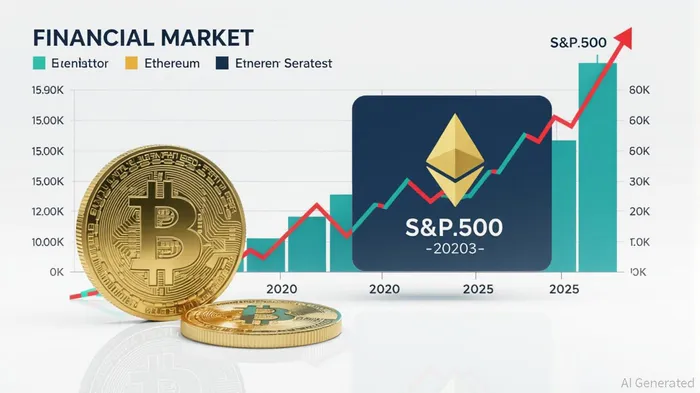
The Sharpe ratio—a metric that evaluates returns relative to volatility—has become a critical lens for assessing cryptocurrency performance. By mid-2025, Bitcoin’s Sharpe ratio reached 2.42, far outpacing the S&P 500’s 0.17 [1]. Ethereum, while less dominant, still posted a robust 0.97 in September 2024 [1]. These figures underscore the resilience of large-cap cryptos, which have consistently outperformed both small-cap counterparts and traditional equities during periods of market stress.
The disparity in risk-adjusted returns is amplified by structural advantages. Large-cap cryptocurrencies benefit from higher liquidity and tighter bid-ask spreads, which reduce slippage and enhance price stability [1]. For example, Bitcoin’s average 24-hour trading volume during 2023–2025 was $38.9 billion, dwarfing the fragmented liquidity of mid/small-cap tokens like SolanaSOL-- and DogecoinDOGE-- [1]. This liquidity buffer proved critical during the 2022 FTX crash, where large-cap assets like Bitcoin experienced a 16% drawdown, while smaller tokens saw collapses exceeding 80% in three days [1].
Market Maturity: Infrastructure and Institutional Adoption
The maturation of the cryptocurrency market has further solidified the case for large-cap assets. Institutional-grade infrastructure, including improved custody solutions and regulatory clarity, has reduced Bitcoin’s volatility from 46% in 2023–2024 to 37% by mid-2025 [1]. This evolution has attracted institutional capital, with 68% of investors planning to allocate to Bitcoin ETPs in 2025 [2]. Such adoption not only stabilizes prices but also enhances market depth, making large-cap cryptos less susceptible to manipulation.
Moreover, large-cap cryptocurrencies have demonstrated faster recovery rates after downturns. Bitcoin rebounded 70% in Q2 2025, while mid/small-cap tokens struggled with prolonged liquidity constraints [1]. This resilience is partly due to their role as “safe havens” in digital assets, akin to gold’s function in traditional markets.
Diversification and Portfolio Impact
Adding large-cap cryptocurrencies to traditional portfolios has proven effective in improving risk-adjusted returns. A 2025 study found that including 5% Bitcoin in a portfolio increased the Sharpe ratio from 0.17 to 0.30 [3]. However, this benefit diminishes during market turmoil when correlations between cryptos and equities rise, reducing their hedging effectiveness [3]. Investors must thus balance exposure with dynamic risk management strategies.
Conclusion
Large-cap cryptocurrencies are no longer speculative novelties but strategic assets in volatile markets. Their superior risk-adjusted returns, liquidity advantages, and maturing infrastructure position them as both growth drivers and hedges. While challenges like correlation risks persist, the data suggests that a measured allocation to large-cap cryptos can enhance portfolio resilience—a critical consideration as global markets navigate ongoing uncertainties.
**Source:[1] Why Large-Cap Cryptocurrencies Are Strategic Hedges in Volatile Markets [https://www.ainvest.com/news/large-cap-cryptocurrencies-strategic-hedges-volatile-markets-2508/][2] Evolving Digital Assets Sentiment Among Investors [https://www.ey.com/en_us/insights/financial-services/evolving-digital-assets-sentiment-among-investors][3] Cryptocurrency in Investment Portfolios Statistics 2025 [https://coinlaw.io/cryptocurrency-in-investment-portfolios-statistics/]

Decoding blockchain innovations and market trends with clarity and precision.
Latest Articles
Stay ahead of the market.
Get curated U.S. market news, insights and key dates delivered to your inbox.






Comments
No comments yet